

218
C. De Stefano· C. Foti . A. Gianguzza . S. Sammartano
As can be seen, in the pH range of natural fluids (6.5-9.5), the species {CH3hSn{OHh
predominates (curve 3), while the other hydrolytic species [i.e. (CH3hSn{OH) and
«CH3hSn{OHh] are negligible in the same pH range.
11.2.3
Monoalkyltin Compounds
Mono-organotin{IV) compounds have not found so many commercial applications
as diorgano and triorgano derivatives, and are considered the least toxic among
organotin{IV) derivatives (R 3 Sn + > R 2 Sn 2 + > RSn 3 + > Sn 4 +, toxicity scale). However, they
are often used as hydrophobic agents for building materials and cellulosic matter
(Blunden et al. 1985) and can be present in the aquatic environment as the first step of
alkylation of inorganic tin (Mennie and Craig 1993).
The majority of studies, carried out many years ago, concern complex formation
with N-donor molecules (Gielen and Sprecher 1966) and with chloro (Kriegsmann and
Pauly 1964; Farrer et al. 1965; Van den Berghe and Van der Kelen 1965) and fluoro ions
(Cassol et al. 1967). Raman measurements by Kriegsmann and Pauly (1964) showed
the formation of [CH3SnCI2{OHhr in the presence of high concentrations of chloride ions. Van den Berghe and Van der Kelen (1965), by means of NMR measurements
made in very concentrated solutions of CH 3 Sn 3 + (from 210 up to 830 mmol dm- 3 ), report the formation of mixed chloro-hydroxo complexes [CH3SnCUOH)yl with x deTable 11.3. Log.8 of hydrolytic species for the systems CH3Sn 3 + at! = 0 mol dm- 3 and T = 25°C
Equilibrium
Species
- 109.8
CH 3 Sn + + 2 Hp = CH 3 Sn(OH); + 2 H+
[CH 3 Sn(OH)/
3.36
CH 3 Sn + + 3 Hp = CH3Sn(OH)~ + 3 H+
[CH 3 Sn(OH)l
8.99
CH 3 Sn + + 4 Hp = CH3Sn(OH)~+ 4 H+
[CH 3 Sn(OH)41
20.27
2 CH 3 Sn + + 5 Hp = (CH 3 Sn)2(OH); + 5 H+
[(CH 3 Sn)2(OH)/
7.61
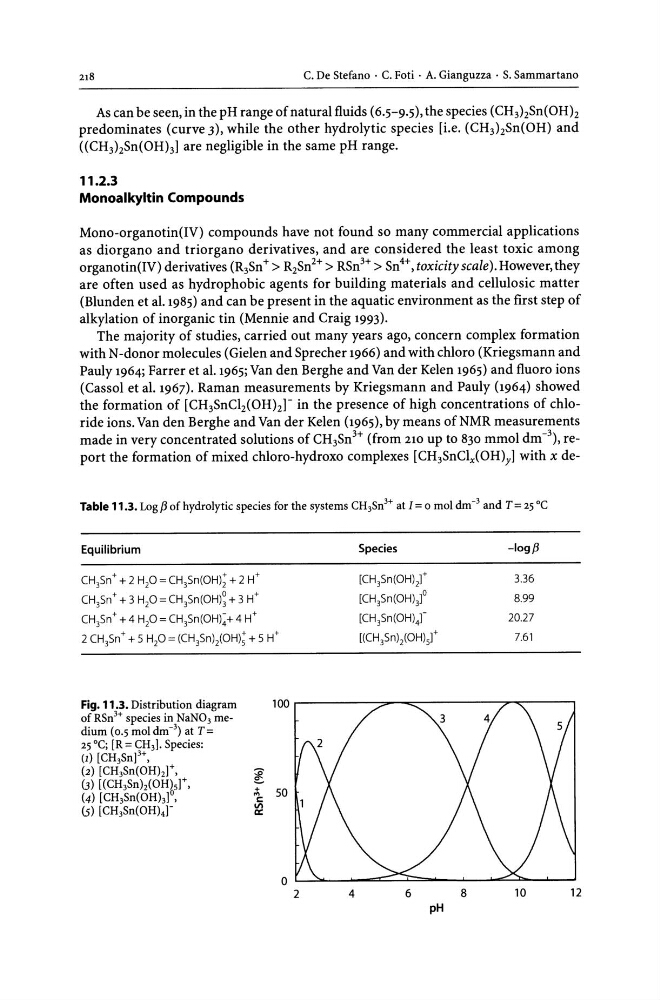
Fig. 11.3. Distribution diagram
of RSn 3 + species in NaN03 medium (0.5 mol dm -3) at T =
25°C; [R = CH31. Species:
100r---------~--~----------~~----~
(1) [CH3Sn1 3 +,
(2) [CH3Sn(OHhl+'
(]) [(CH3Snh(OHlst,
(4) [CH3Sn(OHhlo,
(s) [CH3Sn(OH)4r
4
6
8
10
12
pH
C. De Stefano· C. Foti . A. Gianguzza . S. Sammartano
As can be seen, in the pH range of natural fluids (6.5-9.5), the species {CH3hSn{OHh
predominates (curve 3), while the other hydrolytic species [i.e. (CH3hSn{OH) and
«CH3hSn{OHh] are negligible in the same pH range.
11.2.3
Monoalkyltin Compounds
Mono-organotin{IV) compounds have not found so many commercial applications
as diorgano and triorgano derivatives, and are considered the least toxic among
organotin{IV) derivatives (R 3 Sn + > R 2 Sn 2 + > RSn 3 + > Sn 4 +, toxicity scale). However, they
are often used as hydrophobic agents for building materials and cellulosic matter
(Blunden et al. 1985) and can be present in the aquatic environment as the first step of
alkylation of inorganic tin (Mennie and Craig 1993).
The majority of studies, carried out many years ago, concern complex formation
with N-donor molecules (Gielen and Sprecher 1966) and with chloro (Kriegsmann and
Pauly 1964; Farrer et al. 1965; Van den Berghe and Van der Kelen 1965) and fluoro ions
(Cassol et al. 1967). Raman measurements by Kriegsmann and Pauly (1964) showed
the formation of [CH3SnCI2{OHhr in the presence of high concentrations of chloride ions. Van den Berghe and Van der Kelen (1965), by means of NMR measurements
made in very concentrated solutions of CH 3 Sn 3 + (from 210 up to 830 mmol dm- 3 ), report the formation of mixed chloro-hydroxo complexes [CH3SnCUOH)yl with x deTable 11.3. Log.8 of hydrolytic species for the systems CH3Sn 3 + at! = 0 mol dm- 3 and T = 25°C
Equilibrium
Species
- 109.8
CH 3 Sn + + 2 Hp = CH 3 Sn(OH); + 2 H+
[CH 3 Sn(OH)/
3.36
CH 3 Sn + + 3 Hp = CH3Sn(OH)~ + 3 H+
[CH 3 Sn(OH)l
8.99
CH 3 Sn + + 4 Hp = CH3Sn(OH)~+ 4 H+
[CH 3 Sn(OH)41
20.27
2 CH 3 Sn + + 5 Hp = (CH 3 Sn)2(OH); + 5 H+
[(CH 3 Sn)2(OH)/
7.61
Fig. 11.3. Distribution diagram
of RSn 3 + species in NaN03 medium (0.5 mol dm -3) at T =
25°C; [R = CH31. Species:
100r---------~--~----------~~----~
(1) [CH3Sn1 3 +,
(2) [CH3Sn(OHhl+'
(]) [(CH3Snh(OHlst,
(4) [CH3Sn(OHhlo,
(s) [CH3Sn(OH)4r
4
6
8
10
12
pH