

216
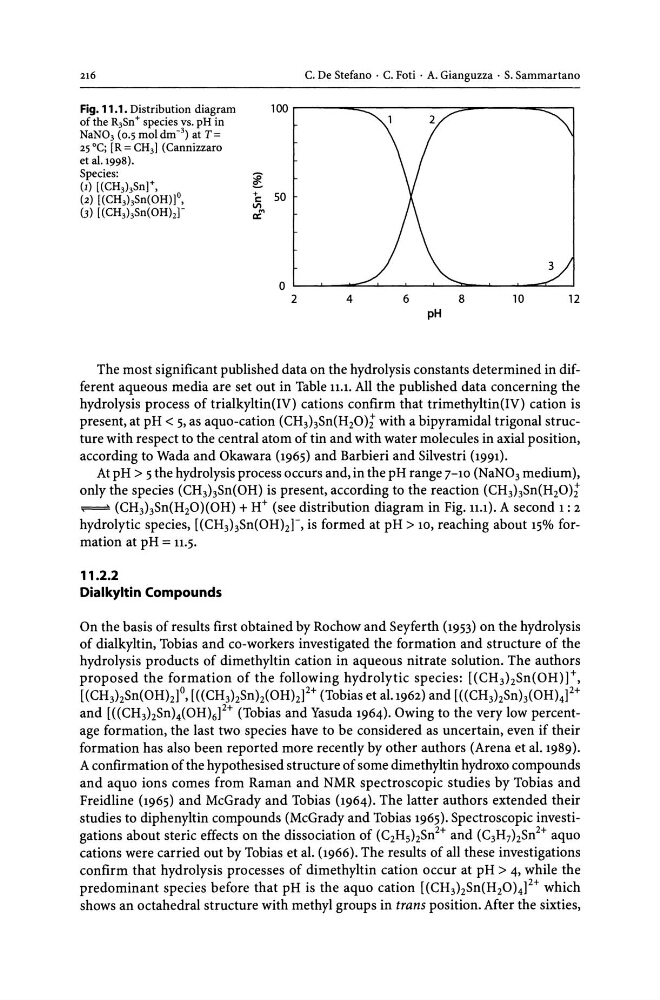
Fig. 11.1. Distribution diagram
of the R3Sn + species vs. pH in
NaN03 (0.5 moldm- 3 ) at T=
25°C; [R = CH3] (Cannizzaro
et al. 1998).
Species:
(1) [(CH3hSn]+,
(2) [(CH3hSn(OH)]o,
(3) [(CH3hSn(OHhf
l
+
c
11\
a:.'"
C. De Stefano . C. Foti . A. Gianguzza . S. Sammartano
100.-------~--------~~--------~_,
50
3
0
2
4
6
8
10
12
pH
The most significant published data on the hydrolysis constants determined in different aqueous media are set out in Table 11.1. All the published data concerning the
hydrolysis process of trialkyltin(IV) cations confirm that trimethyltin(IV) cation is
present, at pH < 5, as aquo-cation (CH3hSn(H20)i with a bipyramidal trigonal structure with respect to the central atom of tin and with water molecules in axial position,
according to Wada and Okawara (1965) and Barbieri and Silvestri (1991).
At pH> 5 the hydrolysis process occurs and, in the pH range 7-10 (NaN03 medium),
only the species (CH 3 hSn(OH) is present, according to the reaction (CH3hSn(H20)i
~ (CH 3 hSn(H 2 0)(OH) + H+ (see distribution diagram in Fig. 11.1). A second 1: 2
hydrolytic species, [(CH3hSn(OHhr. is formed at pH > 10, reaching about 15% formation at pH = 11.5.
11.2.2
Dialkyltin Compounds
On the basis of results first obtained by Rochow and Seyferth (1953) on the hydrolysis
of dialkyltin, Tobias and co-workers investigated the formation and structure of the
hydrolysis products of dimethyltin cation in aqueous nitrate solution. The authors
proposed the formation of the following hydrolytic species: [(CH3hSn(OH)]+,
[(CH 3 hSn(OHh]o, [«CH 3 hSnh(OHh]2+ (Tobias et al.1962) and [«CH 3 hSnh(OH)4f+
and [«CH 3 hSnMOH)6]2+ (Tobias and Yasuda 1964). Owing to the very low percentage formation, the last two species have to be considered as uncertain, even if their
formation has also been reported more recently by other authors (Arena et al. 1989).
A confirmation of the hypothesised structure of some dimethyltin hydroxo compounds
and aquo ions comes from Raman and NMR spectroscopic studies by Tobias and
Freidline (1965) and McGrady and Tobias (1964). The latter authors extended their
studies to diphenyltin compounds (McGrady and Tobias 1965). Spectroscopic investigations about steric effects on the dissociation of (C2H s hSn 2 + and (C3H7hSn 2 + aquo
cations were carried out by Tobias et al. (1966). The results of all these investigations
confirm that hydrolysis processes of dimethyltin cation occur at pH > 4, while the
predominant species before that pH is the aquo cation [(CH3hSn(H20)4]2+ which
shows an octahedral structure with methyl groups in trans position. After the sixties,
Fig. 11.1. Distribution diagram
of the R3Sn + species vs. pH in
NaN03 (0.5 moldm- 3 ) at T=
25°C; [R = CH3] (Cannizzaro
et al. 1998).
Species:
(1) [(CH3hSn]+,
(2) [(CH3hSn(OH)]o,
(3) [(CH3hSn(OHhf
l
+
c
11\
a:.'"
C. De Stefano . C. Foti . A. Gianguzza . S. Sammartano
100.-------~--------~~--------~_,
50
3
0
2
4
6
8
10
12
pH
The most significant published data on the hydrolysis constants determined in different aqueous media are set out in Table 11.1. All the published data concerning the
hydrolysis process of trialkyltin(IV) cations confirm that trimethyltin(IV) cation is
present, at pH < 5, as aquo-cation (CH3hSn(H20)i with a bipyramidal trigonal structure with respect to the central atom of tin and with water molecules in axial position,
according to Wada and Okawara (1965) and Barbieri and Silvestri (1991).
At pH> 5 the hydrolysis process occurs and, in the pH range 7-10 (NaN03 medium),
only the species (CH 3 hSn(OH) is present, according to the reaction (CH3hSn(H20)i
~ (CH 3 hSn(H 2 0)(OH) + H+ (see distribution diagram in Fig. 11.1). A second 1: 2
hydrolytic species, [(CH3hSn(OHhr. is formed at pH > 10, reaching about 15% formation at pH = 11.5.
11.2.2
Dialkyltin Compounds
On the basis of results first obtained by Rochow and Seyferth (1953) on the hydrolysis
of dialkyltin, Tobias and co-workers investigated the formation and structure of the
hydrolysis products of dimethyltin cation in aqueous nitrate solution. The authors
proposed the formation of the following hydrolytic species: [(CH3hSn(OH)]+,
[(CH 3 hSn(OHh]o, [«CH 3 hSnh(OHh]2+ (Tobias et al.1962) and [«CH 3 hSnh(OH)4f+
and [«CH 3 hSnMOH)6]2+ (Tobias and Yasuda 1964). Owing to the very low percentage formation, the last two species have to be considered as uncertain, even if their
formation has also been reported more recently by other authors (Arena et al. 1989).
A confirmation of the hypothesised structure of some dimethyltin hydroxo compounds
and aquo ions comes from Raman and NMR spectroscopic studies by Tobias and
Freidline (1965) and McGrady and Tobias (1964). The latter authors extended their
studies to diphenyltin compounds (McGrady and Tobias 1965). Spectroscopic investigations about steric effects on the dissociation of (C2H s hSn 2 + and (C3H7hSn 2 + aquo
cations were carried out by Tobias et al. (1966). The results of all these investigations
confirm that hydrolysis processes of dimethyltin cation occur at pH > 4, while the
predominant species before that pH is the aquo cation [(CH3hSn(H20)4]2+ which
shows an octahedral structure with methyl groups in trans position. After the sixties,