

CHAPTER 9 . Organic Complexation of Metals in Sea Water
195
side-reactions with the major cations and with hydrogen ions. These side-reactions
lower the effective stability of the complexes with trace metals. Use is made of conditional stability constants valid for sea water of a given salinity and pH as the extent of
the side-reactions of the natural ligands is normally not known but the stability of
their metal complexes can be determined in the sea water. The concept of the conditional stability constant facilitates the calculation of the metal speciation by the
complexing ligands in sea water which has otherwise a generally constant composition with respect to the major ions and pH. The conditional stability constant can then
be used to calculate the complexation of trace metals by the ligand whilst automatically taking the side-reactions into account.
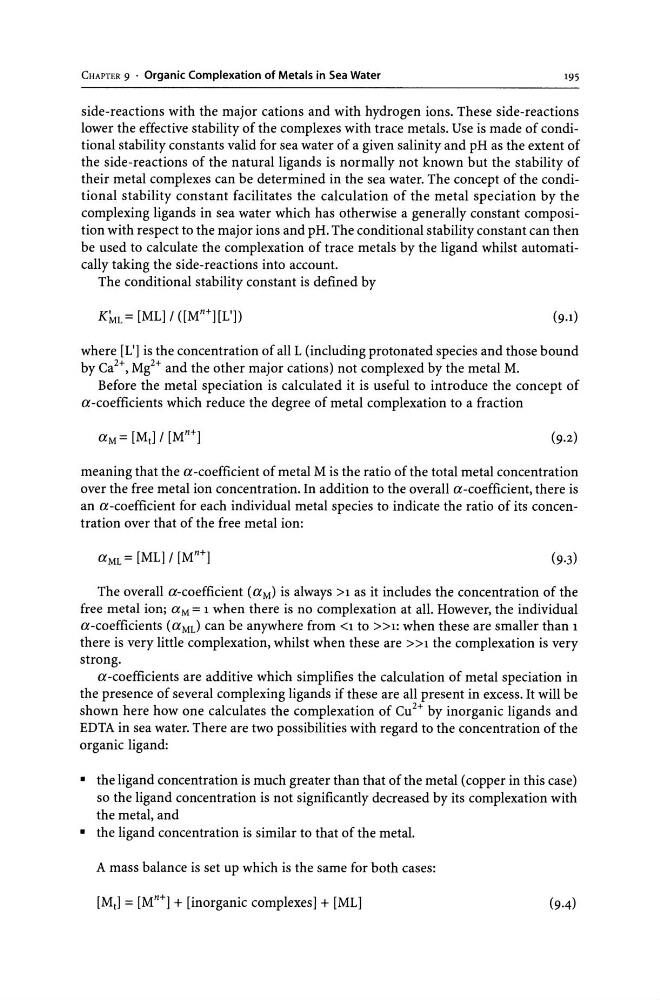
The conditional stability constant is defined by
where [L'l is the concentration of all L (including protonated species and those bound
by Ca 2 +, Mg2+ and the other major cations) not complexed by the metal M.
Before the metal speciation is calculated it is useful to introduce the concept of
a-coefficients which reduce the degree of metal complexation to a fraction
meaning that the a-coefficient of metal M is the ratio of the total metal concentration
over the free metal ion concentration. In addition to the overall a-coefficient, there is
an a-coefficient for each individual metal species to indicate the ratio of its concentration over that of the free metal ion:
The overall a-coefficient (aM) is always >1 as it includes the concentration of the
free metal ion; aM = 1 when there is no complexation at all. However, the individual
a-coefficients (aMd can be anywhere from <1 to »1: when these are smaller than 1
there is very little complexation, whilst when these are> >1 the complexation is very
strong.
a-coefficients are additive which simplifies the calculation of metal speciation in
the presence of several complexing ligands if these are all present in excess. It will be
shown here how one calculates the complexation of Cu 2 + by inorganic ligands and
EDTA in sea water. There are two possibilities with regard to the concentration of the
organic ligand:
• the ligand concentration is much greater than that of the metal (copper in this case)
so the ligand concentration is not significantly decreased by its complexation with
the metal, and
• the ligand concentration is similar to that of the metal.
A mass balance is set up which is the same for both cases:
[Mtl = [Mn+l + [inorganic complexes] + [MLl
195
side-reactions with the major cations and with hydrogen ions. These side-reactions
lower the effective stability of the complexes with trace metals. Use is made of conditional stability constants valid for sea water of a given salinity and pH as the extent of
the side-reactions of the natural ligands is normally not known but the stability of
their metal complexes can be determined in the sea water. The concept of the conditional stability constant facilitates the calculation of the metal speciation by the
complexing ligands in sea water which has otherwise a generally constant composition with respect to the major ions and pH. The conditional stability constant can then
be used to calculate the complexation of trace metals by the ligand whilst automatically taking the side-reactions into account.
The conditional stability constant is defined by
where [L'l is the concentration of all L (including protonated species and those bound
by Ca 2 +, Mg2+ and the other major cations) not complexed by the metal M.
Before the metal speciation is calculated it is useful to introduce the concept of
a-coefficients which reduce the degree of metal complexation to a fraction
meaning that the a-coefficient of metal M is the ratio of the total metal concentration
over the free metal ion concentration. In addition to the overall a-coefficient, there is
an a-coefficient for each individual metal species to indicate the ratio of its concentration over that of the free metal ion:
The overall a-coefficient (aM) is always >1 as it includes the concentration of the
free metal ion; aM = 1 when there is no complexation at all. However, the individual
a-coefficients (aMd can be anywhere from <1 to »1: when these are smaller than 1
there is very little complexation, whilst when these are> >1 the complexation is very
strong.
a-coefficients are additive which simplifies the calculation of metal speciation in
the presence of several complexing ligands if these are all present in excess. It will be
shown here how one calculates the complexation of Cu 2 + by inorganic ligands and
EDTA in sea water. There are two possibilities with regard to the concentration of the
organic ligand:
• the ligand concentration is much greater than that of the metal (copper in this case)
so the ligand concentration is not significantly decreased by its complexation with
the metal, and
• the ligand concentration is similar to that of the metal.
A mass balance is set up which is the same for both cases:
[Mtl = [Mn+l + [inorganic complexes] + [MLl