

CHAPTER 7 • Vapour-Partide Phase Interactions of Organic Pollutants in the Marine Atmosphere
where Kw and Ka refer to whether the calculation uses concentrations expressed on a
liquid phase or a gas phase basis. Cga and Cgw are the gas concentrations in air and
water respectively, H is Henry's Law constant, R is the gas constant and Tthe temperature in degrees Kelvin.
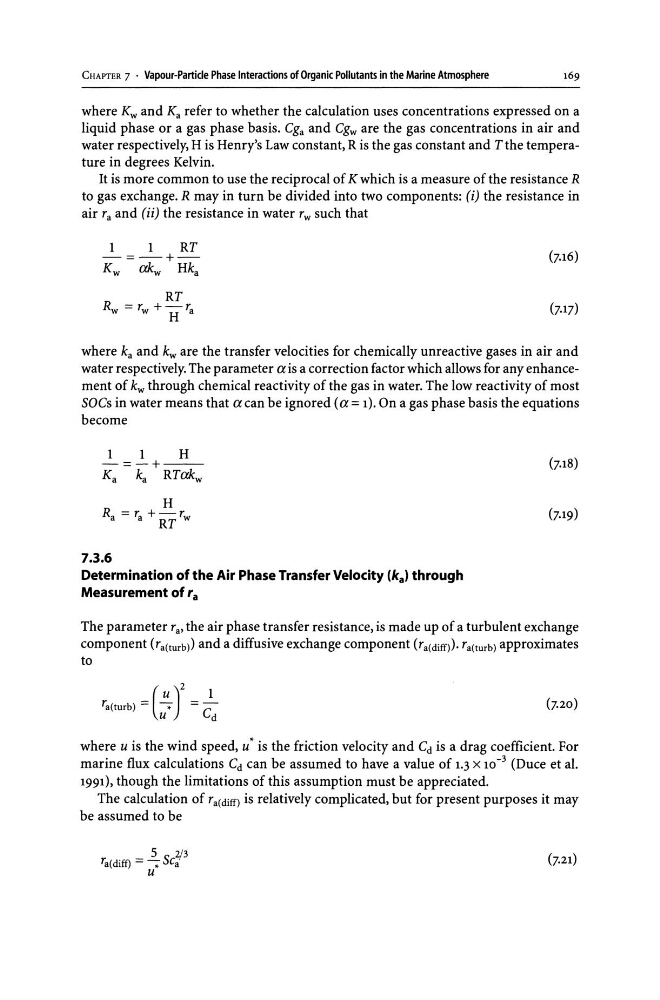
It is more common to use the reciprocal of K which is a measure of the resistance R
to gas exchange. R may in turn be divided into two components: (i) the resistance in
air Ta and (ii) the resistance in water Tw such that
1
1
RT
- = - + -
Kw akw Hka
(7.16)
RT
Rw = Tw +-Ta
H
where ka and kw are the transfer velocities for chemically unreactive gases in air and
water respectively. The parameter a is a correction factor which allows for any enhancement of kw through chemical reactivity of the gas in water. The low reactivity of most
SOCs in water means that a can be ignored (a = 1). On a gas phase basis the equations
become
1
1
H
- = - + - - -
Ka ka RTakw
H
Ra = Ta +-Tw
RT
7.3.6
Determination of the Air Phase Transfer Velocity (k a ) through
Measurement of r a
(7.18)
The parameter Ta, the air phase transfer resistance, is made up of a turbulent exchange
component (Ta(turb» and a diffusive exchange component (Ta(diff)' Ta(turb) approximates
to
Ta(turb) = (;. J
where u is the wind speed, u' is the friction velocity and Cd is a drag coefficient. For
marine flux calculations Cd can be assumed to have a value of 1.3 x 10 -3 (Duce et al.
1991), though the limitations of this assumption must be appreciated.
The calculation of Ta(diff) is relatively complicated, but for present purposes it may
be assumed to be
_ 5 2/3
Ta(diff) - -; Sea
u
(7.21)
where Kw and Ka refer to whether the calculation uses concentrations expressed on a
liquid phase or a gas phase basis. Cga and Cgw are the gas concentrations in air and
water respectively, H is Henry's Law constant, R is the gas constant and Tthe temperature in degrees Kelvin.
It is more common to use the reciprocal of K which is a measure of the resistance R
to gas exchange. R may in turn be divided into two components: (i) the resistance in
air Ta and (ii) the resistance in water Tw such that
1
1
RT
- = - + -
Kw akw Hka
(7.16)
RT
Rw = Tw +-Ta
H
where ka and kw are the transfer velocities for chemically unreactive gases in air and
water respectively. The parameter a is a correction factor which allows for any enhancement of kw through chemical reactivity of the gas in water. The low reactivity of most
SOCs in water means that a can be ignored (a = 1). On a gas phase basis the equations
become
1
1
H
- = - + - - -
Ka ka RTakw
H
Ra = Ta +-Tw
RT
7.3.6
Determination of the Air Phase Transfer Velocity (k a ) through
Measurement of r a
(7.18)
The parameter Ta, the air phase transfer resistance, is made up of a turbulent exchange
component (Ta(turb» and a diffusive exchange component (Ta(diff)' Ta(turb) approximates
to
Ta(turb) = (;. J
where u is the wind speed, u' is the friction velocity and Cd is a drag coefficient. For
marine flux calculations Cd can be assumed to have a value of 1.3 x 10 -3 (Duce et al.
1991), though the limitations of this assumption must be appreciated.
The calculation of Ta(diff) is relatively complicated, but for present purposes it may
be assumed to be
_ 5 2/3
Ta(diff) - -; Sea
u
(7.21)