

CHAPTER 6 • Organic Chemical Reaction Rates in the Ocean:
147
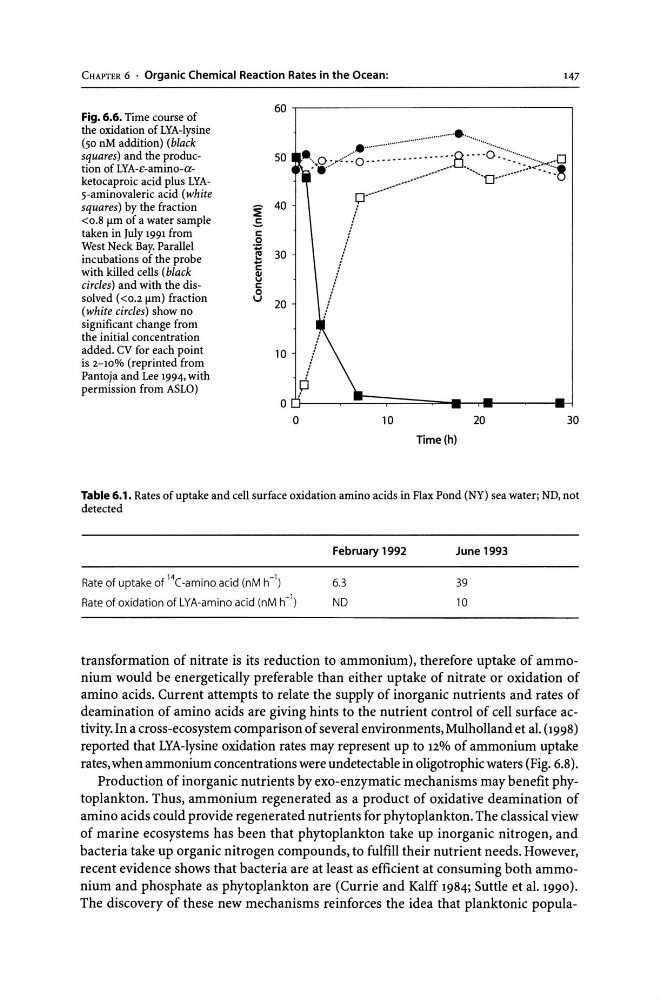
Fig. 6.6. Time course of
the oxidation of LYA-lysine
(50 nM addition) (black
squares) and the production of LYA-e-amino-aketocaproic acid plus LYA5-aminovaleric acid (white
squares) by the fraction
<0.8 f.lIIl of a water sample
taken in July 1991 from
West Neck Bay. Parallel
incubations of the probe
with killed cells (black
circles) and with the dissolved «0.2 f.lIIl) fraction
(white circles) show no
significant change from
the initial concentration
added. CV for each point
is 2-10% (reprinted from
Pantoja and Lee 1994, with
permission from ASLO)
60.-------------------------------,
c
o
i 30
e
a 20
:
:
10
i
!
~
0D-----~~~==~~~~.r-------~-~
o
10
20
30
TIme (h)
Table 6.1. Rates of uptake and cell surface oxidation amino acids in ·Flax Pond (NY) sea water; ND, not
detected
Rate of uptake of '4C-amino acid (nM h-')
Rate of oxidation of LYA-amino acid (nM h-')
February 1992
6.3
ND
June 1993
39
10
transformation of nitrate is its reduction to ammonium), therefore uptake of ammonium would be energetically preferable than either uptake of nitrate or oxidation of
amino acids. Current attempts to relate the supply of inorganic nutrients and rates of
deamination of amino acids are giving hints to the nutrient control of cell surface activity. In a cross-ecosystem comparison of several environments, Mulholland et al. (1998)
reported that LYA-Iysine oxidation rates may represent up to 12% of ammonium uptake
rates, when ammonium concentrations were undetectable in oligotrophic waters (Fig. 6.8).
Production of inorganic nutrients by exo-enzymatic mechanisms may benefit phytoplankton. Thus, ammonium regenerated as a product of oxidative deamination of
amino acids could provide regenerated nutrients for phytoplankton. The classical view
of marine ecosystems has been that phytoplankton take up inorganic nitrogen, and
bacteria take up organic nitrogen compounds, to fulfill their nutrient needs. However,
recent evidence shows that bacteria are at least as efficient at consuming both ammonium and phosphate as phytoplankton are (Currie and Kalff 1984; Suttle et al. 1990).
The discovery of these new mechanisms reinforces the idea that planktonic popula-
147
Fig. 6.6. Time course of
the oxidation of LYA-lysine
(50 nM addition) (black
squares) and the production of LYA-e-amino-aketocaproic acid plus LYA5-aminovaleric acid (white
squares) by the fraction
<0.8 f.lIIl of a water sample
taken in July 1991 from
West Neck Bay. Parallel
incubations of the probe
with killed cells (black
circles) and with the dissolved «0.2 f.lIIl) fraction
(white circles) show no
significant change from
the initial concentration
added. CV for each point
is 2-10% (reprinted from
Pantoja and Lee 1994, with
permission from ASLO)
60.-------------------------------,
c
o
i 30
e
a 20
:
:
10
i
!
~
0D-----~~~==~~~~.r-------~-~
o
10
20
30
TIme (h)
Table 6.1. Rates of uptake and cell surface oxidation amino acids in ·Flax Pond (NY) sea water; ND, not
detected
Rate of uptake of '4C-amino acid (nM h-')
Rate of oxidation of LYA-amino acid (nM h-')
February 1992
6.3
ND
June 1993
39
10
transformation of nitrate is its reduction to ammonium), therefore uptake of ammonium would be energetically preferable than either uptake of nitrate or oxidation of
amino acids. Current attempts to relate the supply of inorganic nutrients and rates of
deamination of amino acids are giving hints to the nutrient control of cell surface activity. In a cross-ecosystem comparison of several environments, Mulholland et al. (1998)
reported that LYA-Iysine oxidation rates may represent up to 12% of ammonium uptake
rates, when ammonium concentrations were undetectable in oligotrophic waters (Fig. 6.8).
Production of inorganic nutrients by exo-enzymatic mechanisms may benefit phytoplankton. Thus, ammonium regenerated as a product of oxidative deamination of
amino acids could provide regenerated nutrients for phytoplankton. The classical view
of marine ecosystems has been that phytoplankton take up inorganic nitrogen, and
bacteria take up organic nitrogen compounds, to fulfill their nutrient needs. However,
recent evidence shows that bacteria are at least as efficient at consuming both ammonium and phosphate as phytoplankton are (Currie and Kalff 1984; Suttle et al. 1990).
The discovery of these new mechanisms reinforces the idea that planktonic popula-