

118
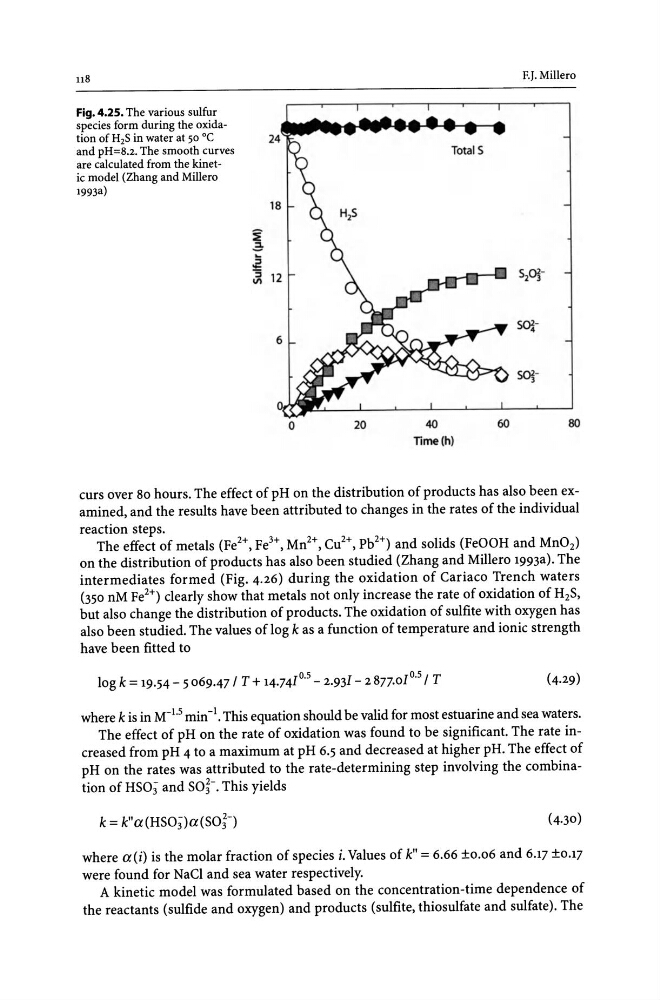
Fig. 4.25. The various sulfur
species form during the oxidation of H2S in water at 50°C
and pH=8.2. The smooth curves
are calculated from the kinetic model (Zhang and MiJlero
1993a)
o
20
40
Ti me (h)
F.J. Millero
s~60
80
curs over 80 hours. The effect of pH on the distribution of products has also been examined, and the results have been attributed to changes in the rates of the individual
reaction steps.
The effect of metals (Fe 2 +, Fe 3 +, Mn2+, Cu z +, Pb z +) and solids (FeOOH and MnOz)
on the distribution of products has also been studied (Zhang and Millero 1993a). The
intermediates formed (Fig. 4.26) during the oxidation of Cariaco Trench waters
(350 nM Fe z +) clearly show that metals not only increase the rate of oxidation of HzS,
but also change the distribution of products. The oxidation of sulfite with oxygen has
also been studied. The values of log k as a function of temperature and ionic strength
have been fitted to
log k = 19.54 - 5069.47/ T + 14.741°·5 - 2.931 - 2877-01°.5/ T
where k is in M-1.5 min-I. This equation should be valid for most estuarine and sea waters.
The effect of pH on the rate of oxidation was found to be significant. The rate increased from pH 4 to a maximum at pH 6.5 and decreased at higher pH. The effect of
pH on the rates was attributed to the rate-determining step involving the combination of HSO;- and SO~-. This yields
k = k"a(HSO;-)a(SO~-)
where a(i) is the molar fraction of species i. Values of k" = 6.66 ±0.o6 and 6.17 ±0.17
were found for NaCI and sea water respectively.
A kinetic model was formulated based on the concentration-time dependence of
the reactants (sulfide and oxygen) and products (sulfite, thiosulfate and sulfate). The
Fig. 4.25. The various sulfur
species form during the oxidation of H2S in water at 50°C
and pH=8.2. The smooth curves
are calculated from the kinetic model (Zhang and MiJlero
1993a)
o
20
40
Ti me (h)
F.J. Millero
s~60
80
curs over 80 hours. The effect of pH on the distribution of products has also been examined, and the results have been attributed to changes in the rates of the individual
reaction steps.
The effect of metals (Fe 2 +, Fe 3 +, Mn2+, Cu z +, Pb z +) and solids (FeOOH and MnOz)
on the distribution of products has also been studied (Zhang and Millero 1993a). The
intermediates formed (Fig. 4.26) during the oxidation of Cariaco Trench waters
(350 nM Fe z +) clearly show that metals not only increase the rate of oxidation of HzS,
but also change the distribution of products. The oxidation of sulfite with oxygen has
also been studied. The values of log k as a function of temperature and ionic strength
have been fitted to
log k = 19.54 - 5069.47/ T + 14.741°·5 - 2.931 - 2877-01°.5/ T
where k is in M-1.5 min-I. This equation should be valid for most estuarine and sea waters.
The effect of pH on the rate of oxidation was found to be significant. The rate increased from pH 4 to a maximum at pH 6.5 and decreased at higher pH. The effect of
pH on the rates was attributed to the rate-determining step involving the combination of HSO;- and SO~-. This yields
k = k"a(HSO;-)a(SO~-)
where a(i) is the molar fraction of species i. Values of k" = 6.66 ±0.o6 and 6.17 ±0.17
were found for NaCI and sea water respectively.
A kinetic model was formulated based on the concentration-time dependence of
the reactants (sulfide and oxygen) and products (sulfite, thiosulfate and sulfate). The