

CHAPTER 4 . Redox Processes in Anoxic Waters
115
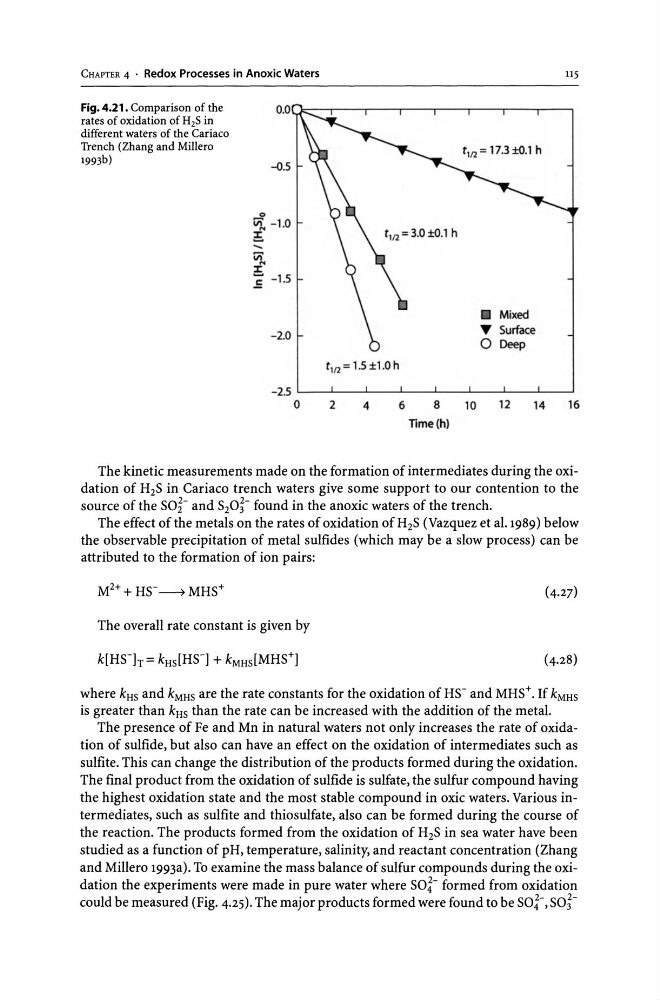
Fig. 4.21. Comparison of the
rates of oxidation of H2S in
different waters of the Cariaco
Trench (Zhang and Millero
1993b)
0.00.::--, - - , - - , - - , - - , - - , - -.------,
-{l.5
o
Vi: -1 .0
~
l
.E - 1.5
- 2.0
t'l2 = 1.5 ±1 .0 h
•
Mi xed
~ Surface
o Deep
- 2.5 L-_L----'L----'L----'L----'L----'L----'_---'
o
2
4
6
8
10
12
14
16
TIme (h)
The kinetic measurements made on the formation of intermediates during the oxidation of H2S in Cariaco trench waters give some support to our contention to the
source of the SO;- and S20~- found in the anoxic waters of the trench.
The effect of the metals on the rates of oxidation of HzS (Vazquez et al. 1989) below
the observable precipitation of metal sulfides (which may be a slow process) can be
attributed to the formation of ion pairs:
The overall rate constant is given by
where kHS and kMHS are the rate constants for the oxidation of HS- and MHS+. If k MHS
is greater than kHS than the rate can be increased with the addition of the metal.
The presence of Fe and Mn in natural waters not only increases the rate of oxidation of sulfide, but also can have an effect on the oxidation of intermediates such as
sulfite. This can change the distribution of the products formed during the oxidation.
The final product from the oxidation of sulfide is sulfate, the sulfur compound having
the highest oxidation state and the most stable compound in oxic waters. Various intermediates, such as sulfite and thiosulfate, also can be formed during the course of
the reaction. The products formed from the oxidation of H 2 S in sea water have been
studied as a function of pH, temperature, salinity, and reactant concentration (Zhang
and Millero 1993a). To examine the mass balance of sulfur compounds during the oxidation the experiments were made in pure water where SO~- formed from oxidation
could be measured (Fig. 4.25). The major products formed were found to be SO~-, SO~-
115
Fig. 4.21. Comparison of the
rates of oxidation of H2S in
different waters of the Cariaco
Trench (Zhang and Millero
1993b)
0.00.::--, - - , - - , - - , - - , - - , - -.------,
-{l.5
o
Vi: -1 .0
~
l
.E - 1.5
- 2.0
t'l2 = 1.5 ±1 .0 h
•
Mi xed
~ Surface
o Deep
- 2.5 L-_L----'L----'L----'L----'L----'L----'_---'
o
2
4
6
8
10
12
14
16
TIme (h)
The kinetic measurements made on the formation of intermediates during the oxidation of H2S in Cariaco trench waters give some support to our contention to the
source of the SO;- and S20~- found in the anoxic waters of the trench.
The effect of the metals on the rates of oxidation of HzS (Vazquez et al. 1989) below
the observable precipitation of metal sulfides (which may be a slow process) can be
attributed to the formation of ion pairs:
The overall rate constant is given by
where kHS and kMHS are the rate constants for the oxidation of HS- and MHS+. If k MHS
is greater than kHS than the rate can be increased with the addition of the metal.
The presence of Fe and Mn in natural waters not only increases the rate of oxidation of sulfide, but also can have an effect on the oxidation of intermediates such as
sulfite. This can change the distribution of the products formed during the oxidation.
The final product from the oxidation of sulfide is sulfate, the sulfur compound having
the highest oxidation state and the most stable compound in oxic waters. Various intermediates, such as sulfite and thiosulfate, also can be formed during the course of
the reaction. The products formed from the oxidation of H 2 S in sea water have been
studied as a function of pH, temperature, salinity, and reactant concentration (Zhang
and Millero 1993a). To examine the mass balance of sulfur compounds during the oxidation the experiments were made in pure water where SO~- formed from oxidation
could be measured (Fig. 4.25). The major products formed were found to be SO~-, SO~-