

106
F.J. Millero
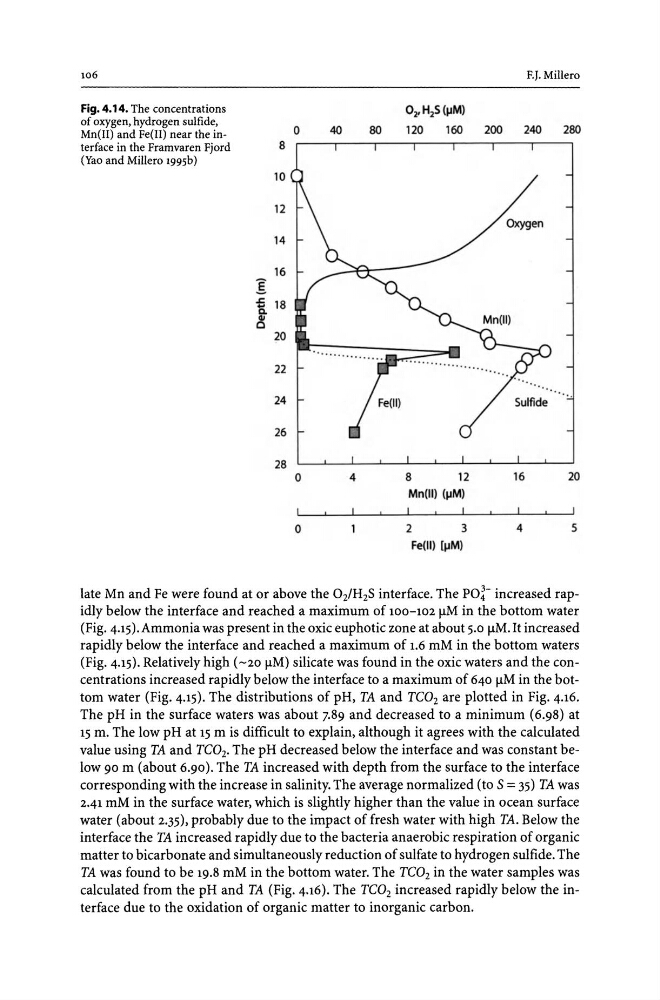
Fig. 4.14. The concentrations
02, H 2 S(IlM)
of oxygen, hydrogen sulfide,
0
40
80
120
160
200
240
280
Mn(II) and Fe(II) near the interface in the Framvaren Fjord
8
(Yao and Millero 1995b)
10
12
14
16
g
~
18
a
2l 20
22
24
Sulfide
26
28
0
4
8
12
16
20
Mn(ll) (11M)
0
2
3
4
5
Fe(ll) 111M)
late Mn and Fe were found at or above the 02/H2S interface. The PO~- increased rapidly below the interface and reached a maximum of 100-102 11M in the bottom water
(Fig. 4.15). Ammonia was present in the oxic euphotic zone at about 5.0 11M. It increased
rapidly below the interface and reached a maximum of 1.6 mM in the bottom waters
(Fig. 4.15). Relatively high (-20 11M) silicate was found in the oxic waters and the concentrations increased rapidly below the interface to a maximum of 640 11M in the bottom water (Fig. 4.15). The distributions of pH, TA and Te0 2 are plotted in Fig. 4.16.
The pH in the surface waters was about 7.89 and decreased to a minimum (6.98) at
15 m. The low pH at 15 m is difficult to explain, although it agrees with the calculated
value using TA and Te0 2 • The pH decreased below the interface and was constant below 90 m (about 6.90). The TA increased with depth from the surface to the interface
corresponding with the increase in salinity. The average normalized (to S = 35) TA was
2.41 mM in the surface water, which is slightly higher than the value in ocean surface
water (about 2.35), probably due to the impact of fresh water with high TA. Below the
interface the TA increased rapidly due to the bacteria anaerobic respiration of organic
matter to bicarbonate and simultaneously reduction of sulfate to hydrogen sulfide. The
TA was found to be 19.8 mM in the bottom water. The Te02 in the water samples was
calculated from the pH and TA (Fig. 4.16). The Te0 2 increased rapidly below the interface due to the oxidation of organic matter to inorganic carbon.
F.J. Millero
Fig. 4.14. The concentrations
02, H 2 S(IlM)
of oxygen, hydrogen sulfide,
0
40
80
120
160
200
240
280
Mn(II) and Fe(II) near the interface in the Framvaren Fjord
8
(Yao and Millero 1995b)
10
12
14
16
g
~
18
a
2l 20
22
24
Sulfide
26
28
0
4
8
12
16
20
Mn(ll) (11M)
0
2
3
4
5
Fe(ll) 111M)
late Mn and Fe were found at or above the 02/H2S interface. The PO~- increased rapidly below the interface and reached a maximum of 100-102 11M in the bottom water
(Fig. 4.15). Ammonia was present in the oxic euphotic zone at about 5.0 11M. It increased
rapidly below the interface and reached a maximum of 1.6 mM in the bottom waters
(Fig. 4.15). Relatively high (-20 11M) silicate was found in the oxic waters and the concentrations increased rapidly below the interface to a maximum of 640 11M in the bottom water (Fig. 4.15). The distributions of pH, TA and Te0 2 are plotted in Fig. 4.16.
The pH in the surface waters was about 7.89 and decreased to a minimum (6.98) at
15 m. The low pH at 15 m is difficult to explain, although it agrees with the calculated
value using TA and Te0 2 • The pH decreased below the interface and was constant below 90 m (about 6.90). The TA increased with depth from the surface to the interface
corresponding with the increase in salinity. The average normalized (to S = 35) TA was
2.41 mM in the surface water, which is slightly higher than the value in ocean surface
water (about 2.35), probably due to the impact of fresh water with high TA. Below the
interface the TA increased rapidly due to the bacteria anaerobic respiration of organic
matter to bicarbonate and simultaneously reduction of sulfate to hydrogen sulfide. The
TA was found to be 19.8 mM in the bottom water. The Te02 in the water samples was
calculated from the pH and TA (Fig. 4.16). The Te0 2 increased rapidly below the interface due to the oxidation of organic matter to inorganic carbon.