

CHAPTER 4 . Redox Processes in Anoxic Waters
101
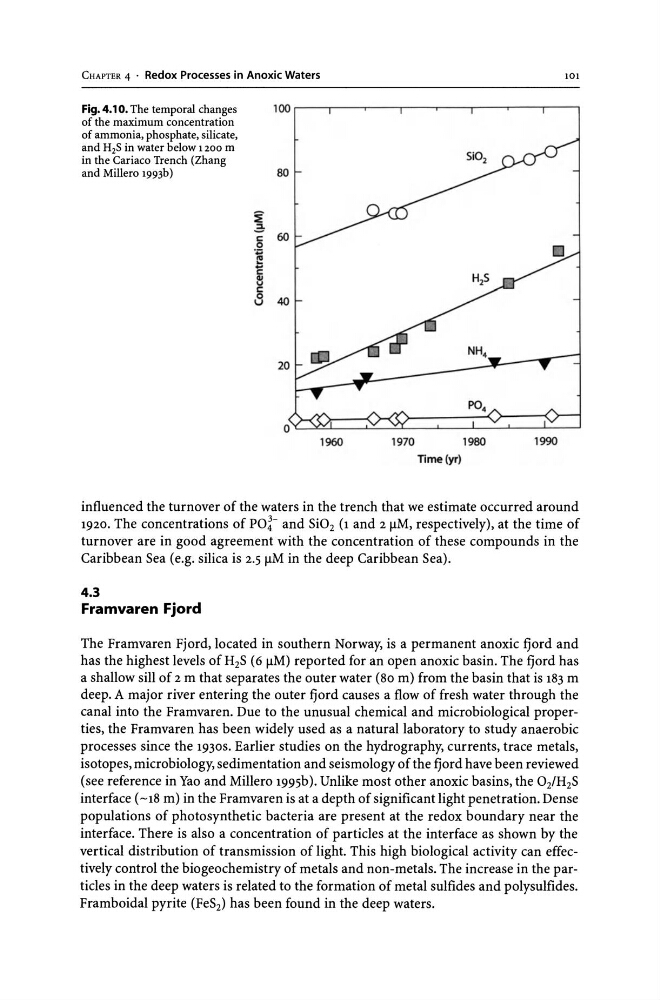
Fig. 4.10. The temporal changes
100 r-- , - ----,-- - , -- -,----,-- -.,.-- - , - - ,
of the maximum concentration
of ammonia, phosphate, silicate,
and H2S in water below 1200 m
in the Cariaco Trench (Zhang
and Millero 1993b)
~
.:. c 0
.~
.. u c
8
80
60
1960
1970
1980
1990
Time (yr)
influenced the turnover of the waters in the trench that we estimate occurred around
1920. The concentrations of PO~- and Si0 2 (1 and 2 flM, respectively), at the time of
turnover are in good agreement with the concentration of these compounds in the
Caribbean Sea (e.g. silica is 2.5 flM in the deep Caribbean Sea).
4.3
Framvaren Fjord
The Framvaren Fjord, located in southern Norway, is a permanent anoxic fjord and
has the highest levels of H2S (6 flM) reported for an open anoxic basin. The fjord has
a shallow sill of 2 m that separates the outer water (80 m) from the basin that is 183 m
deep. A major river entering the outer fjord causes a flow of fresh water through the
canal into the Framvaren. Due to the unusual chemical and microbiological properties, the Framvaren has been widely used as a natural laboratory to study anaerobic
processes since the 1930S. Earlier studies on the hydrography, currents, trace metals,
isotopes, microbiology, sedimentation and seismology of the fjord have been reviewed
(see reference in Yao and Millero 1995b). Unlike most other anoxic basins, the 02/H2S
interface (-18 m) in the Framvaren is at a depth of significant light penetration. Dense
populations of photosynthetic bacteria are present at the redox boundary near the
interface. There is also a concentration of particles at the interface as shown by the
vertical distribution of transmission of light. This high biological activity can effectively control the biogeochemistry of metals and non-metals. The increase in the particles in the deep waters is related to the formation of metal sulfides and polysulfides.
Framboidal pyrite (FeS2) has been found in the deep waters.
101
Fig. 4.10. The temporal changes
100 r-- , - ----,-- - , -- -,----,-- -.,.-- - , - - ,
of the maximum concentration
of ammonia, phosphate, silicate,
and H2S in water below 1200 m
in the Cariaco Trench (Zhang
and Millero 1993b)
~
.:. c 0
.~
.. u c
8
80
60
1960
1970
1980
1990
Time (yr)
influenced the turnover of the waters in the trench that we estimate occurred around
1920. The concentrations of PO~- and Si0 2 (1 and 2 flM, respectively), at the time of
turnover are in good agreement with the concentration of these compounds in the
Caribbean Sea (e.g. silica is 2.5 flM in the deep Caribbean Sea).
4.3
Framvaren Fjord
The Framvaren Fjord, located in southern Norway, is a permanent anoxic fjord and
has the highest levels of H2S (6 flM) reported for an open anoxic basin. The fjord has
a shallow sill of 2 m that separates the outer water (80 m) from the basin that is 183 m
deep. A major river entering the outer fjord causes a flow of fresh water through the
canal into the Framvaren. Due to the unusual chemical and microbiological properties, the Framvaren has been widely used as a natural laboratory to study anaerobic
processes since the 1930S. Earlier studies on the hydrography, currents, trace metals,
isotopes, microbiology, sedimentation and seismology of the fjord have been reviewed
(see reference in Yao and Millero 1995b). Unlike most other anoxic basins, the 02/H2S
interface (-18 m) in the Framvaren is at a depth of significant light penetration. Dense
populations of photosynthetic bacteria are present at the redox boundary near the
interface. There is also a concentration of particles at the interface as shown by the
vertical distribution of transmission of light. This high biological activity can effectively control the biogeochemistry of metals and non-metals. The increase in the particles in the deep waters is related to the formation of metal sulfides and polysulfides.
Framboidal pyrite (FeS2) has been found in the deep waters.