

Chapter 4
Redox Processes in Anoxic Waters
F.J. Millero
4.1
Introduction
Anoxic waters are defined as those waters that have no dissolved oxygen (Richards
1965). This condition can occur in natural waters when the rate of consumption of
oxygen exceeds the supply. The rate of oxidation of organic matter by bacteria is greater
than the supply of oxygen from the atmosphere. The supply of O2 below the photic
zone is dependent upon diffusion and advection. Anoxia normally occurs in enclosed
basins where physical barriers (sills) and density stratification limit the advection of
O2 to the deep waters (Grasshoff 1975). There are two types of anoxic basins. The most
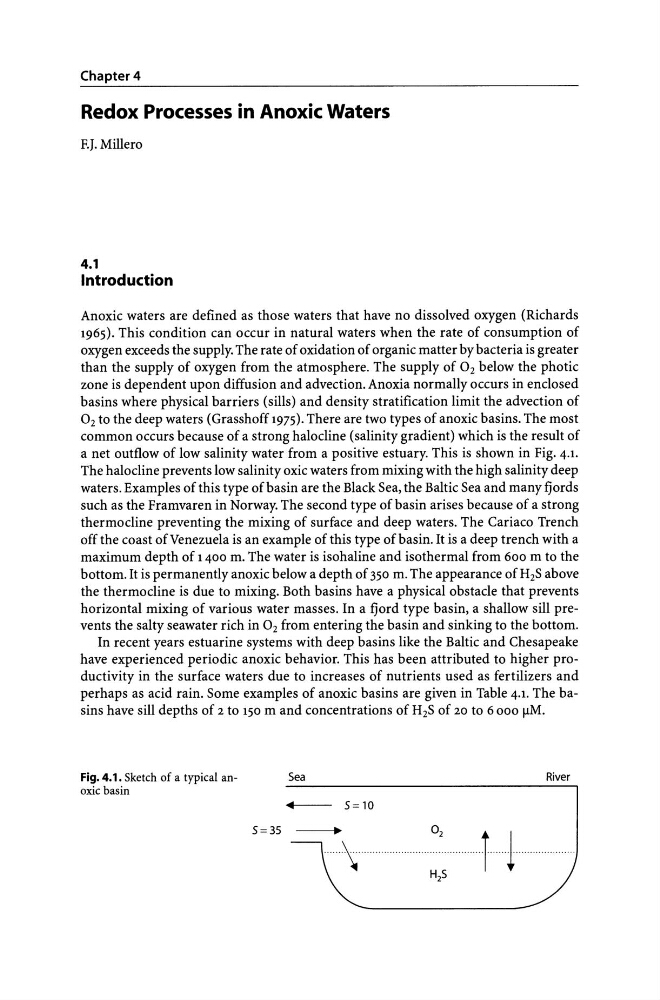
common occurs because of a strong halo cline (salinity gradient) which is the result of
a net outflow of low salinity water from a positive estuary. This is shown in Fig. 4.1.
The halocline prevents low salinity oxic waters from mixing with the high salinity deep
waters. Examples of this type of basin are the Black Sea, the Baltic Sea and many fjords
such as the Framvaren in Norway. The second type of basin arises because of a strong
thermocline preventing the mixing of surface and deep waters. The Cariaco Trench
off the coast of Venezuela is an example of this type of basin. It is a deep trench with a
maximum depth of 1 400 m. The water is isohaline and isothermal from 600 m to the
bottom. It is permanently anoxic below a depth of 350 m. The appearance of H2S above
the thermocline is due to mixing. Both basins have a physical obstacle that prevents
horizontal mixing of various water masses. In a fjord type basin, a shallow sill prevents the salty seawater rich in O2 from entering the basin and sinking to the bottom.
In recent years estuarine systems with deep basins like the Baltic and Chesapeake
have experienced periodic anoxic behavior. This has been attributed to higher productivity in the surface waters due to increases of nutrients used as fertilizers and
perhaps as acid rain. Some examples of anoxic basins are given in Table 4.1. The basins have sill depths of 2 to 150 m and concentrations of H2S of 20 to 6000 11M.
Fig. 4.1. Sketch of a typical anoxic basin
Sea
+--- 5=10
5 = 35 ------.
River
Redox Processes in Anoxic Waters
F.J. Millero
4.1
Introduction
Anoxic waters are defined as those waters that have no dissolved oxygen (Richards
1965). This condition can occur in natural waters when the rate of consumption of
oxygen exceeds the supply. The rate of oxidation of organic matter by bacteria is greater
than the supply of oxygen from the atmosphere. The supply of O2 below the photic
zone is dependent upon diffusion and advection. Anoxia normally occurs in enclosed
basins where physical barriers (sills) and density stratification limit the advection of
O2 to the deep waters (Grasshoff 1975). There are two types of anoxic basins. The most
common occurs because of a strong halo cline (salinity gradient) which is the result of
a net outflow of low salinity water from a positive estuary. This is shown in Fig. 4.1.
The halocline prevents low salinity oxic waters from mixing with the high salinity deep
waters. Examples of this type of basin are the Black Sea, the Baltic Sea and many fjords
such as the Framvaren in Norway. The second type of basin arises because of a strong
thermocline preventing the mixing of surface and deep waters. The Cariaco Trench
off the coast of Venezuela is an example of this type of basin. It is a deep trench with a
maximum depth of 1 400 m. The water is isohaline and isothermal from 600 m to the
bottom. It is permanently anoxic below a depth of 350 m. The appearance of H2S above
the thermocline is due to mixing. Both basins have a physical obstacle that prevents
horizontal mixing of various water masses. In a fjord type basin, a shallow sill prevents the salty seawater rich in O2 from entering the basin and sinking to the bottom.
In recent years estuarine systems with deep basins like the Baltic and Chesapeake
have experienced periodic anoxic behavior. This has been attributed to higher productivity in the surface waters due to increases of nutrients used as fertilizers and
perhaps as acid rain. Some examples of anoxic basins are given in Table 4.1. The basins have sill depths of 2 to 150 m and concentrations of H2S of 20 to 6000 11M.
Fig. 4.1. Sketch of a typical anoxic basin
Sea
+--- 5=10
5 = 35 ------.
River