

86
B. Sulzberger
7.0
5.0
4.5
6.6
-c
4.0 i
·e
c:
·e
i
6.2
i
6'
3.5
. i '
N
.:.ex
1 5.8
1
--'-Iog ~
3.0
5.4
- -0-- log k H20 2
2.5
-
Mille ro (1 989)
5.0
2.0
6.5
7.0
7.5
8.0
8.5
pH
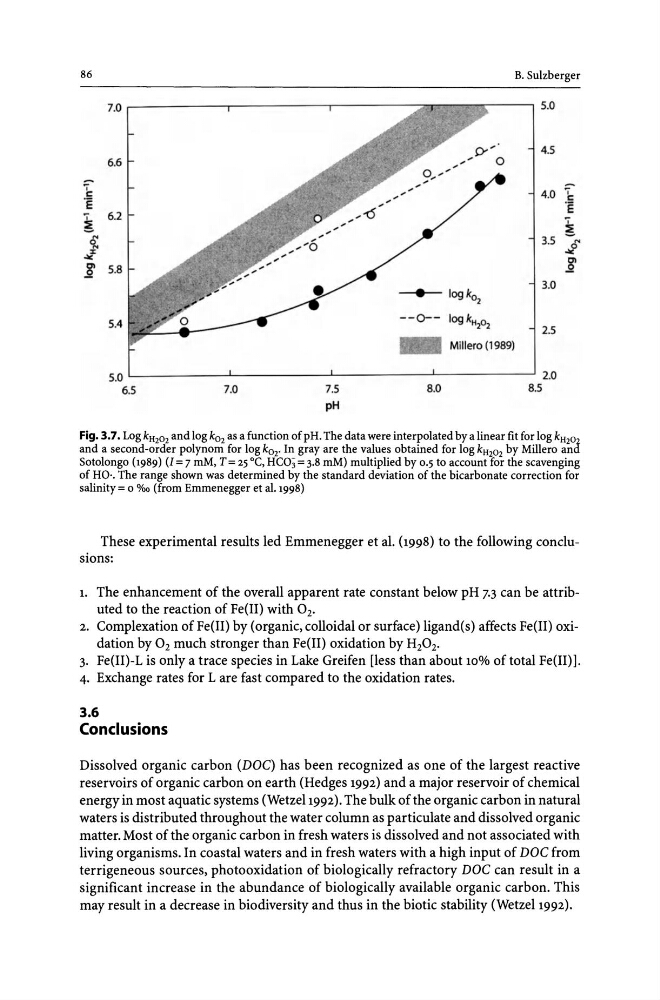
Fig. 3.7. Log k H20 2 and log k02 as a function of pH. The data were interpolated by a linear fit for log k H20 •
and a second-order polynom for log k02" In gray are the values obtained for log k H202 by Millero and
Sotolongo (1989) (1= 7 mM, T= 25 DC, HCOj= 3.8 mM) multiplied by 0.5 to account for the scavenging
of HO·. The range shown was determined by the standard deviation of the bicarbonate correction for
salinity = 0 %0 (from Emmenegger et aI.1998)
These experimental results led Emmenegger et al. (1998) to the following conclusions:
1. The enhancement of the overall apparent rate constant below pH 7.3 can be attributed to the reaction of Fe(lI) with 02'
2. Complexation of Fe(II) by (organic, colloidal or surface) ligand(s) affects Fe(lI) oxidation by O2 much stronger than Fe(II) oxidation by H20 2•
3. Fe(II)-L is only a trace species in Lake Greifen [less than about 10% of total Fe(II) J.
4. Exchange rates for L are fast compared to the oxidation rates.
3.6
Conclusions
Dissolved organic carbon (DOC) has been recognized as one of the largest reactive
reservoirs of organic carbon on earth (Hedges 1992) and a major reservoir of chemical
energy in most aquatic systems (Wetze!1992). The bulk of the organic carbon in natural
waters is distributed throughout the water column as particulate and dissolved organic
matter. Most of the organic carbon in fresh waters is dissolved and not associated with
living organisms. In coastal waters and in fresh waters with a high input of DOC from
terrigeneous sources, photo oxidation of biologically refractory DOC can result in a
significant increase in the abundance of biologically available organic carbon. This
may result in a decrease in biodiversity and thus in the biotic stability (Wetzel 1992).
B. Sulzberger
7.0
5.0
4.5
6.6
-c
4.0 i
·e
c:
·e
i
6.2
i
6'
3.5
. i '
N
.:.ex
1 5.8
1
--'-Iog ~
3.0
5.4
- -0-- log k H20 2
2.5
-
Mille ro (1 989)
5.0
2.0
6.5
7.0
7.5
8.0
8.5
pH
Fig. 3.7. Log k H20 2 and log k02 as a function of pH. The data were interpolated by a linear fit for log k H20 •
and a second-order polynom for log k02" In gray are the values obtained for log k H202 by Millero and
Sotolongo (1989) (1= 7 mM, T= 25 DC, HCOj= 3.8 mM) multiplied by 0.5 to account for the scavenging
of HO·. The range shown was determined by the standard deviation of the bicarbonate correction for
salinity = 0 %0 (from Emmenegger et aI.1998)
These experimental results led Emmenegger et al. (1998) to the following conclusions:
1. The enhancement of the overall apparent rate constant below pH 7.3 can be attributed to the reaction of Fe(lI) with 02'
2. Complexation of Fe(II) by (organic, colloidal or surface) ligand(s) affects Fe(lI) oxidation by O2 much stronger than Fe(II) oxidation by H20 2•
3. Fe(II)-L is only a trace species in Lake Greifen [less than about 10% of total Fe(II) J.
4. Exchange rates for L are fast compared to the oxidation rates.
3.6
Conclusions
Dissolved organic carbon (DOC) has been recognized as one of the largest reactive
reservoirs of organic carbon on earth (Hedges 1992) and a major reservoir of chemical
energy in most aquatic systems (Wetze!1992). The bulk of the organic carbon in natural
waters is distributed throughout the water column as particulate and dissolved organic
matter. Most of the organic carbon in fresh waters is dissolved and not associated with
living organisms. In coastal waters and in fresh waters with a high input of DOC from
terrigeneous sources, photo oxidation of biologically refractory DOC can result in a
significant increase in the abundance of biologically available organic carbon. This
may result in a decrease in biodiversity and thus in the biotic stability (Wetzel 1992).