

Microbial Reclamation of Fish Industry By-products 263
fi sh protein hydrolysates prepared using alcalase had less bitter principles
as compared to those made with plant proteases like papain (Hoyle
and Merritt, 1994; Kristinsson and Rasco, 2000b). Recently hydrolysis
conditions for preparation of protein hydrolysates from freshwater fi sh
processing wastes using alcalase have been optimized (Bhaskar et al.,
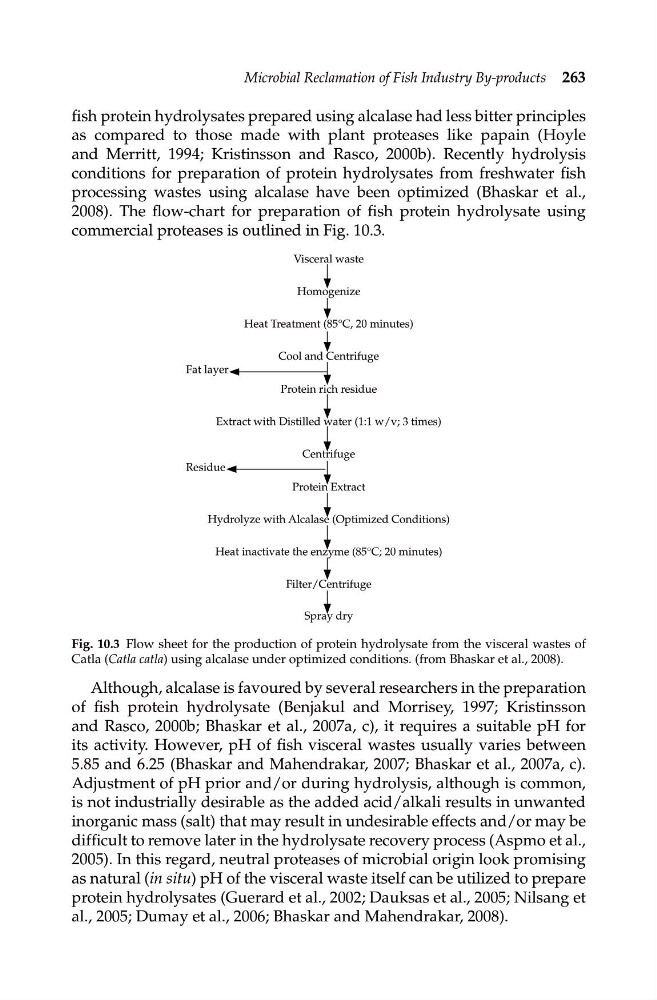
2008). The fl ow-chart for preparation of fi sh protein hydrolysate using
commercial proteases is outlined in Fig. 10.3.
Fig. 10.3 Flow sheet for the production of protein hydrolysate from the visceral wastes of
Catla (Catla catla) using alcalase under optimized conditions. (from Bhaskar et al., 2008).
Visceral waste
Homogenize
Heat Treatment (85°C, 20 minutes)
Cool and Centrifuge
Fat layer
Protein rich residue
Extract with Distilled water (1:1 w/v; 3 times)
Centrifuge
Residue
Protein Extract
Hydrolyze with Alcalase (Optimized Conditions)
Heat inactivate the enzyme (85°C; 20 minutes)
Filter/Centrifuge
Spray dry
Although, alcalase is favoured by several researchers in the preparation
of fi sh protein hydrolysate (Benjakul and Morrisey, 1997; Kristinsson
and Rasco, 2000b; Bhaskar et al., 2007a, c), it requires a suitable pH for
its activity. However, pH of fi sh visceral wastes usually varies between
5.85 and 6.25 (Bhaskar and Mahendrakar, 2007; Bhaskar et al., 2007a, c).
Adjustment of pH prior and/or during hydrolysis, although is common,
is not industrially desirable as the added acid/alkali results in unwanted
inorganic mass (salt) that may result in undesirable effects and/or may be
diffi cult to remove later in the hydrolysate recovery process (Aspmo et al.,
2005). In this regard, neutral proteases of microbial origin look promising
as natural (in situ) pH of the visceral waste itself can be utilized to prepare
protein hydrolysates (Guerard et al., 2002; Dauksas et al., 2005; Nilsang et
al., 2005; Dumay et al., 2006; Bhaskar and Mahendrakar, 2008).
fi sh protein hydrolysates prepared using alcalase had less bitter principles
as compared to those made with plant proteases like papain (Hoyle
and Merritt, 1994; Kristinsson and Rasco, 2000b). Recently hydrolysis
conditions for preparation of protein hydrolysates from freshwater fi sh
processing wastes using alcalase have been optimized (Bhaskar et al.,
2008). The fl ow-chart for preparation of fi sh protein hydrolysate using
commercial proteases is outlined in Fig. 10.3.
Fig. 10.3 Flow sheet for the production of protein hydrolysate from the visceral wastes of
Catla (Catla catla) using alcalase under optimized conditions. (from Bhaskar et al., 2008).
Visceral waste
Homogenize
Heat Treatment (85°C, 20 minutes)
Cool and Centrifuge
Fat layer
Protein rich residue
Extract with Distilled water (1:1 w/v; 3 times)
Centrifuge
Residue
Protein Extract
Hydrolyze with Alcalase (Optimized Conditions)
Heat inactivate the enzyme (85°C; 20 minutes)
Filter/Centrifuge
Spray dry
Although, alcalase is favoured by several researchers in the preparation
of fi sh protein hydrolysate (Benjakul and Morrisey, 1997; Kristinsson
and Rasco, 2000b; Bhaskar et al., 2007a, c), it requires a suitable pH for
its activity. However, pH of fi sh visceral wastes usually varies between
5.85 and 6.25 (Bhaskar and Mahendrakar, 2007; Bhaskar et al., 2007a, c).
Adjustment of pH prior and/or during hydrolysis, although is common,
is not industrially desirable as the added acid/alkali results in unwanted
inorganic mass (salt) that may result in undesirable effects and/or may be
diffi cult to remove later in the hydrolysate recovery process (Aspmo et al.,
2005). In this regard, neutral proteases of microbial origin look promising
as natural (in situ) pH of the visceral waste itself can be utilized to prepare
protein hydrolysates (Guerard et al., 2002; Dauksas et al., 2005; Nilsang et
al., 2005; Dumay et al., 2006; Bhaskar and Mahendrakar, 2008).