

Microbial Reclamation of Fish Industry By-products 253
leather making etc. (e.g., silage, composting)], food purposes (e.g.,
fi sh sauce) and for specialty products (mainly bioactive molecules; e.g.
carotenoids, collagen, peptides, enzymes, etc.). There is normally a far
better profi tability in making products for human consumption while
the highest profi tability is in producing bioactive compounds that have
biotechnological/pharmaceutical applications (Rustad, 2003). Several
methods have been reported for recovering proteins and lipids from these
processing wastes. These include recovering proteins/lipid and related
products through various physical, chemical and biological treatments
or their combinations. The possible methods of recovering protein/lipid
and related molecules from fi n fi sh and shell fi sh processing waste is
summarized in Fig. 10.2. As can be seen fermentation or hydrolysis using
enzymes results in simultaneous recovery of proteins, fats and related
compounds.
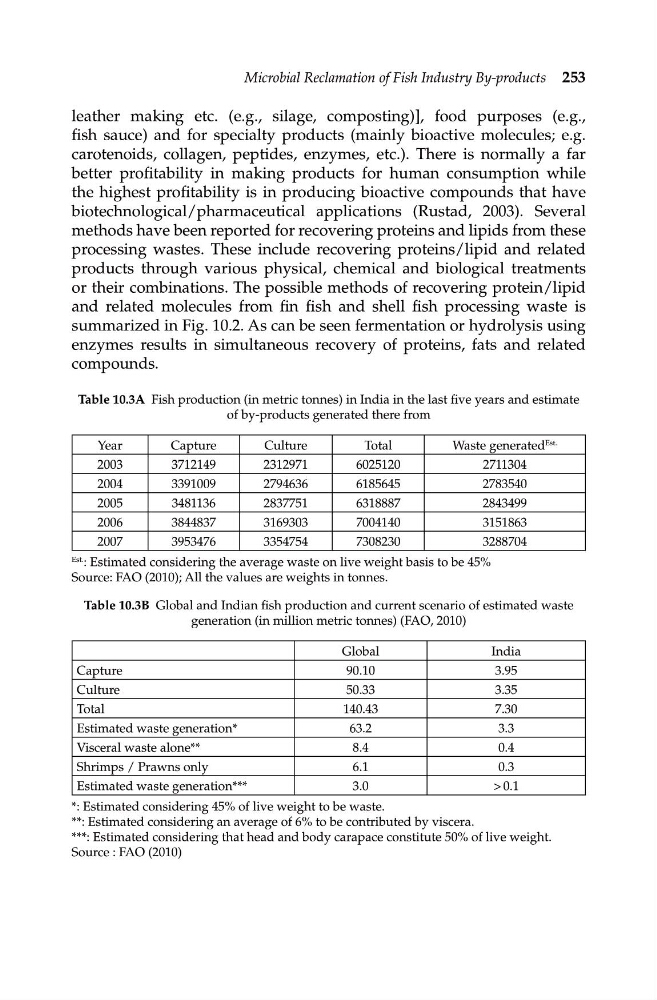
Table 10.3A Fish production (in metric tonnes) in India in the last fi ve years and estimate
of by-products generated there from
Year
Capture
Culture
Total
Waste generated
Est.
2003
3712149
2312971
6025120
2711304
2004
3391009
2794636
6185645
2783540
2005
3481136
2837751
6318887
2843499
2006
3844837
3169303
7004140
3151863
2007
3953476
3354754
7308230
3288704
Est. : Estimated considering the average waste on live weight basis to be 45%
Source: FAO (2010); All the values are weights in tonnes.
Table 10.3B Global and Indian fi sh production and current scenario of estimated waste
generation (in million metric tonnes) (FAO, 2010)
Global
India
Capture
90.10
3.95
Culture
50.33
3.35
Total
140.43
7.30
Estimated waste generation*
63.2
3.3
Visceral waste alone**
8.4
0.4
Shrimps / Prawns only
6.1
0.3
Estimated waste generation***
3.0
> 0.1
*: Estimated considering 45% of live weight to be waste.
**: Estimated considering an average of 6% to be contributed by viscera.
***: Estimated considering that head and body carapace constitute 50% of live weight.
Source : FAO (2010)
leather making etc. (e.g., silage, composting)], food purposes (e.g.,
fi sh sauce) and for specialty products (mainly bioactive molecules; e.g.
carotenoids, collagen, peptides, enzymes, etc.). There is normally a far
better profi tability in making products for human consumption while
the highest profi tability is in producing bioactive compounds that have
biotechnological/pharmaceutical applications (Rustad, 2003). Several
methods have been reported for recovering proteins and lipids from these
processing wastes. These include recovering proteins/lipid and related
products through various physical, chemical and biological treatments
or their combinations. The possible methods of recovering protein/lipid
and related molecules from fi n fi sh and shell fi sh processing waste is
summarized in Fig. 10.2. As can be seen fermentation or hydrolysis using
enzymes results in simultaneous recovery of proteins, fats and related
compounds.
Table 10.3A Fish production (in metric tonnes) in India in the last fi ve years and estimate
of by-products generated there from
Year
Capture
Culture
Total
Waste generated
Est.
2003
3712149
2312971
6025120
2711304
2004
3391009
2794636
6185645
2783540
2005
3481136
2837751
6318887
2843499
2006
3844837
3169303
7004140
3151863
2007
3953476
3354754
7308230
3288704
Est. : Estimated considering the average waste on live weight basis to be 45%
Source: FAO (2010); All the values are weights in tonnes.
Table 10.3B Global and Indian fi sh production and current scenario of estimated waste
generation (in million metric tonnes) (FAO, 2010)
Global
India
Capture
90.10
3.95
Culture
50.33
3.35
Total
140.43
7.30
Estimated waste generation*
63.2
3.3
Visceral waste alone**
8.4
0.4
Shrimps / Prawns only
6.1
0.3
Estimated waste generation***
3.0
> 0.1
*: Estimated considering 45% of live weight to be waste.
**: Estimated considering an average of 6% to be contributed by viscera.
***: Estimated considering that head and body carapace constitute 50% of live weight.
Source : FAO (2010)