

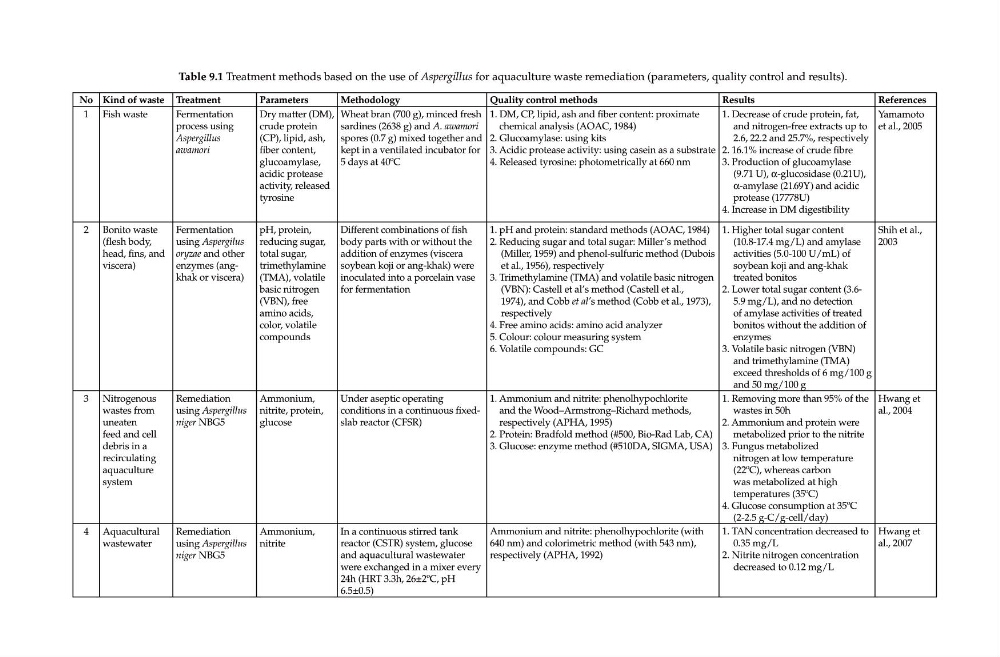
Table 9.1 Treatment methods based on the use of Aspergillus for aquaculture waste remediation (parameters, quality control and results).
No Kind of waste Treatment
Parameters
Methodology
Quality control methods
Results
References
1 Fish waste
Fermentation
process using
Aspergillus
awamori
Dry matter (DM),
crude protein
(CP), lipid, ash,
fi ber content,
glucoamylase,
acidic protease
activity, released
tyrosine
Wheat bran (700 g), minced fresh
sardines (2638 g) and A. awamori
spores (0.7 g) mixed together and
kept in a ventilated incubator for
5 days at 40ºC
1. DM, CP, lipid, ash and fi ber content: proximate
chemical analysis (AOAC, 1984)
2. Glucoamylase: using kits
3. Acidic protease activity: using casein as a substrate
4. Released tyrosine: photometrically at 660 nm
1. Decrease of crude protein, fat,
and nitrogen-free extracts up to
2.6, 22.2 and 25.7%, respectively
2. 16.1% increase of crude fi bre
3. Production of glucoamylase
(9.71 U), a-glucosidase (0.21U),
a-amylase (21.69U) and acidic
protease (17778U)
4. Increase in DM digestibility
Yamamoto
et al., 2005
2 Bonito waste
(fl esh body,
head, fi ns, and
viscera)
Fermentation
using Aspergilus
oryzae and other
enzymes (angkhak or viscera)
pH, protein,
reducing sugar,
total sugar,
trimethylamine
(TMA), volatile
basic nitrogen
(VBN), free
amino acids,
color, volatile
compounds
Different combinations of fi sh
body parts with or without the
addition of enzymes (viscera
soybean koji or ang-khak) were
inoculated into a porcelain vase
for fermentation
1. pH and protein: standard methods (AOAC, 1984)
2. Reducing sugar and total sugar: Miller’s method
(Miller, 1959) and phenol-sulfuric method (Dubois
et al., 1956), respectively
3. Trimethylamine (TMA) and volatile basic nitrogen
(VBN): Castell et al’s method (Castell et al.,
1974), and Cobb et al’s method (Cobb et al., 1973),
respectively
4. Free amino acids: amino acid analyzer
5. Colour: colour measuring system
6. Volatile compounds: GC
1. Higher total sugar content
(10.8-17.4 mg/L) and amylase
activities (5.0-100 U/mL) of
soybean koji and ang-khak
treated bonitos
2. Lower total sugar content (3.65.9 mg/L), and no detection
of amylase activities of treated
bonitos without the addition of
enzymes
3. Volatile basic nitrogen (VBN)
and trimethylamine (TMA)
exceed thresholds of 6 mg/100 g
and 50 mg/100 g
Shih et al.,
2003
3 Nitrogenous
wastes from
uneaten
feed and cell
debris in a
recirculating
aquaculture
system
Remediation
using Aspergillus
niger NBG5
Ammonium,
nitrite, protein,
glucose
Under aseptic operating
conditions in a continuous fi xedslab reactor (CFSR)
1. Ammonium and nitrite: phenolhypochlorite
and the Wood–Armstrong–Richard methods,
respectively (APHA, 1995)
2. Protein: Bradfold method (#500, Bio-Rad Lab, CA)
3. Glucose: enzyme method (#510DA, SIGMA, USA)
1. Removing more than 95% of the
wastes in 50h
2. Ammonium and protein were
metabolized prior to the nitrite
3. Fungus metabolized
nitrogen at low temperature
(22ºC), whereas carbon
was metabolized at high
temperatures (35ºC)
4. Glucose consumption at 35ºC
(2-2.5 g-C/g-cell/day)
Hwang et
al., 2004
4 Aquacultural
wastewater
Remediation
using Aspergillus
niger NBG5
Ammonium,
nitrite
In a continuous stirred tank
reactor (CSTR) system, glucose
and aquacultural wastewater
were exchanged in a mixer every
24h (HRT 3.3h, 26±2ºC, pH
6.5±0.5)
Ammonium and nitrite: phenolhypochlorite (with
640 nm) and colorimetric method (with 543 nm),
respectively (APHA, 1992)
1. TAN concentration decreased to
0.35 mg/L
2. Nitrite nitrogen concentration
decreased to 0.12 mg/L
Hwang et
al., 2007
No Kind of waste Treatment
Parameters
Methodology
Quality control methods
Results
References
1 Fish waste
Fermentation
process using
Aspergillus
awamori
Dry matter (DM),
crude protein
(CP), lipid, ash,
fi ber content,
glucoamylase,
acidic protease
activity, released
tyrosine
Wheat bran (700 g), minced fresh
sardines (2638 g) and A. awamori
spores (0.7 g) mixed together and
kept in a ventilated incubator for
5 days at 40ºC
1. DM, CP, lipid, ash and fi ber content: proximate
chemical analysis (AOAC, 1984)
2. Glucoamylase: using kits
3. Acidic protease activity: using casein as a substrate
4. Released tyrosine: photometrically at 660 nm
1. Decrease of crude protein, fat,
and nitrogen-free extracts up to
2.6, 22.2 and 25.7%, respectively
2. 16.1% increase of crude fi bre
3. Production of glucoamylase
(9.71 U), a-glucosidase (0.21U),
a-amylase (21.69U) and acidic
protease (17778U)
4. Increase in DM digestibility
Yamamoto
et al., 2005
2 Bonito waste
(fl esh body,
head, fi ns, and
viscera)
Fermentation
using Aspergilus
oryzae and other
enzymes (angkhak or viscera)
pH, protein,
reducing sugar,
total sugar,
trimethylamine
(TMA), volatile
basic nitrogen
(VBN), free
amino acids,
color, volatile
compounds
Different combinations of fi sh
body parts with or without the
addition of enzymes (viscera
soybean koji or ang-khak) were
inoculated into a porcelain vase
for fermentation
1. pH and protein: standard methods (AOAC, 1984)
2. Reducing sugar and total sugar: Miller’s method
(Miller, 1959) and phenol-sulfuric method (Dubois
et al., 1956), respectively
3. Trimethylamine (TMA) and volatile basic nitrogen
(VBN): Castell et al’s method (Castell et al.,
1974), and Cobb et al’s method (Cobb et al., 1973),
respectively
4. Free amino acids: amino acid analyzer
5. Colour: colour measuring system
6. Volatile compounds: GC
1. Higher total sugar content
(10.8-17.4 mg/L) and amylase
activities (5.0-100 U/mL) of
soybean koji and ang-khak
treated bonitos
2. Lower total sugar content (3.65.9 mg/L), and no detection
of amylase activities of treated
bonitos without the addition of
enzymes
3. Volatile basic nitrogen (VBN)
and trimethylamine (TMA)
exceed thresholds of 6 mg/100 g
and 50 mg/100 g
Shih et al.,
2003
3 Nitrogenous
wastes from
uneaten
feed and cell
debris in a
recirculating
aquaculture
system
Remediation
using Aspergillus
niger NBG5
Ammonium,
nitrite, protein,
glucose
Under aseptic operating
conditions in a continuous fi xedslab reactor (CFSR)
1. Ammonium and nitrite: phenolhypochlorite
and the Wood–Armstrong–Richard methods,
respectively (APHA, 1995)
2. Protein: Bradfold method (#500, Bio-Rad Lab, CA)
3. Glucose: enzyme method (#510DA, SIGMA, USA)
1. Removing more than 95% of the
wastes in 50h
2. Ammonium and protein were
metabolized prior to the nitrite
3. Fungus metabolized
nitrogen at low temperature
(22ºC), whereas carbon
was metabolized at high
temperatures (35ºC)
4. Glucose consumption at 35ºC
(2-2.5 g-C/g-cell/day)
Hwang et
al., 2004
4 Aquacultural
wastewater
Remediation
using Aspergillus
niger NBG5
Ammonium,
nitrite
In a continuous stirred tank
reactor (CSTR) system, glucose
and aquacultural wastewater
were exchanged in a mixer every
24h (HRT 3.3h, 26±2ºC, pH
6.5±0.5)
Ammonium and nitrite: phenolhypochlorite (with
640 nm) and colorimetric method (with 543 nm),
respectively (APHA, 1992)
1. TAN concentration decreased to
0.35 mg/L
2. Nitrite nitrogen concentration
decreased to 0.12 mg/L
Hwang et
al., 2007