

104 Aquaculture Microbiology and Biotechnology
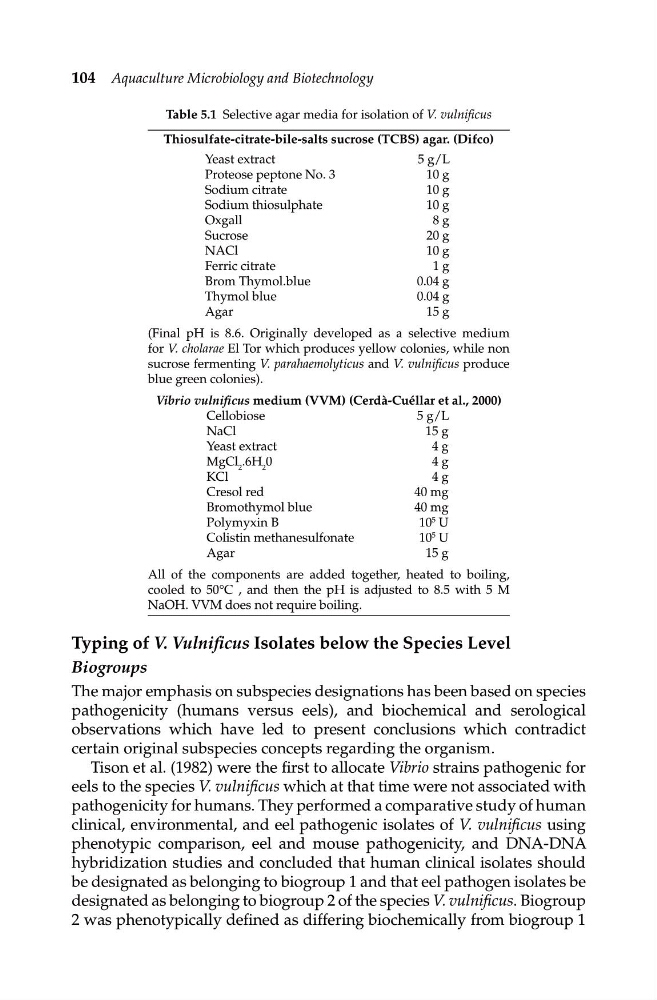
Table 5.1 Selective agar media for isolation of V. vulnifi cus
Thiosulfate-citrate-bile-salts sucrose (TCBS) agar. (Difco)
Yeast extract
5 g/L
Proteose peptone No. 3
10 g
Sodium citrate
10 g
Sodium thiosulphate
10 g
Oxgall
8 g
Sucrose
20 g
NACl
10 g
Ferric citrate
1 g
Brom Thymol.blue
0.04 g
Thymol blue
0.04 g
Agar
15 g
(Final pH is 8.6. Originally developed as a selective medium
for V. cholarae El Tor which produces yellow colonies, while non
sucrose fermenting V. parahaemolyticus and V. vulnifi cus produce
blue green colonies).
Vibrio vulnifi cus medium (VVM) (Cerdà-Cuéllar et al., 2000)
Cellobiose
5 g/L
NaCl
15 g
Yeast extract
4 g
MgCl 2 .6H 2 0
4 g
KCl
4 g
Cresol red
40 mg
Bromothymol blue
40 mg
Polymyxin B
10
5 U
Colistin methanesulfonate
10
5 U
Agar
15 g
All of the components are added together, heated to boiling,
cooled to 50°C , and then the pH is adjusted to 8.5 with 5 M
NaOH. VVM does not require boiling.
Typing of V. Vulnifi cus Isolates below the Species Level
Biogroups
The major emphasis on subspecies designations has been based on species
pathogenicity (humans versus eels), and biochemical and serological
observations which have led to present conclusions which contradict
certain original subspecies concepts regarding the organism.
Tison et al. (1982) were the fi rst to allocate Vibrio strains pathogenic for
eels to the species V. vulnifi cus which at that time were not associated with
pathogenicity for humans. They performed a comparative study of human
clinical, environmental, and eel pathogenic isolates of V. vulnifi cus using
phenotypic comparison, eel and mouse pathogenicity, and DNA-DNA
hybridization studies and concluded that human clinical isolates should
be designated as belonging to biogroup 1 and that eel pathogen isolates be
designated as belonging to biogroup 2 of the species V. vulnifi cus. Biogroup
2 was phenotypically defi ned as differing biochemically from biogroup 1
Table 5.1 Selective agar media for isolation of V. vulnifi cus
Thiosulfate-citrate-bile-salts sucrose (TCBS) agar. (Difco)
Yeast extract
5 g/L
Proteose peptone No. 3
10 g
Sodium citrate
10 g
Sodium thiosulphate
10 g
Oxgall
8 g
Sucrose
20 g
NACl
10 g
Ferric citrate
1 g
Brom Thymol.blue
0.04 g
Thymol blue
0.04 g
Agar
15 g
(Final pH is 8.6. Originally developed as a selective medium
for V. cholarae El Tor which produces yellow colonies, while non
sucrose fermenting V. parahaemolyticus and V. vulnifi cus produce
blue green colonies).
Vibrio vulnifi cus medium (VVM) (Cerdà-Cuéllar et al., 2000)
Cellobiose
5 g/L
NaCl
15 g
Yeast extract
4 g
MgCl 2 .6H 2 0
4 g
KCl
4 g
Cresol red
40 mg
Bromothymol blue
40 mg
Polymyxin B
10
5 U
Colistin methanesulfonate
10
5 U
Agar
15 g
All of the components are added together, heated to boiling,
cooled to 50°C , and then the pH is adjusted to 8.5 with 5 M
NaOH. VVM does not require boiling.
Typing of V. Vulnifi cus Isolates below the Species Level
Biogroups
The major emphasis on subspecies designations has been based on species
pathogenicity (humans versus eels), and biochemical and serological
observations which have led to present conclusions which contradict
certain original subspecies concepts regarding the organism.
Tison et al. (1982) were the fi rst to allocate Vibrio strains pathogenic for
eels to the species V. vulnifi cus which at that time were not associated with
pathogenicity for humans. They performed a comparative study of human
clinical, environmental, and eel pathogenic isolates of V. vulnifi cus using
phenotypic comparison, eel and mouse pathogenicity, and DNA-DNA
hybridization studies and concluded that human clinical isolates should
be designated as belonging to biogroup 1 and that eel pathogen isolates be
designated as belonging to biogroup 2 of the species V. vulnifi cus. Biogroup
2 was phenotypically defi ned as differing biochemically from biogroup 1