

96 Aquaculture Microbiology and Biotechnology
(Klausen and Huss, 1987). However, large amounts of histamine were
formed by M.morganii at low temperatures (0-5°C) following storage for
up to 24 h at high temperatures (10-25°C) even though bacterial growth
did not take place at 5°C and below. Many studies agree that histamineproducing bacteria are mesophilic. However, Ababouch et al., (1991)
found considerable histamine production in sardines at temperatures
< 5°C, and van Spreekens (1987) has reported on histamine production by
Photobacterium sp., which are also able to grow at temperatures < 5°C.
The principal histamine producing bacteria M. morganii grow best at
neutral pH, but they can grow in the pH range 4.7-8.1. The organism is
not very resistant to NaCl, but optimal conditions growth can take place
in up to 5% NaCl. Thus histamine production by this organism is only a
problem in very lightly salted fi sh products. It should be emphasized that
once the histamine has been produced in the fi sh, the risk of provoking
disease is very high. Histamine is very resistant to heat, so even if the
fi sh is cooked, canned or otherwise heat-treated before consumption, the
histamine is not destroyed.
The evidence that histamine is causing disease is mostly circumstantial.
High levels of histamine have consistently been found in samples
implicated in outbreaks, and the symptoms noted in outbreaks are
consistent with histamine as the causative agents. However, high intake
of histamine does not always result in disease, even when “hazard action
level” (50 mg/100 g for tunafi sh) is exceeded. The human body will
tolerate a certain amount of histamine without any reaction. The ingested
histamine will be detoxifi ed in the intestinal tract by at least two enzymes,
the diamine oxidase and histamine N-methyltransferase (Taylor, 1986).
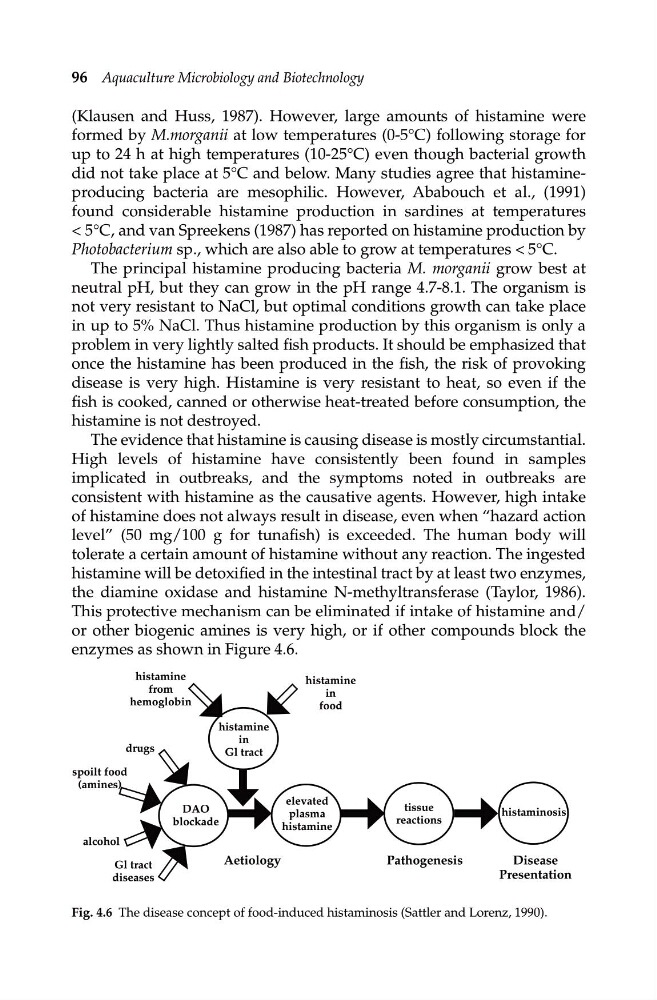
This protective mechanism can be eliminated if intake of histamine and/
or other biogenic amines is very high, or if other compounds block the
enzymes as shown in Figure 4.6.
Fig. 4.6 The disease concept of food-induced histaminosis (Sattler and Lorenz, 1990).
histamine
from
hemoglobin
drugs
spoilt food
(amines)
alcohol
Gl tract
diseases
DAO
blockade
histamine
in
Gl tract
Aetiology
elevated
plasma
histamine
tissue
reactions
histamine
in
food
histaminosis
Disease
Presentation
Pathogenesis
(Klausen and Huss, 1987). However, large amounts of histamine were
formed by M.morganii at low temperatures (0-5°C) following storage for
up to 24 h at high temperatures (10-25°C) even though bacterial growth
did not take place at 5°C and below. Many studies agree that histamineproducing bacteria are mesophilic. However, Ababouch et al., (1991)
found considerable histamine production in sardines at temperatures
< 5°C, and van Spreekens (1987) has reported on histamine production by
Photobacterium sp., which are also able to grow at temperatures < 5°C.
The principal histamine producing bacteria M. morganii grow best at
neutral pH, but they can grow in the pH range 4.7-8.1. The organism is
not very resistant to NaCl, but optimal conditions growth can take place
in up to 5% NaCl. Thus histamine production by this organism is only a
problem in very lightly salted fi sh products. It should be emphasized that
once the histamine has been produced in the fi sh, the risk of provoking
disease is very high. Histamine is very resistant to heat, so even if the
fi sh is cooked, canned or otherwise heat-treated before consumption, the
histamine is not destroyed.
The evidence that histamine is causing disease is mostly circumstantial.
High levels of histamine have consistently been found in samples
implicated in outbreaks, and the symptoms noted in outbreaks are
consistent with histamine as the causative agents. However, high intake
of histamine does not always result in disease, even when “hazard action
level” (50 mg/100 g for tunafi sh) is exceeded. The human body will
tolerate a certain amount of histamine without any reaction. The ingested
histamine will be detoxifi ed in the intestinal tract by at least two enzymes,
the diamine oxidase and histamine N-methyltransferase (Taylor, 1986).
This protective mechanism can be eliminated if intake of histamine and/
or other biogenic amines is very high, or if other compounds block the
enzymes as shown in Figure 4.6.
Fig. 4.6 The disease concept of food-induced histaminosis (Sattler and Lorenz, 1990).
histamine
from
hemoglobin
drugs
spoilt food
(amines)
alcohol
Gl tract
diseases
DAO
blockade
histamine
in
Gl tract
Aetiology
elevated
plasma
histamine
tissue
reactions
histamine
in
food
histaminosis
Disease
Presentation
Pathogenesis