

CHAPTER 2 . The Chemical and Physical Properties of Marine Aerosols: An Introduction
75
et al. 2000; Huebert and Charlson 2000). Liousse et al. (1996) provide a summary of
global Be and total De distributions. Typical concentrations at remote ocean sites are
in the range of several hundred ng C m -3, except for some locations impacted by proximate sources. Be concentrations were substantially lower, mostly in the range of
lO'S of ng C m- 3 in the Northern Hemisphere and mostly below 10 ng C m- 3 in the
Southern Hemisphere.
There is great interest in Be because it is an extremely efficient absorber of solar
radiation; consequently Be is believed to play major role in climate (Hansen et al. 2000).
Aliliough measurements are limited, studies show that Be and De are important to
climate related processes over the oceans. Extremely high concentrations of DC and
Be (along with many oilier pollutant species) were measured in the Arabian Sea in air
masses emerging from the Indian subcontinent; the radiative properties of the atmosphere were strongly affected by the organic component in the aerosol (Lelieveld et al.
2000; Satheesh et al. 1999). In haze layers, BC constituted as much as 17% of the fine
particle mass (Novakov et al. 2000). A substantial fraction of the organic aerosol is
water-soluble (Saxena and Hildemann 1996). Indeed, over the western North Atlantic,
organic aerosols (and associated water) scattered more light than sulphate aerosol
(Hegg et al. 1997).
The presence of Be and De over the oceans is clearly associated with the transport
of continental aerosols to the marine environment. Recently, Heintzenberg et al. (2000)
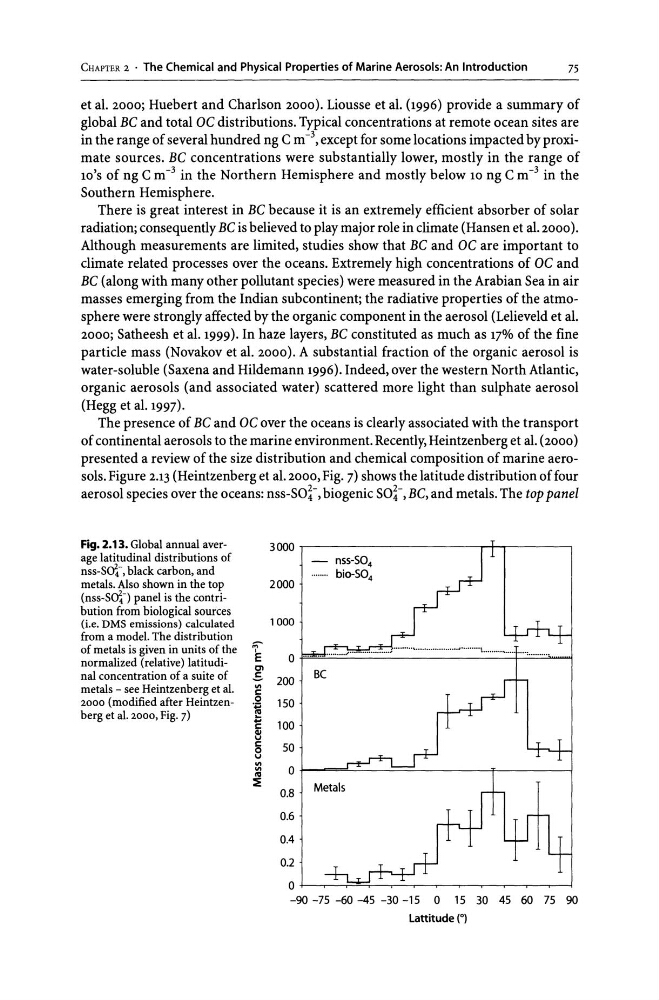
presented a review of ilie size distribution and chemical composition of marine aerosols. Figure 2.13 (Heintzenberg et al. 2000, Fig. 7) shows the latitude distribution of four
aerosol species over the oceans: nss-SO~-, biogenic SO~-, Be, and metals. The top panel
Fig. 2.13. Global annual average latitudinal distributions of
nss-So!-, black carbon, and
metals. Also shown in the top
(nss-So!-) panel is the contribution from biological sources
(Le. DMS emissions) calculated
from a model. The distribution
of metals is given in units of the
normalized (relative) latitudinal concentration of a suite of
metals - see Heintzenberg et al.
2000 (modified after Heintzenberg et al. 2000, Fig. 7)
i
C1
E.
VI
I:
.2 ...
~
... I: Qj v
I:
0
v
VI
VI
'"
::E
3000rl----------------------r+-.-------,
2000
1000
0
200 I
150
100
50
0
0.8
0.6
0.4
0.2
Be
nss-S0 4
bio-S0 4
01
---:
1
-90 -75 -60 -45 -30 -15 0 15 30 45 60 75 90
Lattitude (0)
75
et al. 2000; Huebert and Charlson 2000). Liousse et al. (1996) provide a summary of
global Be and total De distributions. Typical concentrations at remote ocean sites are
in the range of several hundred ng C m -3, except for some locations impacted by proximate sources. Be concentrations were substantially lower, mostly in the range of
lO'S of ng C m- 3 in the Northern Hemisphere and mostly below 10 ng C m- 3 in the
Southern Hemisphere.
There is great interest in Be because it is an extremely efficient absorber of solar
radiation; consequently Be is believed to play major role in climate (Hansen et al. 2000).
Aliliough measurements are limited, studies show that Be and De are important to
climate related processes over the oceans. Extremely high concentrations of DC and
Be (along with many oilier pollutant species) were measured in the Arabian Sea in air
masses emerging from the Indian subcontinent; the radiative properties of the atmosphere were strongly affected by the organic component in the aerosol (Lelieveld et al.
2000; Satheesh et al. 1999). In haze layers, BC constituted as much as 17% of the fine
particle mass (Novakov et al. 2000). A substantial fraction of the organic aerosol is
water-soluble (Saxena and Hildemann 1996). Indeed, over the western North Atlantic,
organic aerosols (and associated water) scattered more light than sulphate aerosol
(Hegg et al. 1997).
The presence of Be and De over the oceans is clearly associated with the transport
of continental aerosols to the marine environment. Recently, Heintzenberg et al. (2000)
presented a review of ilie size distribution and chemical composition of marine aerosols. Figure 2.13 (Heintzenberg et al. 2000, Fig. 7) shows the latitude distribution of four
aerosol species over the oceans: nss-SO~-, biogenic SO~-, Be, and metals. The top panel
Fig. 2.13. Global annual average latitudinal distributions of
nss-So!-, black carbon, and
metals. Also shown in the top
(nss-So!-) panel is the contribution from biological sources
(Le. DMS emissions) calculated
from a model. The distribution
of metals is given in units of the
normalized (relative) latitudinal concentration of a suite of
metals - see Heintzenberg et al.
2000 (modified after Heintzenberg et al. 2000, Fig. 7)
i
C1
E.
VI
I:
.2 ...
~
... I: Qj v
I:
0
v
VI
VI
'"
::E
3000rl----------------------r+-.-------,
2000
1000
0
200 I
150
100
50
0
0.8
0.6
0.4
0.2
Be
nss-S0 4
bio-S0 4
01
---:
1
-90 -75 -60 -45 -30 -15 0 15 30 45 60 75 90
Lattitude (0)