

72
J. M. Pro spero
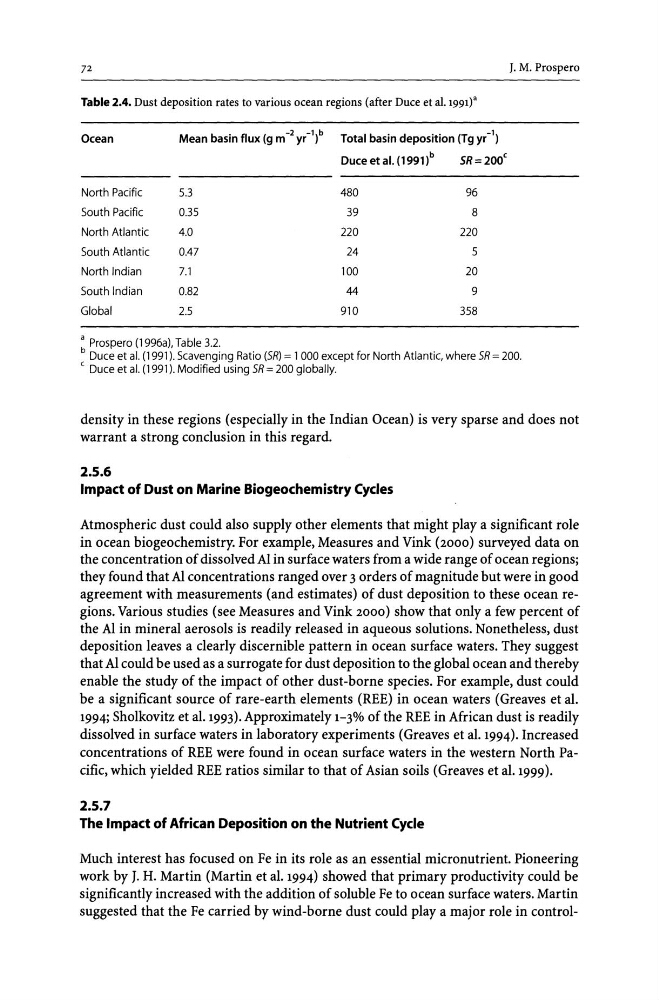
Table 2.4. Dust deposition rates to various ocean regions (after Duce et al.1991)'
Ocean
Mean basin flux (g m- 2 yr-')b
Total basin deposition (Tg yr-')
Duce et al. (1991)b
SR=200 c
North Pacific
5.3
480
96
South Pacific
0.35
39
8
North Atlantic
4.0
220
220
South Atlantic
0.47
24
5
North Indian
7.1
100
20
South Indian
0.82
44
9
Global
2.5
910
358
a Prospero (1996a), Table 3.2.
b Duce et al. (1991). Scavenging Ratio (SR) = 1 000 except for North Atlantic, where SR = 200.
eDuce et al. (1991 J. Modified using SR = 200 globally.
density in these regions (especially in the Indian Ocean) is very sparse and does not
warrant a strong conclusion in this regard.
2.5.6
Impact of Dust on Marine Biogeochemistry Cycles
Atmospheric dust could also supply other elements that might playa significant role
in ocean biogeochemistry. For example, Measures and Vink (2000) surveyed data on
the concentration of dissolved Al in surface waters from a wide range of ocean regions;
they found that AI concentrations ranged over 3 orders of magnitude but were in good
agreement with measurements (and estimates) of dust deposition to these ocean regions. Various studies (see Measures and Vink 2000) show that only a few percent of
the Al in mineral aerosols is readily released in aqueous solutions. Nonetheless, dust
deposition leaves a clearly discernible pattern in ocean surface waters. They suggest
that Al could be used as a surrogate for dust deposition to the global ocean and thereby
enable the study of the impact of other dust-borne species. For example, dust could
be a significant source of rare-earth elements (REE) in ocean waters (Greaves et al.
1994; Sholkovitz et al. 1993). Approximately 1-3% of the REE in African dust is readily
dissolved in surface waters in laboratory experiments (Greaves et al. 1994). Increased
concentrations of REE were found in ocean surface waters in the western North Pacific, which yielded REE ratios similar to that of Asian soils (Greaves et al. 1999).
2.5.7
The Impact of African Deposition on the Nutrient Cycle
Much interest has focused on Fe in its role as an essential micronutrient. Pioneering
work by J. H. Martin (Martin et al. 1994) showed that primary productivity could be
significantly increased with the addition of soluble Fe to ocean surface waters. Martin
suggested that the Fe carried by wind-borne dust could playa major role in control-
J. M. Pro spero
Table 2.4. Dust deposition rates to various ocean regions (after Duce et al.1991)'
Ocean
Mean basin flux (g m- 2 yr-')b
Total basin deposition (Tg yr-')
Duce et al. (1991)b
SR=200 c
North Pacific
5.3
480
96
South Pacific
0.35
39
8
North Atlantic
4.0
220
220
South Atlantic
0.47
24
5
North Indian
7.1
100
20
South Indian
0.82
44
9
Global
2.5
910
358
a Prospero (1996a), Table 3.2.
b Duce et al. (1991). Scavenging Ratio (SR) = 1 000 except for North Atlantic, where SR = 200.
eDuce et al. (1991 J. Modified using SR = 200 globally.
density in these regions (especially in the Indian Ocean) is very sparse and does not
warrant a strong conclusion in this regard.
2.5.6
Impact of Dust on Marine Biogeochemistry Cycles
Atmospheric dust could also supply other elements that might playa significant role
in ocean biogeochemistry. For example, Measures and Vink (2000) surveyed data on
the concentration of dissolved Al in surface waters from a wide range of ocean regions;
they found that AI concentrations ranged over 3 orders of magnitude but were in good
agreement with measurements (and estimates) of dust deposition to these ocean regions. Various studies (see Measures and Vink 2000) show that only a few percent of
the Al in mineral aerosols is readily released in aqueous solutions. Nonetheless, dust
deposition leaves a clearly discernible pattern in ocean surface waters. They suggest
that Al could be used as a surrogate for dust deposition to the global ocean and thereby
enable the study of the impact of other dust-borne species. For example, dust could
be a significant source of rare-earth elements (REE) in ocean waters (Greaves et al.
1994; Sholkovitz et al. 1993). Approximately 1-3% of the REE in African dust is readily
dissolved in surface waters in laboratory experiments (Greaves et al. 1994). Increased
concentrations of REE were found in ocean surface waters in the western North Pacific, which yielded REE ratios similar to that of Asian soils (Greaves et al. 1999).
2.5.7
The Impact of African Deposition on the Nutrient Cycle
Much interest has focused on Fe in its role as an essential micronutrient. Pioneering
work by J. H. Martin (Martin et al. 1994) showed that primary productivity could be
significantly increased with the addition of soluble Fe to ocean surface waters. Martin
suggested that the Fe carried by wind-borne dust could playa major role in control-