

CHAPTER 2 • The Chemical and Physical Properties of Marine Aerosols: An Introduction
53
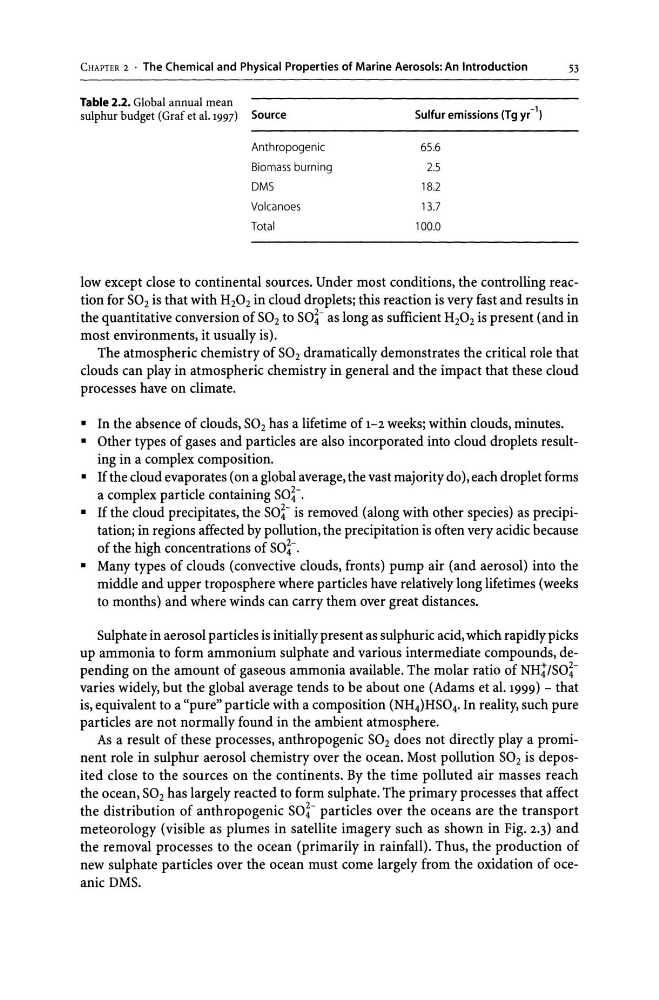
Table 2.2. Global annual mean
sulphur budget (Graf et al. 1997) Source
Anthropogenic
Biomass burning
DMS
Volcanoes
Total
Sulfur emissions (T9 yr-')
65.6
2.5
18.2
13.7
100.0
low except close to continental sources. Under most conditions, the controlling reaction for S02 is that with H20 2 in cloud droplets; this reaction is very fast and results in
the quantitative conversion of S02 to SO~- as long as sufficient H 2 0 2 is present (and in
most environments, it usually is).
The atmospheric chemistry of S02 dramatically demonstrates the critical role that
clouds can play in atmospheric chemistry in general and the impact that these cloud
processes have on climate.
• In the absence of clouds, S02 has a lifetime of 1-2 weeks; within clouds, minutes.
• Other types of gases and particles are also incorporated into cloud droplets resulting in a complex composition.
• If the cloud evaporates (on a global average, the vast majority do), each droplet forms
a complex particle containing SO~-.
• If the cloud precipitates, the SO~- is removed (along with other species) as precipitation; in regions affected by pollution, the precipitation is often very acidic because
of the high concentrations of SO~-.
• Many types of clouds (convective clouds, fronts) pump air (and aerosol) into the
middle and upper troposphere where particles have relatively long lifetimes (weeks
to months) and where winds can carry them over great distances.
Sulphate in aerosol particles is initially present as sulphuric acid, which rapidly picks
up ammonia to form ammonium sulphate and various intermediate compounds, depending on the amount of gaseous ammonia available. The molar ratio of NHrISO~varies widely, but the global average tends to be about one (Adams et al. 1999) - that
is, equivalent to a "pure" particle with a composition {NH4)HS04• In reality, such pure
particles are not normally found in the ambient atmosphere.
As a result of these processes, anthropogenic S02 does not directly playa prominent role in sulphur aerosol chemistry over the ocean. Most pollution S02 is deposited close to the sources on the continents. By the time polluted air masses reach
the ocean, S02 has largely reacted to form sulphate. The primary processes that affect
the distribution of anthropogenic SO~- particles over the oceans are the transport
meteorology (visible as plumes in satellite imagery such as shown in Fig. 2.3) and
the removal processes to the ocean (primarily in rainfall). Thus, the production of
new sulphate particles over the ocean must come largely from the oxidation of oceanic DMS.
53
Table 2.2. Global annual mean
sulphur budget (Graf et al. 1997) Source
Anthropogenic
Biomass burning
DMS
Volcanoes
Total
Sulfur emissions (T9 yr-')
65.6
2.5
18.2
13.7
100.0
low except close to continental sources. Under most conditions, the controlling reaction for S02 is that with H20 2 in cloud droplets; this reaction is very fast and results in
the quantitative conversion of S02 to SO~- as long as sufficient H 2 0 2 is present (and in
most environments, it usually is).
The atmospheric chemistry of S02 dramatically demonstrates the critical role that
clouds can play in atmospheric chemistry in general and the impact that these cloud
processes have on climate.
• In the absence of clouds, S02 has a lifetime of 1-2 weeks; within clouds, minutes.
• Other types of gases and particles are also incorporated into cloud droplets resulting in a complex composition.
• If the cloud evaporates (on a global average, the vast majority do), each droplet forms
a complex particle containing SO~-.
• If the cloud precipitates, the SO~- is removed (along with other species) as precipitation; in regions affected by pollution, the precipitation is often very acidic because
of the high concentrations of SO~-.
• Many types of clouds (convective clouds, fronts) pump air (and aerosol) into the
middle and upper troposphere where particles have relatively long lifetimes (weeks
to months) and where winds can carry them over great distances.
Sulphate in aerosol particles is initially present as sulphuric acid, which rapidly picks
up ammonia to form ammonium sulphate and various intermediate compounds, depending on the amount of gaseous ammonia available. The molar ratio of NHrISO~varies widely, but the global average tends to be about one (Adams et al. 1999) - that
is, equivalent to a "pure" particle with a composition {NH4)HS04• In reality, such pure
particles are not normally found in the ambient atmosphere.
As a result of these processes, anthropogenic S02 does not directly playa prominent role in sulphur aerosol chemistry over the ocean. Most pollution S02 is deposited close to the sources on the continents. By the time polluted air masses reach
the ocean, S02 has largely reacted to form sulphate. The primary processes that affect
the distribution of anthropogenic SO~- particles over the oceans are the transport
meteorology (visible as plumes in satellite imagery such as shown in Fig. 2.3) and
the removal processes to the ocean (primarily in rainfall). Thus, the production of
new sulphate particles over the ocean must come largely from the oxidation of oceanic DMS.