

40
Drop continues to grow
by collecting smallercloud
droplets already
acidified by nucleation
scavenging and aqueous
phase chemical reactions
Raindrop collects aerosol
and absorbs/desorbs
gases as it falls to
ground (below cloud
precipitationscavenging)
J. M. Pro spero
Cloud evaporates leaving behind
a "cloud" of aerosol particles
Droplet grows by condensation.
Ambient gases absorb in droplet
and activity is increased by
aqueous phase chemical reactions.
CCN dissolves in droplet
Cloud droplet
nucleates on a CCN
(nucleation scavenging)
Raindrops evaporate in dry air
below cloud to produce aerosol
particles + * ____
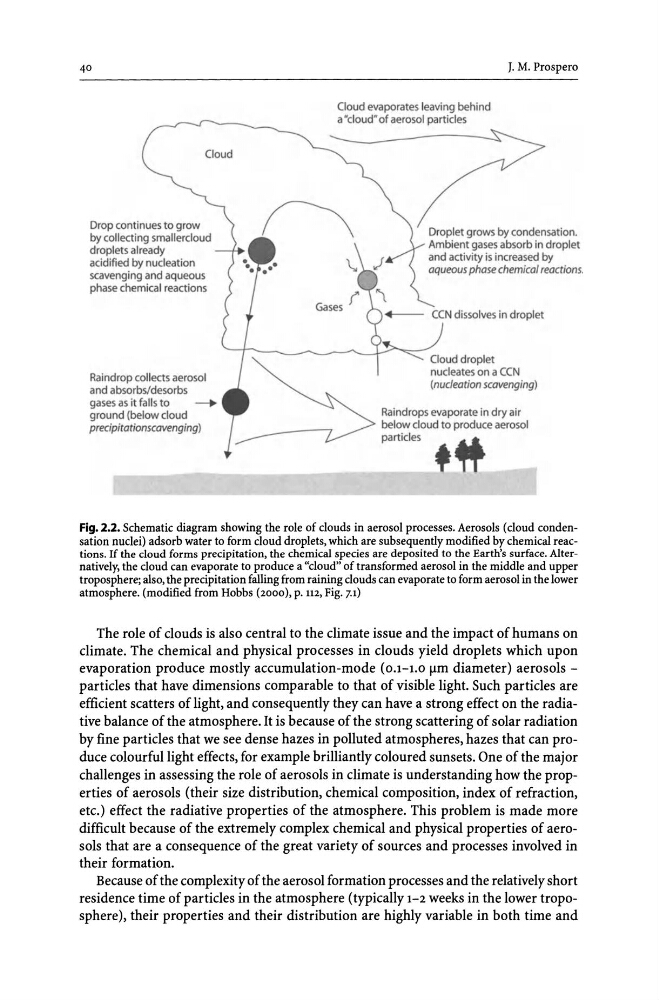
----~~~-----Fig. 2.2. Schematic diagram showing the role of clouds in aerosol processes. Aerosols (cloud condensation nuclei) adsorb water to form cloud droplets, which are subsequently modified by chemical reactions. If the cloud forms precipitation, the chemical species are deposited to the Earth's surface. Alternatively, the cloud can evaporate to produce a "cloud" of transformed aerosol in the middle and upper
troposphere; also, the precipitation falling from raining clouds can evaporate to form aerosol in the lower
atmosphere. (modified from Hobbs (2000), p. 112, Fig. 7.1)
The role of clouds is also central to the climate issue and the impact of humans on
climate. The chemical and physical processes in clouds yield droplets which upon
evaporation produce mostly accumulation-mode (0.1-1.0 !lm diameter) aerosols -
particles that have dimensions comparable to that of visible light. Such particles are
efficient scatters of light, and consequently they can have a strong effect on the radiative balance of the atmosphere. It is because of the strong scattering of solar radiation
by fine particles that we see dense hazes in polluted atmospheres, hazes that can produce colourful light effects, for example brilliantly coloured sunsets. One of the major
challenges in assessing the role of aerosols in climate is understanding how the properties of aerosols (their size distribution, chemical composition, index of refraction,
etc.) effect the radiative properties of the atmosphere. This problem is made more
difficult because of the extremely complex chemical and physical properties of aerosols that are a consequence of the great variety of sources and processes involved in
their formation.
Because of the complexity of the aerosol formation processes and the relatively short
residence time of particles in the atmosphere (typically 1-2 weeks in the lower troposphere), their properties and their distribution are highly variable in both time and
Drop continues to grow
by collecting smallercloud
droplets already
acidified by nucleation
scavenging and aqueous
phase chemical reactions
Raindrop collects aerosol
and absorbs/desorbs
gases as it falls to
ground (below cloud
precipitationscavenging)
J. M. Pro spero
Cloud evaporates leaving behind
a "cloud" of aerosol particles
Droplet grows by condensation.
Ambient gases absorb in droplet
and activity is increased by
aqueous phase chemical reactions.
CCN dissolves in droplet
Cloud droplet
nucleates on a CCN
(nucleation scavenging)
Raindrops evaporate in dry air
below cloud to produce aerosol
particles + * ____
----~~~-----Fig. 2.2. Schematic diagram showing the role of clouds in aerosol processes. Aerosols (cloud condensation nuclei) adsorb water to form cloud droplets, which are subsequently modified by chemical reactions. If the cloud forms precipitation, the chemical species are deposited to the Earth's surface. Alternatively, the cloud can evaporate to produce a "cloud" of transformed aerosol in the middle and upper
troposphere; also, the precipitation falling from raining clouds can evaporate to form aerosol in the lower
atmosphere. (modified from Hobbs (2000), p. 112, Fig. 7.1)
The role of clouds is also central to the climate issue and the impact of humans on
climate. The chemical and physical processes in clouds yield droplets which upon
evaporation produce mostly accumulation-mode (0.1-1.0 !lm diameter) aerosols -
particles that have dimensions comparable to that of visible light. Such particles are
efficient scatters of light, and consequently they can have a strong effect on the radiative balance of the atmosphere. It is because of the strong scattering of solar radiation
by fine particles that we see dense hazes in polluted atmospheres, hazes that can produce colourful light effects, for example brilliantly coloured sunsets. One of the major
challenges in assessing the role of aerosols in climate is understanding how the properties of aerosols (their size distribution, chemical composition, index of refraction,
etc.) effect the radiative properties of the atmosphere. This problem is made more
difficult because of the extremely complex chemical and physical properties of aerosols that are a consequence of the great variety of sources and processes involved in
their formation.
Because of the complexity of the aerosol formation processes and the relatively short
residence time of particles in the atmosphere (typically 1-2 weeks in the lower troposphere), their properties and their distribution are highly variable in both time and