

38
Condensation
0.001
0,01
Chemical conversation
of gases to low
valatility vapours
Low
volatility
vapour
Homogeneous
nucleation
+
Condensation
Growth of nuclei
. .
0.1
i
Particle diameter (J,lm) I
i
Wind blown dust
+
Emissions
+
Sea spray
+
Volcanoes
+
Plant particles
10
J. M. Prospero
100
. - - - Transient nuclei or __ ~+-- Accumulation ~.-- Mechanically generated ------.
Aitken nuclei range ~
range
i
aerosol range
..... 1.. ...
•
Fine particles
,11··T .....
Coarse particles
•
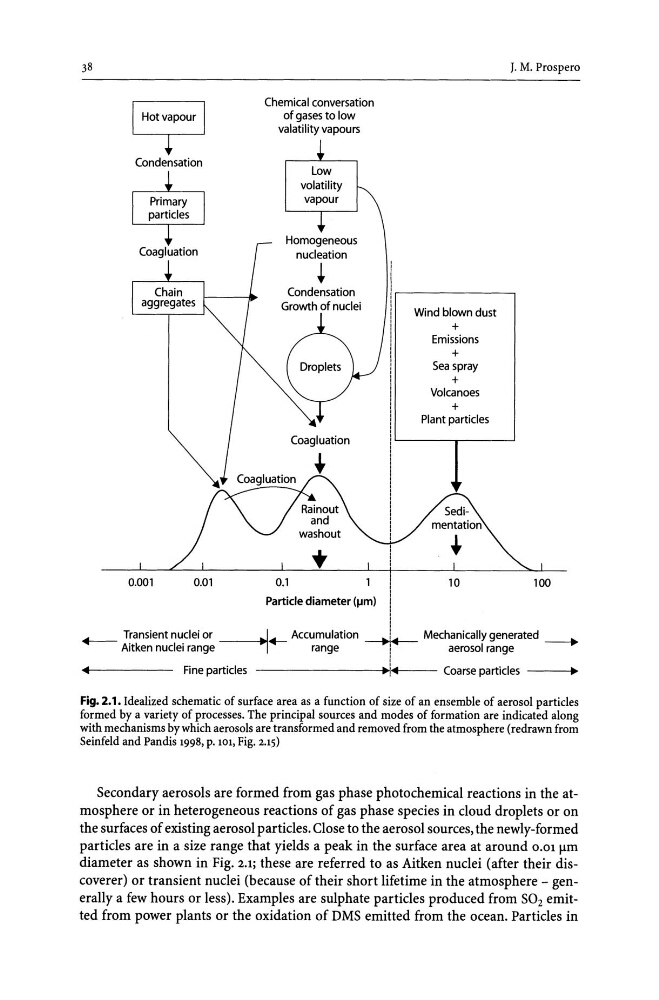
Fig. 2.1. Idealized schematic of surface area as a function of size of an ensemble of aerosol particles
formed by a variety of processes. The principal sources and modes of formation are indicated along
with mechanisms by which aerosols are transformed and removed from the atmosphere (redrawn from
Seinfeld and Pandis 1998, p. 101, Fig. 2.15)
Secondary aerosols are formed from gas phase photochemical reactions in the atmosphere or in heterogeneous reactions of gas phase species in cloud droplets or on
the surfaces of existing aerosol particles. Close to the aerosol sources, the newly-formed
particles are in a size range that yields a peak in the surface area at around 0.01 flm
diameter as shown in Fig. 2.1; these are referred to as Aitken nuclei (after their discoverer) or transient nuclei (because of their short lifetime in the atmosphere - generallya few hours or less). Examples are sulphate particles produced from S02 emitted from power plants or the oxidation of DMS emitted from the ocean. Particles in
Condensation
0.001
0,01
Chemical conversation
of gases to low
valatility vapours
Low
volatility
vapour
Homogeneous
nucleation
+
Condensation
Growth of nuclei
. .
0.1
i
Particle diameter (J,lm) I
i
Wind blown dust
+
Emissions
+
Sea spray
+
Volcanoes
+
Plant particles
10
J. M. Prospero
100
. - - - Transient nuclei or __ ~+-- Accumulation ~.-- Mechanically generated ------.
Aitken nuclei range ~
range
i
aerosol range
..... 1.. ...
•
Fine particles
,11··T .....
Coarse particles
•
Fig. 2.1. Idealized schematic of surface area as a function of size of an ensemble of aerosol particles
formed by a variety of processes. The principal sources and modes of formation are indicated along
with mechanisms by which aerosols are transformed and removed from the atmosphere (redrawn from
Seinfeld and Pandis 1998, p. 101, Fig. 2.15)
Secondary aerosols are formed from gas phase photochemical reactions in the atmosphere or in heterogeneous reactions of gas phase species in cloud droplets or on
the surfaces of existing aerosol particles. Close to the aerosol sources, the newly-formed
particles are in a size range that yields a peak in the surface area at around 0.01 flm
diameter as shown in Fig. 2.1; these are referred to as Aitken nuclei (after their discoverer) or transient nuclei (because of their short lifetime in the atmosphere - generallya few hours or less). Examples are sulphate particles produced from S02 emitted from power plants or the oxidation of DMS emitted from the ocean. Particles in