

CHAPTER 21 • Solid Speciation and Selective Extraction Procedures
457
of metals oxalate can occur, also at low pH. Dithionite-citrate reagent dissolves oxides
and hydroxides, but can also attack iron rich silicates. Therefore, no reducing agent is
either selective or completely efficient. Oxidizing agents destroy organic matter and
transform sulphides into sulphates. The reagents most widely used are acidic hydrogen peroxide and sodium hypochlorite, and to a less extent, 8 M nitric acid. Residual
fraction is usually extracted using the same reagents utilized for the total solubilization, a mixture of strong acids, with or without fluoridric acid, in closed systems at
high temperature (usually microwaves ovens). Alternatively, the amount of metals
bonded to the residue can be estimated by the difference between the total content
and the sum of the amount extracted in the various selective steps.
21.4
Case Studies
Some case studies will be described and commented on to show how selective extraction
can be a useful indication concerning metal solid speciation and how this information
completes data on the metal content of marine sediments. In some cases, data on
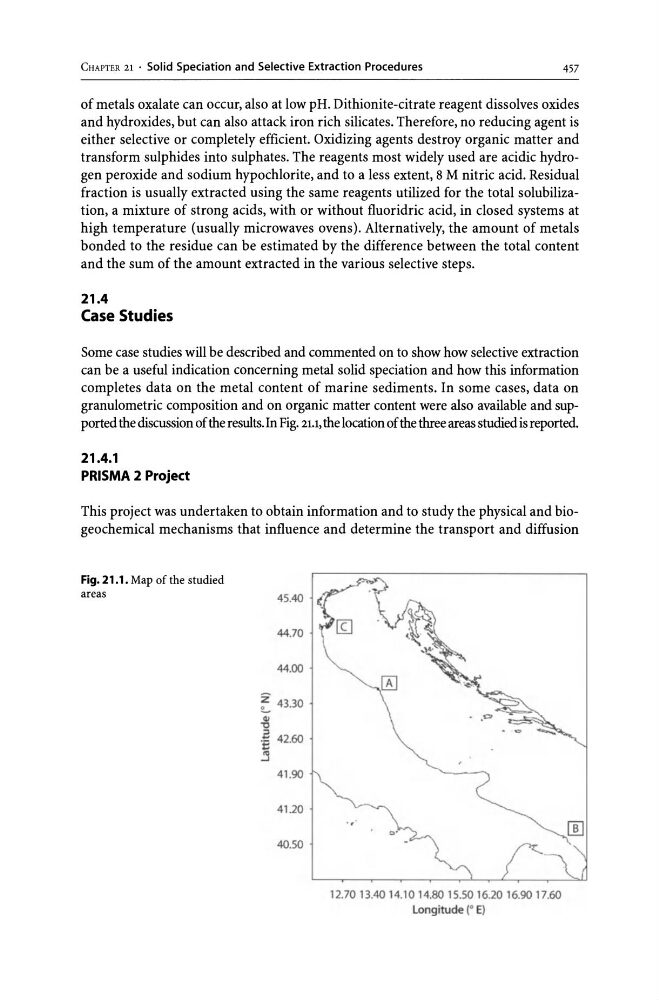
granulometric composition and on organic matter content were also available and supported the discussion of the results. In Fig. 21.1, the location of the three areas studied is reported.
21.4.1
PRISMA 2 Project
This project was undertaken to obtain information and to study the physical and biogeochemical mechanisms that influence and determine the transport and diffusion
Fig. 21.1. Map of the studied
areas
45.40
44.70
44.00
Z 43.30
L
E 42.60
"f
j
41.90
41.20
40.50
., '
co·
12.7013.40 14.1014.80 15.50 16.2016.90 17.60
longitude (0 E)
[[]
457
of metals oxalate can occur, also at low pH. Dithionite-citrate reagent dissolves oxides
and hydroxides, but can also attack iron rich silicates. Therefore, no reducing agent is
either selective or completely efficient. Oxidizing agents destroy organic matter and
transform sulphides into sulphates. The reagents most widely used are acidic hydrogen peroxide and sodium hypochlorite, and to a less extent, 8 M nitric acid. Residual
fraction is usually extracted using the same reagents utilized for the total solubilization, a mixture of strong acids, with or without fluoridric acid, in closed systems at
high temperature (usually microwaves ovens). Alternatively, the amount of metals
bonded to the residue can be estimated by the difference between the total content
and the sum of the amount extracted in the various selective steps.
21.4
Case Studies
Some case studies will be described and commented on to show how selective extraction
can be a useful indication concerning metal solid speciation and how this information
completes data on the metal content of marine sediments. In some cases, data on
granulometric composition and on organic matter content were also available and supported the discussion of the results. In Fig. 21.1, the location of the three areas studied is reported.
21.4.1
PRISMA 2 Project
This project was undertaken to obtain information and to study the physical and biogeochemical mechanisms that influence and determine the transport and diffusion
Fig. 21.1. Map of the studied
areas
45.40
44.70
44.00
Z 43.30
L
E 42.60
"f
j
41.90
41.20
40.50
., '
co·
12.7013.40 14.1014.80 15.50 16.2016.90 17.60
longitude (0 E)
[[]