

446
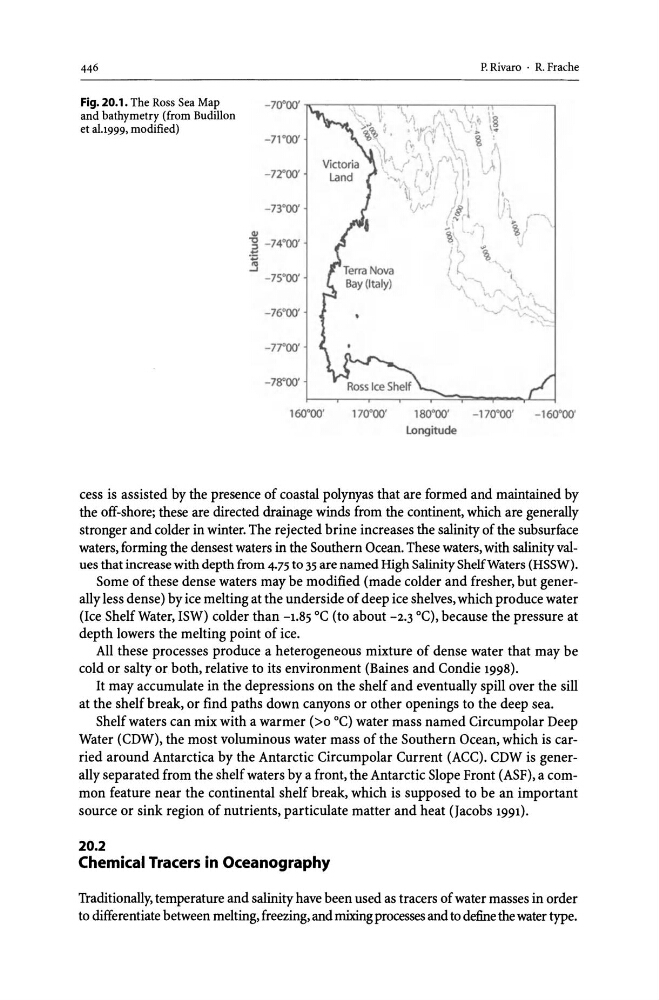
Fig. 20.1. The Ross Sea Map
and bathymetry (from Budillon
et al.1999, modified)
P. Rivaro . R. Frache
...
I,!_
(L
\t
70"00'
,.
':
\.
(.""
\f ~ I§
-
I\.'~. \' "", I\'~" ~'" I ..
'-'~ I
. • J-' r \ I
""
.
~, ' , : 71"; 1 \\ ~ ·f,
- 71 ·00'
_72°00'
- 73"00'
GI
"C -74.00'
i
:3
- 75°00'
- 76"00'
-n ·oo'
- 7S·00'
160·00'
t ~ ~1
,,"",
( \
\~,'\. ; "") \ /"\ 'i \ l./~ )
--....., r~' J 711
....... L L ,,'
170"00'
i\ ·v./ j I
\l i (i l
(J.:r
"i .
I ... .
'j
r:
,l -""
~i
% \
~
I
\
% '
,i" %
i I
'.'
I " .
,
\..,,\ ~ '"' \ ..
- ... 1 - "r. I
' \ ~ ,-._\~ .... "'-....
'-.J
~~,~
lS0·00'
Longitude
.,,~
- 1 70°00'
- 160·00'
cess is assisted by the presence of coastal polynyas that are formed and maintained by
the off-shore; these are directed drainage winds from the continent, which are generally
stronger and colder in winter. The rejected brine increases the salinity of the subsurface
waters, forming the densest waters in the Southern Ocean. These waters, with salinity values that increase with depth from 4.75 to 35 are named High Salinity Shelf Waters (HSSW).
Some of these dense waters may be modified (made colder and fresher, but generally less dense) by ice melting at the underside of deep ice shelves, which produce water
(Ice Shelf Water, ISW) colder than -1.85 °C (to about -2.3 0C), because the pressure at
depth lowers the melting point of ice.
All these processes produce a heterogeneous mixture of dense water that may be
cold or salty or both, relative to its environment (Baines and Condie 1998).
It may accumulate in the depressions on the shelf and eventually spill over the sill
at the shelf break, or find paths down canyons or other openings to the deep sea.
Shelf waters can mix with a warmer (>0 °C) water mass named Circumpolar Deep
Water (CDW), the most voluminous water mass of the Southern Ocean, which is carried around Antarctica by the Antarctic Circumpolar Current (ACC). CDW is generally separated from the shelf waters by a front, the Antarctic Slope Front (ASF), a common feature near the continental shelf break, which is supposed to be an important
source or sink region of nutrients, particulate matter and heat (Jacobs 1991).
20.2
Chemical Tracers in Oceanography
Traditionally, temperature and salinity have been used as tracers of water masses in order
to differentiate between melting, freezing, and mixing processes and to define the water type.
Fig. 20.1. The Ross Sea Map
and bathymetry (from Budillon
et al.1999, modified)
P. Rivaro . R. Frache
...
I,!_
(L
\t
70"00'
,.
':
\.
(.""
\f ~ I§
-
I\.'~. \' "", I\'~" ~'" I ..
'-'~ I
. • J-' r \ I
""
.
~, ' , : 71"; 1 \\ ~ ·f,
- 71 ·00'
_72°00'
- 73"00'
GI
"C -74.00'
i
:3
- 75°00'
- 76"00'
-n ·oo'
- 7S·00'
160·00'
t ~ ~1
,,"",
( \
\~,'\. ; "") \ /"\ 'i \ l./~ )
--....., r~' J 711
....... L L ,,'
170"00'
i\ ·v./ j I
\l i (i l
(J.:r
"i .
I ... .
'j
r:
,l -""
~i
% \
~
I
\
% '
,i" %
i I
'.'
I " .
,
\..,,\ ~ '"' \ ..
- ... 1 - "r. I
' \ ~ ,-._\~ .... "'-....
'-.J
~~,~
lS0·00'
Longitude
.,,~
- 1 70°00'
- 160·00'
cess is assisted by the presence of coastal polynyas that are formed and maintained by
the off-shore; these are directed drainage winds from the continent, which are generally
stronger and colder in winter. The rejected brine increases the salinity of the subsurface
waters, forming the densest waters in the Southern Ocean. These waters, with salinity values that increase with depth from 4.75 to 35 are named High Salinity Shelf Waters (HSSW).
Some of these dense waters may be modified (made colder and fresher, but generally less dense) by ice melting at the underside of deep ice shelves, which produce water
(Ice Shelf Water, ISW) colder than -1.85 °C (to about -2.3 0C), because the pressure at
depth lowers the melting point of ice.
All these processes produce a heterogeneous mixture of dense water that may be
cold or salty or both, relative to its environment (Baines and Condie 1998).
It may accumulate in the depressions on the shelf and eventually spill over the sill
at the shelf break, or find paths down canyons or other openings to the deep sea.
Shelf waters can mix with a warmer (>0 °C) water mass named Circumpolar Deep
Water (CDW), the most voluminous water mass of the Southern Ocean, which is carried around Antarctica by the Antarctic Circumpolar Current (ACC). CDW is generally separated from the shelf waters by a front, the Antarctic Slope Front (ASF), a common feature near the continental shelf break, which is supposed to be an important
source or sink region of nutrients, particulate matter and heat (Jacobs 1991).
20.2
Chemical Tracers in Oceanography
Traditionally, temperature and salinity have been used as tracers of water masses in order
to differentiate between melting, freezing, and mixing processes and to define the water type.