

CHAPTER 19 . Palaeoenvironmental Reconstructions
431
2 200-m deep basin is restricted, and bottom waters (:<:120 m) are permanently anoxic.
During a cruise to the Black Sea in 1988, organic geochemists and microbiologists were
surprised to discover that the oxic-anoxic boundary in the water column (the "chemodine") was located well within in the photic zone (Murray et al.1989). Associated with
the chemodine were concentration maxima for bacteriochlorophyll e and carotenoid
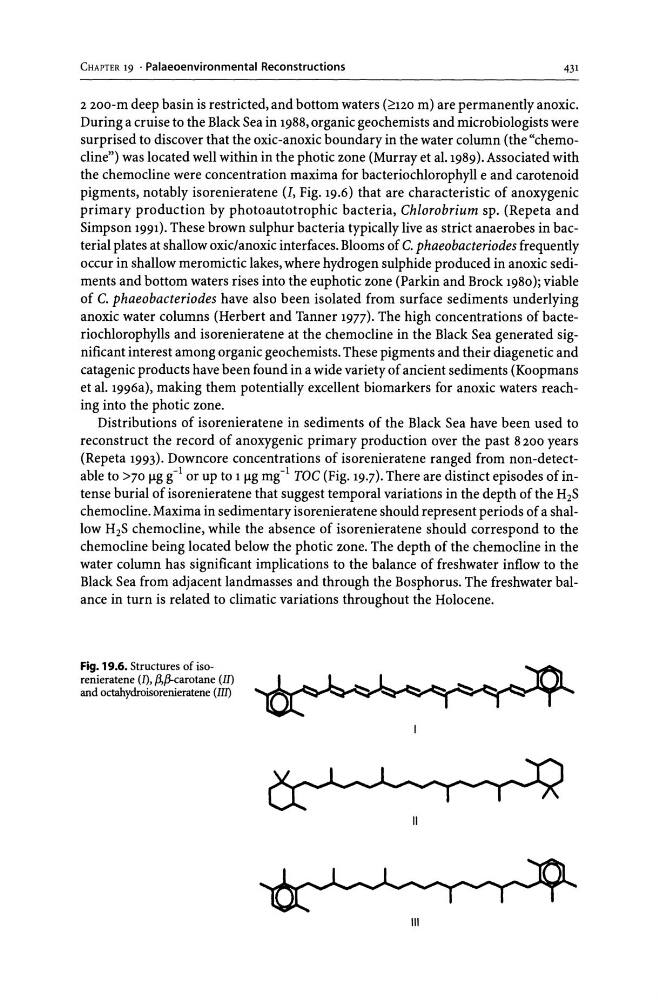
pigments, notably isorenieratene (1, Fig. 19.6) that are characteristic of an oxygenic
primary production by photoautotrophic bacteria, Chlorobrium sp. (Repeta and
Simpson 1991). These brown sulphur bacteria typically live as strict anaerobes in bacterial plates at shallow oxic/anoxic interfaces. Blooms of C. phaeobacteriodes frequently
occur in shallow meromictic lakes, where hydrogen sulphide produced in anoxic sediments and bottom waters rises into the euphotic zone (Parkin and Brock 1980); viable
of C. phaeobacteriodes have also been isolated from surface sediments underlying
anoxic water columns (Herbert and Tanner 1977). The high concentrations of bacteriochlorophylls and isorenieratene at the chemodine in the Black Sea generated significant interest among organic geochemists. These pigments and their diagenetic and
catagenic products have been found in a wide variety of ancient sediments (Koopmans
et al. 1996a), making them potentially excellent biomarkers for anoxic waters reaching into the photic zone.
Distributions of isorenieratene in sediments of the Black Sea have been used to
reconstruct the record of anoxygenic primary production over the past 8200 years
(Repeta 1993). Downcore concentrations of isorenieratene ranged from non-detectable to >70 Ilg g-l or up to 11lg mg- 1 TOC (Fig. 19.7). There are distinct episodes of intense burial of isorenieratene that suggest temporal variations in the depth of the H 2 S
chemodine. Maxima in sedimentary isorenieratene should represent periods of a shallow H2S chemodine, while the absence of isorenieratene should correspond to the
chemodine being located below the photic zone. The depth of the chemodine in the
water column has significant implications to the balance of freshwater inflow to the
Black Sea from adjacent landmasses and through the Bosphorus. The freshwater balance in turn is related to dimatic variations throughout the Holocene.
Fig. 19.6. Structures of isorenieratene (1), f3,~carotane (II)
and octahydroisorenieratene (III)
II
III
431
2 200-m deep basin is restricted, and bottom waters (:<:120 m) are permanently anoxic.
During a cruise to the Black Sea in 1988, organic geochemists and microbiologists were
surprised to discover that the oxic-anoxic boundary in the water column (the "chemodine") was located well within in the photic zone (Murray et al.1989). Associated with
the chemodine were concentration maxima for bacteriochlorophyll e and carotenoid
pigments, notably isorenieratene (1, Fig. 19.6) that are characteristic of an oxygenic
primary production by photoautotrophic bacteria, Chlorobrium sp. (Repeta and
Simpson 1991). These brown sulphur bacteria typically live as strict anaerobes in bacterial plates at shallow oxic/anoxic interfaces. Blooms of C. phaeobacteriodes frequently
occur in shallow meromictic lakes, where hydrogen sulphide produced in anoxic sediments and bottom waters rises into the euphotic zone (Parkin and Brock 1980); viable
of C. phaeobacteriodes have also been isolated from surface sediments underlying
anoxic water columns (Herbert and Tanner 1977). The high concentrations of bacteriochlorophylls and isorenieratene at the chemodine in the Black Sea generated significant interest among organic geochemists. These pigments and their diagenetic and
catagenic products have been found in a wide variety of ancient sediments (Koopmans
et al. 1996a), making them potentially excellent biomarkers for anoxic waters reaching into the photic zone.
Distributions of isorenieratene in sediments of the Black Sea have been used to
reconstruct the record of anoxygenic primary production over the past 8200 years
(Repeta 1993). Downcore concentrations of isorenieratene ranged from non-detectable to >70 Ilg g-l or up to 11lg mg- 1 TOC (Fig. 19.7). There are distinct episodes of intense burial of isorenieratene that suggest temporal variations in the depth of the H 2 S
chemodine. Maxima in sedimentary isorenieratene should represent periods of a shallow H2S chemodine, while the absence of isorenieratene should correspond to the
chemodine being located below the photic zone. The depth of the chemodine in the
water column has significant implications to the balance of freshwater inflow to the
Black Sea from adjacent landmasses and through the Bosphorus. The freshwater balance in turn is related to dimatic variations throughout the Holocene.
Fig. 19.6. Structures of isorenieratene (1), f3,~carotane (II)
and octahydroisorenieratene (III)
II
III