

CHAPTER 17 . Luminescence for the Analysis of Organic Compounds in Natural Waters
409
quence and consequently of the reporter gene in a quantitative manner, followed by
the synthesis of the corresponding protein. Luc and lux genes encoding firefly and
marine bacteria luciferases, respectively, are widely used as reporters. When the corresponding luciferin substrate is either added or produced by the recombinant cells, a
luciferin/luciferase-mediated light output occurs. The light emission intensity is proportional to the analyte concentration, which allows quantitative analysis to be performed. The use of enzymes as reporter molecules permits the analytical signal amplification, which combined with the high detectability of bioluminescent reactions,
lowers the detection limit of the system. Recently, the genes encoding two naturally
occurring and recombinantly produced luminescent proteins from the jellyfish
Aequorea victoria, i.e. aequorin and green fluorescent protein (GFP), have been used
as reporter genes in the development of recombinant cell-based biosensors. Aequorin
is naturally bioluminescent upon binding to Ca 2 + ions and has virtually no associated
background signal, thus allowing highly sensitive detection. GFP is an autofluorescent
protein that does not require addition of substrates or co-factors. These characteristics made the use of these photoproteins very attractive in diverse analytical applications (Shetty et al. 1999; Lewis and Daunert 2000).
17.3.1
Applications
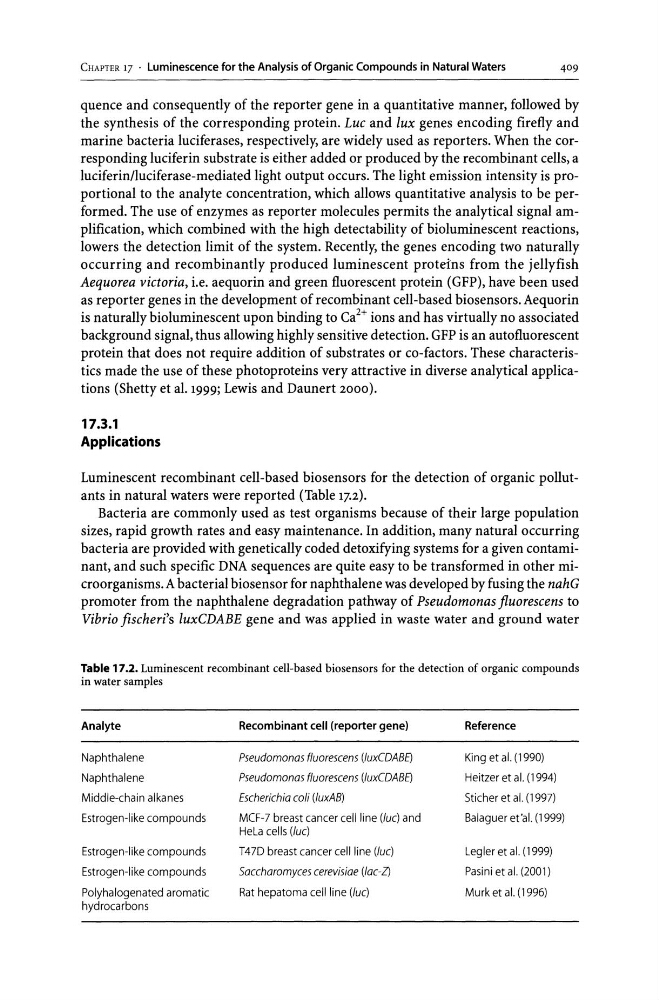
Luminescent recombinant cell-based biosensors for the detection of organic pollutants in natural waters were reported (Table 17.2).
Bacteria are commonly used as test organisms because of their large population
sizes, rapid growth rates and easy maintenance. In addition, many natural occurring
bacteria are provided with genetically coded detoxifying systems for a given contaminant, and such specific DNA sequences are quite easy to be transformed in other microorganisms. A bacterial biosensor for naphthalene was developed by fusing the nahG
promoter from the naphthalene degradation pathway of Pseudomonas fluorescens to
Vibrio fischeri's luxCDABE gene and was applied in waste water and ground water
Table 17.2. Luminescent recombinant cell-based biosensors for the detection of organic compounds
in water samples
Analyte
Recombinant cell (reporter gene)
Reference
Naphthalene
Pseudomonas fluorescens (fuxCDABE)
King et al. (1990)
Naphthalene
Pseudomonas fluorescens (fuxCDABE)
Heitzer et al. (1994)
Middle-chain alkanes
Escherichia coli (fuxAB)
Sticher et al. (1997)
Estrogen-like compounds
MCF-7 breast cancer cell line (fuc) and
Balaguer et'al. (1999)
HeLa cells (fuc)
Estrogen-like compounds
T47D breast cancer cell line (fuc)
Legler et al. (1999)
Estrogen-like compounds
Saccharomyces cerevisiae (fac-Z)
Pasini et al. (2001)
Polyhalogenated aromatic
Rat hepatoma cell line (fue)
Murk et al. (1996)
hyd roca rbons
409
quence and consequently of the reporter gene in a quantitative manner, followed by
the synthesis of the corresponding protein. Luc and lux genes encoding firefly and
marine bacteria luciferases, respectively, are widely used as reporters. When the corresponding luciferin substrate is either added or produced by the recombinant cells, a
luciferin/luciferase-mediated light output occurs. The light emission intensity is proportional to the analyte concentration, which allows quantitative analysis to be performed. The use of enzymes as reporter molecules permits the analytical signal amplification, which combined with the high detectability of bioluminescent reactions,
lowers the detection limit of the system. Recently, the genes encoding two naturally
occurring and recombinantly produced luminescent proteins from the jellyfish
Aequorea victoria, i.e. aequorin and green fluorescent protein (GFP), have been used
as reporter genes in the development of recombinant cell-based biosensors. Aequorin
is naturally bioluminescent upon binding to Ca 2 + ions and has virtually no associated
background signal, thus allowing highly sensitive detection. GFP is an autofluorescent
protein that does not require addition of substrates or co-factors. These characteristics made the use of these photoproteins very attractive in diverse analytical applications (Shetty et al. 1999; Lewis and Daunert 2000).
17.3.1
Applications
Luminescent recombinant cell-based biosensors for the detection of organic pollutants in natural waters were reported (Table 17.2).
Bacteria are commonly used as test organisms because of their large population
sizes, rapid growth rates and easy maintenance. In addition, many natural occurring
bacteria are provided with genetically coded detoxifying systems for a given contaminant, and such specific DNA sequences are quite easy to be transformed in other microorganisms. A bacterial biosensor for naphthalene was developed by fusing the nahG
promoter from the naphthalene degradation pathway of Pseudomonas fluorescens to
Vibrio fischeri's luxCDABE gene and was applied in waste water and ground water
Table 17.2. Luminescent recombinant cell-based biosensors for the detection of organic compounds
in water samples
Analyte
Recombinant cell (reporter gene)
Reference
Naphthalene
Pseudomonas fluorescens (fuxCDABE)
King et al. (1990)
Naphthalene
Pseudomonas fluorescens (fuxCDABE)
Heitzer et al. (1994)
Middle-chain alkanes
Escherichia coli (fuxAB)
Sticher et al. (1997)
Estrogen-like compounds
MCF-7 breast cancer cell line (fuc) and
Balaguer et'al. (1999)
HeLa cells (fuc)
Estrogen-like compounds
T47D breast cancer cell line (fuc)
Legler et al. (1999)
Estrogen-like compounds
Saccharomyces cerevisiae (fac-Z)
Pasini et al. (2001)
Polyhalogenated aromatic
Rat hepatoma cell line (fue)
Murk et al. (1996)
hyd roca rbons