

CHAPTER 17 . Luminescence for the Analysis of Organic Compounds in Natural Waters
405
usually higher than that of colourimetric immunoassays. In many cases, the sensitivity of chemiluminescent immunoassays is comparable to or even better than that obtained with radioactive labels. This trend was clearly demonstrated by the comparison of the detection limits obtained in the colourimetric, luminescent and radio-immunological determination of steroids in real samples, like plasma and saliva (Roda
et al. 1984). It should be noted that saliva has a composition resembling quite closely
that of surface waters, thus suggesting the convenient applicability of chemiluminescent immunoassays to natural water samples. In addition, luminescent detection is
generally characterized by a rapid response, and its dynamic range can be linear for
up to 5 decades of concentration. Electrochemiluminescence represents an alternative
way to implement luminescent detection in immunoassays. This technique offers the
advantage that the luminescent signal is triggered by the application of a suitable potential rather than by the addition of a chemiluminescent reagent, thus reducing problems related to signal handling or to the background emission shown by some chemiluminescent substrates. Time-resolved fluorescence measurement techniques represent an improvement over the conventional fluorescent detection. Fluorescence potentially allows a high detectability, but its sensitivity is reduced by the presence of a
background emission, which is mainly due to the excitation of the biological components of the sample. Time-resolved fluorescence detection, in which the measurement
of the emission is delayed with respect to the excitation of the sample and long-lived
luminescent labels are used, allows one to efficiently suppress the background emission, thus increasing the detectability of the luminescent probe.
17.2.2
Applications
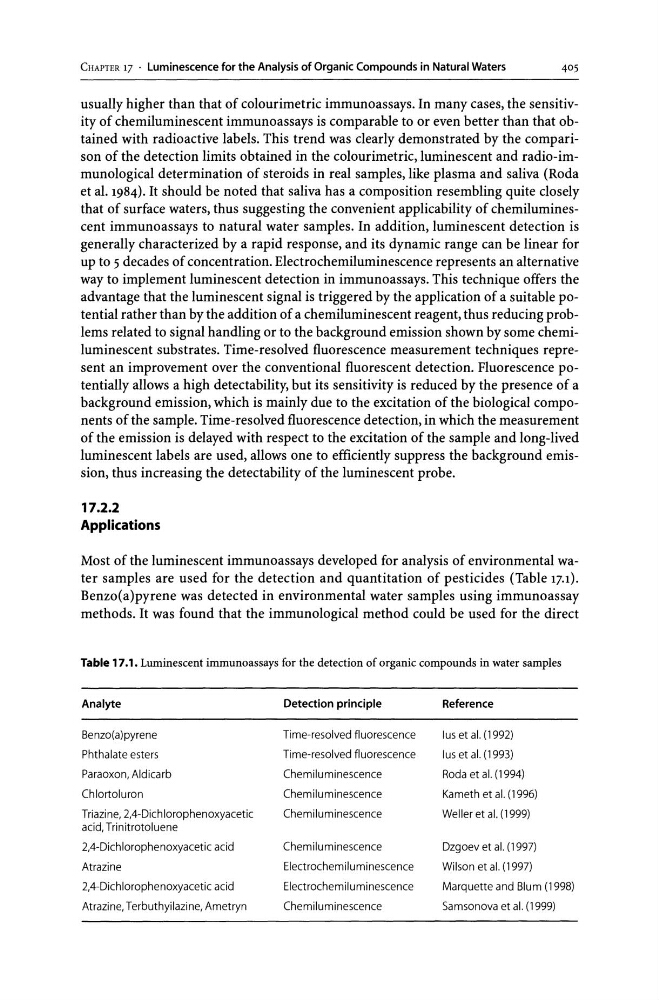
Most of the luminescent immunoassays developed for analysis of environmental water samples are used for the detection and quantitation of pesticides (Table 17.1).
Benzo(a)pyrene was detected in environmental water samples using immunoassay
methods. It was found that the immunological method could be used for the direct
Table 17.1. Luminescent immunoassays for the detection of organic compounds in water samples
Analyte
Detection principle
Reference
Benzo(a)pyrene
Time-resolved fluorescence
Ius et al. (1992)
Phthalate esters
Time-resolved fluorescence
Ius et al. (1993)
Paraoxon, Aldicarb
Chemiluminescence
Roda et al. (1994)
Chlortoluron
Chemiluminescence
Kameth et al. (1996)
Triazine,2A-Dichlorophenoxyacetic
Chemiluminescence
Weller et al. (1999)
acid, Trinitrotoluene
2A-Dichlorophenoxyacetic acid
Chemiluminescence
Dzgoev et al. (1997)
Atrazine
Electrochemiluminescence
Wilson et al. (1997)
2,4-Dichlorophenoxyacetic acid
Electrochemiluminescence
Marquette and Blum (1998)
Atrazine, Terbuthyilazine, Ametryn
Chemiluminescence
Samsonova et al. (1999)
405
usually higher than that of colourimetric immunoassays. In many cases, the sensitivity of chemiluminescent immunoassays is comparable to or even better than that obtained with radioactive labels. This trend was clearly demonstrated by the comparison of the detection limits obtained in the colourimetric, luminescent and radio-immunological determination of steroids in real samples, like plasma and saliva (Roda
et al. 1984). It should be noted that saliva has a composition resembling quite closely
that of surface waters, thus suggesting the convenient applicability of chemiluminescent immunoassays to natural water samples. In addition, luminescent detection is
generally characterized by a rapid response, and its dynamic range can be linear for
up to 5 decades of concentration. Electrochemiluminescence represents an alternative
way to implement luminescent detection in immunoassays. This technique offers the
advantage that the luminescent signal is triggered by the application of a suitable potential rather than by the addition of a chemiluminescent reagent, thus reducing problems related to signal handling or to the background emission shown by some chemiluminescent substrates. Time-resolved fluorescence measurement techniques represent an improvement over the conventional fluorescent detection. Fluorescence potentially allows a high detectability, but its sensitivity is reduced by the presence of a
background emission, which is mainly due to the excitation of the biological components of the sample. Time-resolved fluorescence detection, in which the measurement
of the emission is delayed with respect to the excitation of the sample and long-lived
luminescent labels are used, allows one to efficiently suppress the background emission, thus increasing the detectability of the luminescent probe.
17.2.2
Applications
Most of the luminescent immunoassays developed for analysis of environmental water samples are used for the detection and quantitation of pesticides (Table 17.1).
Benzo(a)pyrene was detected in environmental water samples using immunoassay
methods. It was found that the immunological method could be used for the direct
Table 17.1. Luminescent immunoassays for the detection of organic compounds in water samples
Analyte
Detection principle
Reference
Benzo(a)pyrene
Time-resolved fluorescence
Ius et al. (1992)
Phthalate esters
Time-resolved fluorescence
Ius et al. (1993)
Paraoxon, Aldicarb
Chemiluminescence
Roda et al. (1994)
Chlortoluron
Chemiluminescence
Kameth et al. (1996)
Triazine,2A-Dichlorophenoxyacetic
Chemiluminescence
Weller et al. (1999)
acid, Trinitrotoluene
2A-Dichlorophenoxyacetic acid
Chemiluminescence
Dzgoev et al. (1997)
Atrazine
Electrochemiluminescence
Wilson et al. (1997)
2,4-Dichlorophenoxyacetic acid
Electrochemiluminescence
Marquette and Blum (1998)
Atrazine, Terbuthyilazine, Ametryn
Chemiluminescence
Samsonova et al. (1999)