

CHAPTER 16 . Flow Injection Techniques for the in situ Monitoring of Marine Processes
389
only be made by direct measurements. Iron removal in surface waters is thought to be
dominated by biological processes. A schematic of sources, transport and reactivity
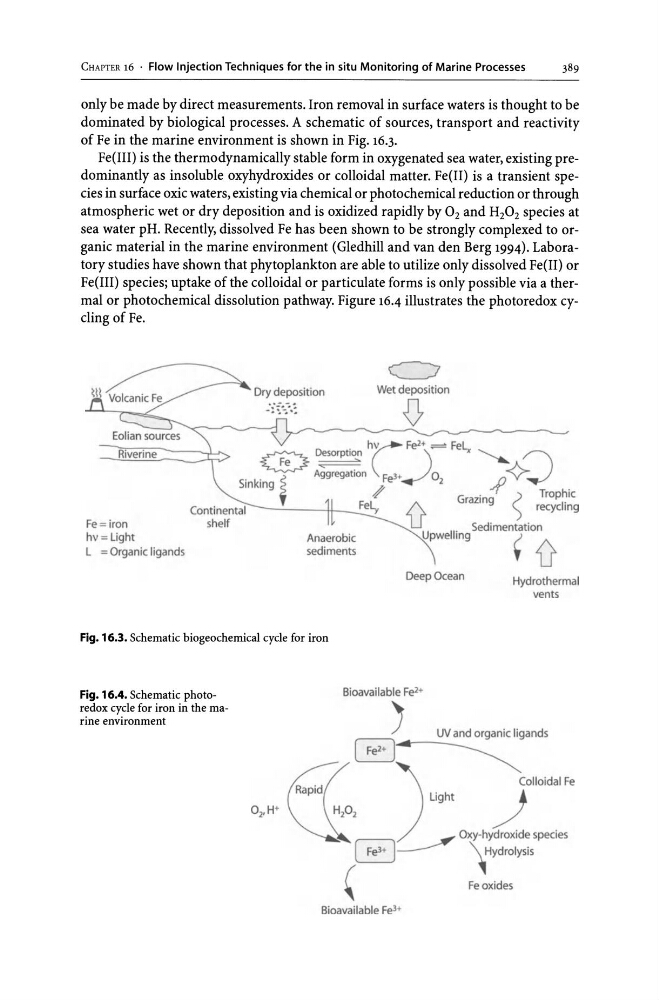
of Fe in the marine environment is shown in Fig. 16.3.
Fe(III) is the thermodynamically stable form in oxygenated sea water, existing predominantly as insoluble oxyhydroxides or colloidal matter. Fe(II) is a transient species in surface oxic waters, existing via chemical or photochemical reduction or through
atmospheric wet or dry deposition and is oxidized rapidly by O2 and H20 2 species at
sea water pH. Recently, dissolved Fe has been shown to be strongly complexed to organic material in the marine environment (Gledhill and van den Berg 1994). Laboratory studies have shown that phytoplankton are able to utilize only dissolved Fe(II) or
Fe(III) species; uptake of the colloidal or particulate forms is only possible via a thermal or photochemical dissolution pathway. Figure 16.4 illustrates the photoredox cycling of Fe.
c=J
Dry deposition
Wet deposition
V
Riverine
Desorption
........
. h C Fe2+ ==" FeLx .......... .
Fe = iron
hv = Light
. <§>,Fe A~n Fe3+ .)Oz
£)<>-~
Sinking
f
. "'(
Trophic
.
I
Fel
{1 Grazing? recycling
Contlnenta
-y
' >
shelf
Sedimentation
L = Organic ligands
Anaerobic
Upwelling
( A
sediments
,
U
Deep Ocean
Hydrothermal
vents
Fig. 16.3. Schematic biogeochemical cycle for iron
Fig. 16.4. Schematic photoredox cycle for iron in the marine environment
°z.H+
Bioavailable Fe z +
)
UV and organic ligands
8~
~)
Colloidal Fe
Rapid
L i g h t .
HzOz
~
.
Oxy-hydroxide speCies
8~ \HYdrOIYSis
(
Fe oxides
Bioavailable Fe3+
389
only be made by direct measurements. Iron removal in surface waters is thought to be
dominated by biological processes. A schematic of sources, transport and reactivity
of Fe in the marine environment is shown in Fig. 16.3.
Fe(III) is the thermodynamically stable form in oxygenated sea water, existing predominantly as insoluble oxyhydroxides or colloidal matter. Fe(II) is a transient species in surface oxic waters, existing via chemical or photochemical reduction or through
atmospheric wet or dry deposition and is oxidized rapidly by O2 and H20 2 species at
sea water pH. Recently, dissolved Fe has been shown to be strongly complexed to organic material in the marine environment (Gledhill and van den Berg 1994). Laboratory studies have shown that phytoplankton are able to utilize only dissolved Fe(II) or
Fe(III) species; uptake of the colloidal or particulate forms is only possible via a thermal or photochemical dissolution pathway. Figure 16.4 illustrates the photoredox cycling of Fe.
c=J
Dry deposition
Wet deposition
V
Riverine
Desorption
........
. h C Fe2+ ==" FeLx .......... .
Fe = iron
hv = Light
. <§>,Fe A~n Fe3+ .)Oz
£)<>-~
Sinking
f
. "'(
Trophic
.
I
Fel
{1 Grazing? recycling
Contlnenta
-y
' >
shelf
Sedimentation
L = Organic ligands
Anaerobic
Upwelling
( A
sediments
,
U
Deep Ocean
Hydrothermal
vents
Fig. 16.3. Schematic biogeochemical cycle for iron
Fig. 16.4. Schematic photoredox cycle for iron in the marine environment
°z.H+
Bioavailable Fe z +
)
UV and organic ligands
8~
~)
Colloidal Fe
Rapid
L i g h t .
HzOz
~
.
Oxy-hydroxide speCies
8~ \HYdrOIYSis
(
Fe oxides
Bioavailable Fe3+