

CHAPTER 15 . Toxic Effects of Organometallic Compounds towards Marine Biota
349
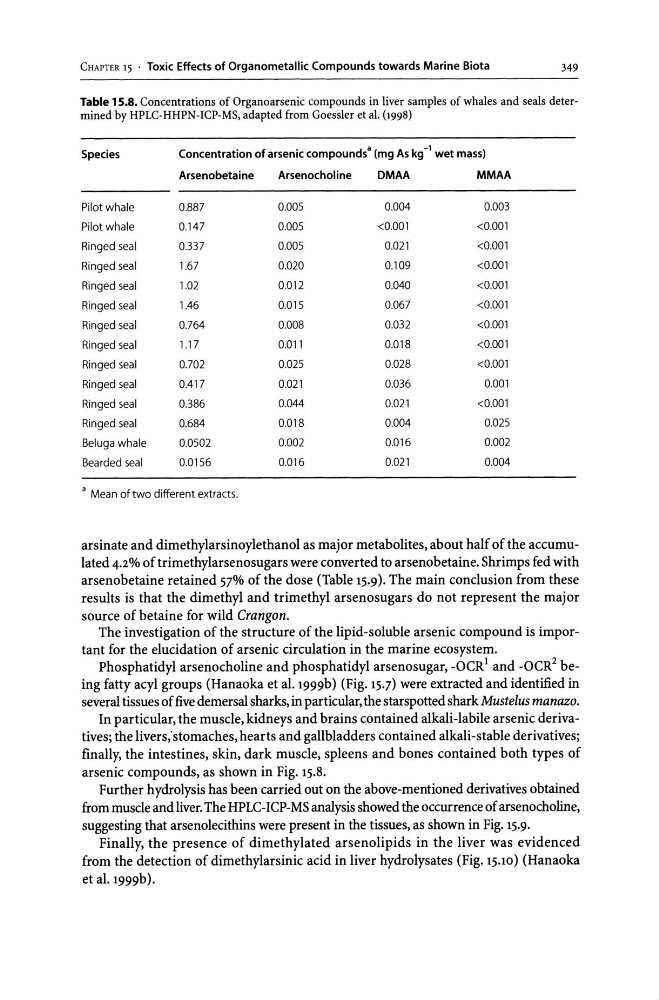
Table 15.8. Concentrations of Organoarsenic compounds in liver samples of whales and seals determined by HPLC-HHPN-ICP-MS, adapted from Goessler et al. (1998)
Species
Concentration of arsenic compounds· (mg As kg -1 wet mass)
Arsenobetaine
Arsenocholine
DMAA
MMAA
Pilot whale
0.887
0.005
0.004
0.003
Pilot whale
0.147
0.005
<0.001
<0.001
Ringed seal
0.337
0.005
0.021
<0.001
Ringed seal
1.67
0.020
0.109
<0.001
Ringed seal
1.02
0.012
0.040
<0.001
Ringed seal
1.46
0.G15
0.067
<0.001
Ringed seal
0.764
0.008
0.032
<0.001
Ringed seal
1.17
0.G11
0.G18
<0.001
Ringed seal
0.702
0.G25
0.028
<0.001
Ringed seal
0.417
0.021
0.036
0.001
Ringed seal
0.386
0.044
0.021
<0.001
Ringed seal
0.684
0.G18
0.004
0.G25
Beluga whale
0.0502
0.002
0.016
0.002
Bearded seal
0.0156
0.016
0.021
0.004
a Mean of two different extracts.
arsinate and dimethylarsinoylethanol as major metabolites, about half of the accumulated 4.2% of trimethylarsenosugars were converted to arsenobetaine. Shrimps fed with
arsenobetaine retained S7% of the dose (Table IS.9). The main conclusion from these
results is that the dimethyl and trimethyl arsenosugars do not represent the major
source of betaine for wild Crangon.
The investigation of the structure of the lipid-soluble arsenic compound is important for the elucidation of arsenic circulation in the marine ecosystem.
Phosphatidyl arsenocholine and phosphatidyl arsenosugar, -OCR! and -OCR 2 being fatty acyl groups (Hanaoka et al. 1999b) (Fig. IS.7) were extracted and identified in
several tissues of five demersal sharks, in particular, the starspotted shark Mustelus manazo.
In particular, the muscle, kidneys and brains contained alkali-labile arsenic derivatives; the livers; stomaches, hearts and gallbladders contained alkali-stable derivatives;
finally, the intestines, skin, dark muscle, spleens and bones contained both types of
arsenic compounds, as shown in Fig. IS.S.
Further hydrolysis has been carried out on the above-mentioned derivatives obtained
from muscle and liver. The HPLC-I CP-MS analysis showed the occurrence of arsenocholine,
suggesting that arsenolecithins were present in the tissues, as shown in Fig. IS.9.
Finally, the presence of dimethylated arsenolipids in the liver was evidenced
from the detection of dimethylarsinic acid in liver hydrolysates (Fig. IS.lO) (Hanaoka
et al. 1999b).
349
Table 15.8. Concentrations of Organoarsenic compounds in liver samples of whales and seals determined by HPLC-HHPN-ICP-MS, adapted from Goessler et al. (1998)
Species
Concentration of arsenic compounds· (mg As kg -1 wet mass)
Arsenobetaine
Arsenocholine
DMAA
MMAA
Pilot whale
0.887
0.005
0.004
0.003
Pilot whale
0.147
0.005
<0.001
<0.001
Ringed seal
0.337
0.005
0.021
<0.001
Ringed seal
1.67
0.020
0.109
<0.001
Ringed seal
1.02
0.012
0.040
<0.001
Ringed seal
1.46
0.G15
0.067
<0.001
Ringed seal
0.764
0.008
0.032
<0.001
Ringed seal
1.17
0.G11
0.G18
<0.001
Ringed seal
0.702
0.G25
0.028
<0.001
Ringed seal
0.417
0.021
0.036
0.001
Ringed seal
0.386
0.044
0.021
<0.001
Ringed seal
0.684
0.G18
0.004
0.G25
Beluga whale
0.0502
0.002
0.016
0.002
Bearded seal
0.0156
0.016
0.021
0.004
a Mean of two different extracts.
arsinate and dimethylarsinoylethanol as major metabolites, about half of the accumulated 4.2% of trimethylarsenosugars were converted to arsenobetaine. Shrimps fed with
arsenobetaine retained S7% of the dose (Table IS.9). The main conclusion from these
results is that the dimethyl and trimethyl arsenosugars do not represent the major
source of betaine for wild Crangon.
The investigation of the structure of the lipid-soluble arsenic compound is important for the elucidation of arsenic circulation in the marine ecosystem.
Phosphatidyl arsenocholine and phosphatidyl arsenosugar, -OCR! and -OCR 2 being fatty acyl groups (Hanaoka et al. 1999b) (Fig. IS.7) were extracted and identified in
several tissues of five demersal sharks, in particular, the starspotted shark Mustelus manazo.
In particular, the muscle, kidneys and brains contained alkali-labile arsenic derivatives; the livers; stomaches, hearts and gallbladders contained alkali-stable derivatives;
finally, the intestines, skin, dark muscle, spleens and bones contained both types of
arsenic compounds, as shown in Fig. IS.S.
Further hydrolysis has been carried out on the above-mentioned derivatives obtained
from muscle and liver. The HPLC-I CP-MS analysis showed the occurrence of arsenocholine,
suggesting that arsenolecithins were present in the tissues, as shown in Fig. IS.9.
Finally, the presence of dimethylated arsenolipids in the liver was evidenced
from the detection of dimethylarsinic acid in liver hydrolysates (Fig. IS.lO) (Hanaoka
et al. 1999b).