

CHAPTER 15 • Toxic Effects of Organometallic Compounds towards Marine Biota
343
was being investigated, while vertical distribution was being determined in the west
Pacific Ocean. The concentrations of the biologically produced species, namely
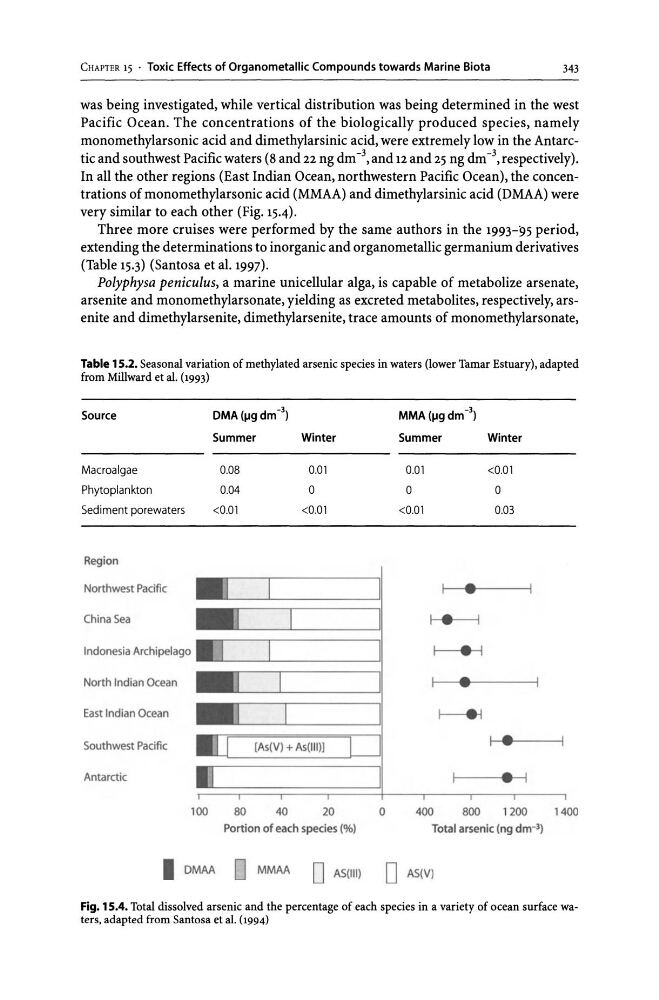
monomethylarsonic acid and dimethylarsinic acid, were extremely low in the Antarctic and southwest Pacific waters (8 and 22 ng dm -3, and 12 and 25 ng dm -3, respectively).
In all the other regions (East Indian Ocean, northwestern Pacific Ocean), the concentrations of monomethylarsonic acid (MMAA) and dimethylarsinic acid (DMAA) were
very similar to each other (Fig. 15.4).
Three more cruises were performed by the same authors in the 1993-95 period,
extending the determinations to inorganic and organometallic germanium derivatives
(Table 15.3) (Santosa et al. 1997).
Polyphysa peniculus, a marine unicellular alga, is capable of metabolize arsenate,
arsenite and monomethylarsonate, yielding as excreted metabolites, respectively, arsenite and dimethylarsenite, dimethylarsenite, trace amounts of monomethylarsonate,
Table 15.2. Seasonal variation of methylated arsenic species in waters (lower Tamar Estuary), adapted
from Millward et al. (1993)
Source
DMA (~g dm -3)
MMA (~g dm -3)
Summer
Winter
Summer
Winter
Macroalgae
0.08
0.G1
0.01
<0.01
Phytoplankton
0.04
0
0
0
Sediment porewaters
<0.01
<0.01
<0.01
0.03
Region
Northwest Pacific
. 1
•
China Sea
•
Indonesia Archipelago . J
•
North Indian Ocean
. . I
•
East Indian Ocean
f------*l
;1 1
:
Southwest Pacific
[As(V) + As(lll)]
Antarctic
I
•
100
80
40
20
0
400
800
1200
1400
Portion of each species (%)
Total arsenic (ng dm-3)
I DMAA o MMAA o AS(III) o AS(V)
Fig. 15.4. Total dissolved arsenic and the percentage of each species in a variety of ocean surface waters, adapted from Santosa et al. (1994)
343
was being investigated, while vertical distribution was being determined in the west
Pacific Ocean. The concentrations of the biologically produced species, namely
monomethylarsonic acid and dimethylarsinic acid, were extremely low in the Antarctic and southwest Pacific waters (8 and 22 ng dm -3, and 12 and 25 ng dm -3, respectively).
In all the other regions (East Indian Ocean, northwestern Pacific Ocean), the concentrations of monomethylarsonic acid (MMAA) and dimethylarsinic acid (DMAA) were
very similar to each other (Fig. 15.4).
Three more cruises were performed by the same authors in the 1993-95 period,
extending the determinations to inorganic and organometallic germanium derivatives
(Table 15.3) (Santosa et al. 1997).
Polyphysa peniculus, a marine unicellular alga, is capable of metabolize arsenate,
arsenite and monomethylarsonate, yielding as excreted metabolites, respectively, arsenite and dimethylarsenite, dimethylarsenite, trace amounts of monomethylarsonate,
Table 15.2. Seasonal variation of methylated arsenic species in waters (lower Tamar Estuary), adapted
from Millward et al. (1993)
Source
DMA (~g dm -3)
MMA (~g dm -3)
Summer
Winter
Summer
Winter
Macroalgae
0.08
0.G1
0.01
<0.01
Phytoplankton
0.04
0
0
0
Sediment porewaters
<0.01
<0.01
<0.01
0.03
Region
Northwest Pacific
. 1
•
China Sea
•
Indonesia Archipelago . J
•
North Indian Ocean
. . I
•
East Indian Ocean
f------*l
;1 1
:
Southwest Pacific
[As(V) + As(lll)]
Antarctic
I
•
100
80
40
20
0
400
800
1200
1400
Portion of each species (%)
Total arsenic (ng dm-3)
I DMAA o MMAA o AS(III) o AS(V)
Fig. 15.4. Total dissolved arsenic and the percentage of each species in a variety of ocean surface waters, adapted from Santosa et al. (1994)