

338
L. Pellerito· R. Barbieri· R. Di Stefano· M. Scopelliti . C. Pellerito· T. Fiore· F. Triolo
Phytoplankton, Algae
Marine animals
0CH3
OH
("*0
Hc-L~
~
3
H3C --L+ Arsenobetaine
I
Arsenocholine
I
"'&
CH 3
CH 3
CH 3
t
I
H3C-As= 0
Trimethylarsine oxide
lH
3
Arsenosugars
~
CH 3
..
Dimethylarsinic acid
I
Sea water
OH
OH
OH
H3C-~S-OH
I
I
I
0
HO-As-OH
HO-As-OH ~ HC-As-OH
¥'
II
3
II
0
0
Inorganic arsenic(V)
Inorganic arsenic(lIl)
Methanearsonic acid
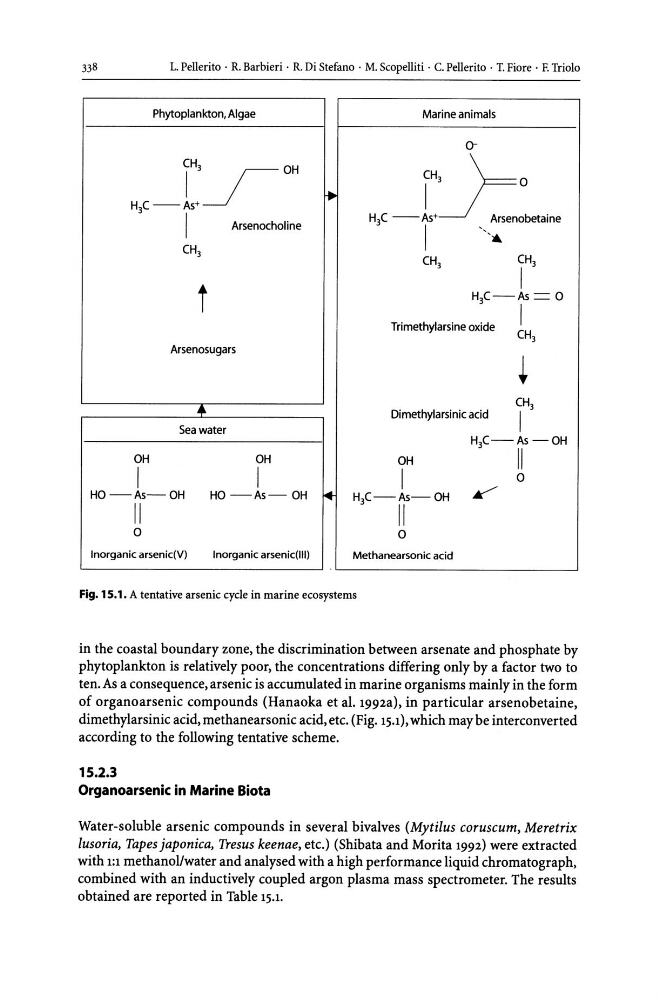
Fig. 15.1. A tentative arsenic cycle in marine ecosystems
in the coastal boundary zone, the discrimination between arsenate and phosphate by
phytoplankton is relatively poor, the concentrations differing only by a factor two to
ten. As a consequence, arsenic is accumulated in marine organisms mainly in the form
of organoarsenic compounds (Hanaoka et al. 1992a), in particular arsenobetaine,
dimethylarsinic acid, methanearsonic acid, etc. (Fig. 15.1), which may be interconverted
according to the following tentative scheme.
15.2.3
Organoarsenic in Marine Biota
Water-soluble arsenic compounds in several bivalves (Mytilus coruscum, Meretrix
fusaria, Tapes japanica, Tresus keenae, etc.) (Shibata and Morita 1992) were extracted
with 1:1 methanol/water and analysed with a high performance liquid chromatograph,
combined with an inductively coupled argon plasma mass spectrometer. The results
obtained are reported in Table 15.1.
L. Pellerito· R. Barbieri· R. Di Stefano· M. Scopelliti . C. Pellerito· T. Fiore· F. Triolo
Phytoplankton, Algae
Marine animals
0CH3
OH
("*0
Hc-L~
~
3
H3C --L+ Arsenobetaine
I
Arsenocholine
I
"'&
CH 3
CH 3
CH 3
t
I
H3C-As= 0
Trimethylarsine oxide
lH
3
Arsenosugars
~
CH 3
..
Dimethylarsinic acid
I
Sea water
OH
OH
OH
H3C-~S-OH
I
I
I
0
HO-As-OH
HO-As-OH ~ HC-As-OH
¥'
II
3
II
0
0
Inorganic arsenic(V)
Inorganic arsenic(lIl)
Methanearsonic acid
Fig. 15.1. A tentative arsenic cycle in marine ecosystems
in the coastal boundary zone, the discrimination between arsenate and phosphate by
phytoplankton is relatively poor, the concentrations differing only by a factor two to
ten. As a consequence, arsenic is accumulated in marine organisms mainly in the form
of organoarsenic compounds (Hanaoka et al. 1992a), in particular arsenobetaine,
dimethylarsinic acid, methanearsonic acid, etc. (Fig. 15.1), which may be interconverted
according to the following tentative scheme.
15.2.3
Organoarsenic in Marine Biota
Water-soluble arsenic compounds in several bivalves (Mytilus coruscum, Meretrix
fusaria, Tapes japanica, Tresus keenae, etc.) (Shibata and Morita 1992) were extracted
with 1:1 methanol/water and analysed with a high performance liquid chromatograph,
combined with an inductively coupled argon plasma mass spectrometer. The results
obtained are reported in Table 15.1.