

CHAPTER 14 . Chemistry of Organic Toxicants in Marine Environments
335
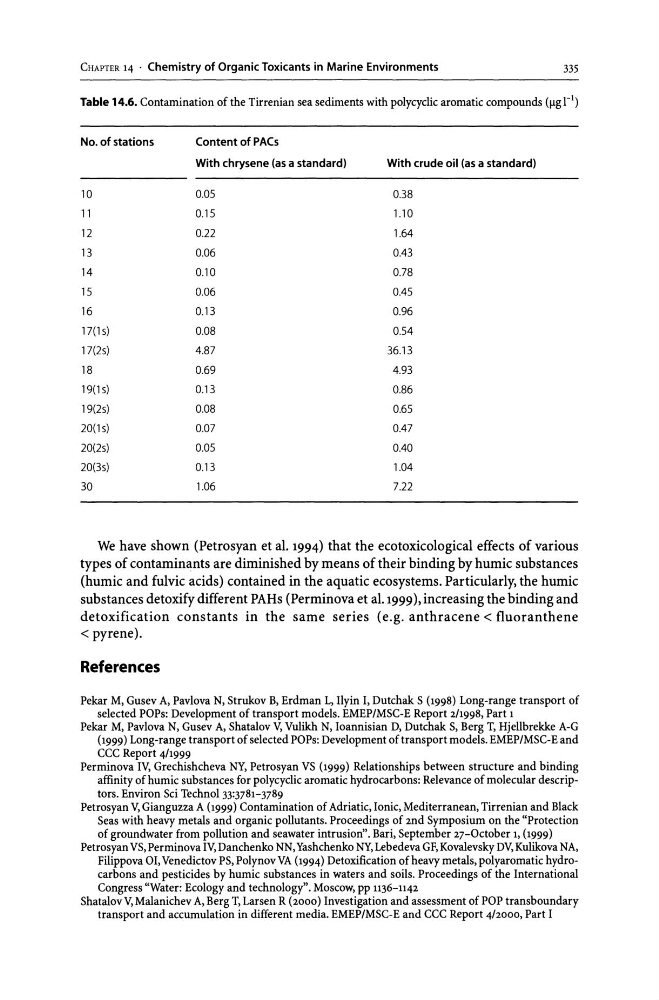
Table 14.6. Contamination of the Tirrenian sea sediments with polycyclic aromatic compounds (fig tl)
No. of stations
Content of PACs
With chrysene (as a standard)
With crude oil (as a standard)
10
0.05
0.38
11
0.15
1.10
12
0.22
1.64
13
0.06
0.43
14
0.10
0.78
15
0.06
0.45
16
0.13
0.96
17(1 s)
0.08
0.54
17(2s)
4.87
36.13
18
0.69
4.93
19(1s)
0.13
0.86
19(2s)
0.08
0.65
20(ls)
0.07
0.47
20(2s)
0.05
0.40
20(3s)
0.13
l.04
30
1.06
7.22
We have shown (Petrosyan et al. 1994) that the ecotoxicological effects of various
types of contaminants are diminished by means of their binding by humic substances
(humic and fulvic acids) contained in the aquatic ecosystems. Particularly, the humic
substances detoxify different PAHs (Perminova et al.1999), increasing the binding and
detoxification constants in the same series (e.g. anthracene < fluoranthene
< pyrene).
References
Pekar M, Gusev A, Pavlova N, Strukov B, Erdman L, Ilyin I, Dutchak S (1998) Long-range transport of
selected POPs: Development of transport models. EMEP/MSC-E Report 2/1998, Part 1
Pekar M, Pavlova N, Gusev A, Shatalov V, Vulikh N, Ioannisian D, Dutchak S, Berg T, Hjellbrekke A-G
(1999) Long-range transport of selected POPs: Development of transport models. EMEP/MSC-E and
CCC Report 411999
Perminova IV, Grechishcheva NY, Petrosyan VS (1999) Relationships between structure and binding
affinity of humic substances for polycyclic aromatic hydrocarbons: Relevance of molecular descriptors. Environ Sci TechnoI33:3781-3789
Petrosyan V, Gianguzza A (1999) Contamination of Adriatic, Ionic, Mediterranean, Tirrenian and Black
Seas with heavy metals and organic pollutants. Proceedings of 2nd Symposium on the "Protection
of groundwater from pollution and seawater intrusion". Bari, September 27-0ctober 1, (1999)
Petrosyan VS, Perminova IV, Danchenko NN, Yashchenko NY, Lebedeva GF, Kovalevsky DV, Kulikova NA,
Filippova or, Venedictov PS, Polynov VA (1994) Detoxification of heavy metals, polyaromatic hydrocarbons and pesticides by humic substances in waters and soils. Proceedings of the International
Congress "Water: Ecology and technology". Moscow, pp 1136-1142
Shatalov V, Malanichev A, Berg T, Larsen R (2000) Investigation and assessment of POP transboundary
transport and accumulation in different media. EMEP/MSC-E and CCC Report 4/2000, Part I
335
Table 14.6. Contamination of the Tirrenian sea sediments with polycyclic aromatic compounds (fig tl)
No. of stations
Content of PACs
With chrysene (as a standard)
With crude oil (as a standard)
10
0.05
0.38
11
0.15
1.10
12
0.22
1.64
13
0.06
0.43
14
0.10
0.78
15
0.06
0.45
16
0.13
0.96
17(1 s)
0.08
0.54
17(2s)
4.87
36.13
18
0.69
4.93
19(1s)
0.13
0.86
19(2s)
0.08
0.65
20(ls)
0.07
0.47
20(2s)
0.05
0.40
20(3s)
0.13
l.04
30
1.06
7.22
We have shown (Petrosyan et al. 1994) that the ecotoxicological effects of various
types of contaminants are diminished by means of their binding by humic substances
(humic and fulvic acids) contained in the aquatic ecosystems. Particularly, the humic
substances detoxify different PAHs (Perminova et al.1999), increasing the binding and
detoxification constants in the same series (e.g. anthracene < fluoranthene
< pyrene).
References
Pekar M, Gusev A, Pavlova N, Strukov B, Erdman L, Ilyin I, Dutchak S (1998) Long-range transport of
selected POPs: Development of transport models. EMEP/MSC-E Report 2/1998, Part 1
Pekar M, Pavlova N, Gusev A, Shatalov V, Vulikh N, Ioannisian D, Dutchak S, Berg T, Hjellbrekke A-G
(1999) Long-range transport of selected POPs: Development of transport models. EMEP/MSC-E and
CCC Report 411999
Perminova IV, Grechishcheva NY, Petrosyan VS (1999) Relationships between structure and binding
affinity of humic substances for polycyclic aromatic hydrocarbons: Relevance of molecular descriptors. Environ Sci TechnoI33:3781-3789
Petrosyan V, Gianguzza A (1999) Contamination of Adriatic, Ionic, Mediterranean, Tirrenian and Black
Seas with heavy metals and organic pollutants. Proceedings of 2nd Symposium on the "Protection
of groundwater from pollution and seawater intrusion". Bari, September 27-0ctober 1, (1999)
Petrosyan VS, Perminova IV, Danchenko NN, Yashchenko NY, Lebedeva GF, Kovalevsky DV, Kulikova NA,
Filippova or, Venedictov PS, Polynov VA (1994) Detoxification of heavy metals, polyaromatic hydrocarbons and pesticides by humic substances in waters and soils. Proceedings of the International
Congress "Water: Ecology and technology". Moscow, pp 1136-1142
Shatalov V, Malanichev A, Berg T, Larsen R (2000) Investigation and assessment of POP transboundary
transport and accumulation in different media. EMEP/MSC-E and CCC Report 4/2000, Part I