

Chapter 14
Chemistry of Organic Toxicants in
Marine Environment
V. S. Petrosyan
The problems of environmental pollution with the persistent organic compounds are
of great importance both on national and international levels. Many of the persistent
organic pollutants (POPs) are toxic, and this is why their chemistry and toxicology in
different environmental media (aquatic ecosystems, soils, atmosphere, biota, etc.) are
under the detailed investigations.
In this paper, some of the important POPs entering the marine environment, their
properties and behaviour in various compartments of the marine ecosystems (water,
sediments), the problems of qualitative and quantitative assessments, and the ways of
detoxification of POPs by means of naturally occurring humic substances will be considered.
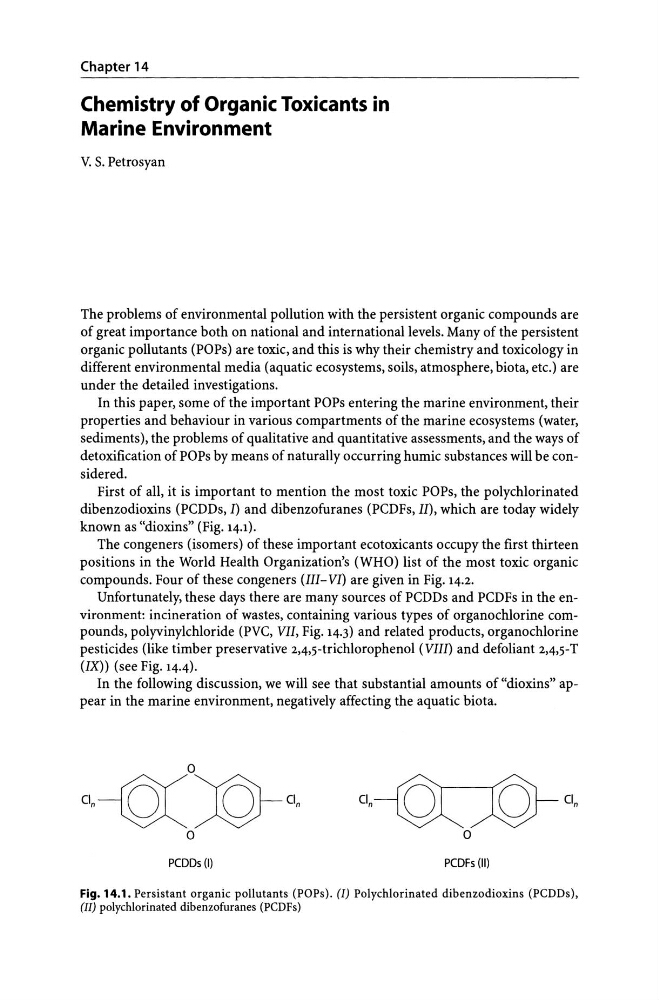
First of all, it is important to mention the most toxic POPs, the polychlorinated
dibenzodioxins (PCDDs, I) and dibenzofuranes (PCDFs, II), which are today widely
known as "dioxins" (Fig. 14.1).
The congeners (isomers) of these important ecotoxicants occupy the first thirteen
positions in the World Health Organization's (WHO) list of the most toxic organic
compounds. Four of these congeners (III- VI) are given in Fig. 14.2.
Unfortunately, these days there are many sources of PCDDs and PCDFs in the environment: incineration of wastes, containing various types of organochlorine compounds, polyvinylchloride (PVC, VII, Fig. 14.3) and related products, organochlorine
pesticides (like timber preservative 2,4,5-trichlorophenol (VIII) and defoliant 2,4,5-T
(IX)) (see Fig. 14.4).
In the following discussion, we will see that substantial amounts of "dioxins" appear in the marine environment, negatively affecting the aquatic biota.
CI.-©()fJJ-a.
(In
(In
o
o
PCDDs(l)
PCDFs(l1)
Fig. 14.1. Persistant organic pollutants (POPs). (I) Polychlorinated dibenzodioxins (PCDDs),
(II) polychlorinated dibenzofuranes (PCDFs)
Chemistry of Organic Toxicants in
Marine Environment
V. S. Petrosyan
The problems of environmental pollution with the persistent organic compounds are
of great importance both on national and international levels. Many of the persistent
organic pollutants (POPs) are toxic, and this is why their chemistry and toxicology in
different environmental media (aquatic ecosystems, soils, atmosphere, biota, etc.) are
under the detailed investigations.
In this paper, some of the important POPs entering the marine environment, their
properties and behaviour in various compartments of the marine ecosystems (water,
sediments), the problems of qualitative and quantitative assessments, and the ways of
detoxification of POPs by means of naturally occurring humic substances will be considered.
First of all, it is important to mention the most toxic POPs, the polychlorinated
dibenzodioxins (PCDDs, I) and dibenzofuranes (PCDFs, II), which are today widely
known as "dioxins" (Fig. 14.1).
The congeners (isomers) of these important ecotoxicants occupy the first thirteen
positions in the World Health Organization's (WHO) list of the most toxic organic
compounds. Four of these congeners (III- VI) are given in Fig. 14.2.
Unfortunately, these days there are many sources of PCDDs and PCDFs in the environment: incineration of wastes, containing various types of organochlorine compounds, polyvinylchloride (PVC, VII, Fig. 14.3) and related products, organochlorine
pesticides (like timber preservative 2,4,5-trichlorophenol (VIII) and defoliant 2,4,5-T
(IX)) (see Fig. 14.4).
In the following discussion, we will see that substantial amounts of "dioxins" appear in the marine environment, negatively affecting the aquatic biota.
CI.-©()fJJ-a.
(In
(In
o
o
PCDDs(l)
PCDFs(l1)
Fig. 14.1. Persistant organic pollutants (POPs). (I) Polychlorinated dibenzodioxins (PCDDs),
(II) polychlorinated dibenzofuranes (PCDFs)