

CHAPTER 13 . Endocrine-Disrupting Chemicals in Marine Environment
317
seems open to debate with for example Bowerman et al. (2000) citing evidence for
population level effects of hormone-disrupting chemicals in bald eagles (Halineetus
leucocephalus) in the Great Lakes and Leatherland (1998), indicating that polyhalogenated aromatic hydrocarbons represent a significant threat to the thyroid hormone
economy in both birds and seals. Conversely, Dawson (2000) argues that there is no
evidence that avian wildlife has suffered endocrine disruption and refutes the link
between eggshell thinning, supernormal clutches and endocrine disrupters. As part
of the efforts to determine the validity of these opposing views, it is possible to identify the work of Berg et al. (1998), Fossi et al. (1999) and Halldin et al. (1999), who have
examined methods for determining the effects of endocrine-disrupting chemicals on
birds and that of Huet (2000), who has described the areas currently under active investigation by the OECD in this area.
13.4.4
Mammals
Much of the earlier work on the effects of endocrine disrupters on mammals focused
on typicallaboratory test animals, particularly rats and mice (see e.g. Kelce et al.I995).
Whilst such work is really outside the scope of this chapter, a useful comparative study
of the relative potency of a number of natural and synthetic endocrine disrupters has
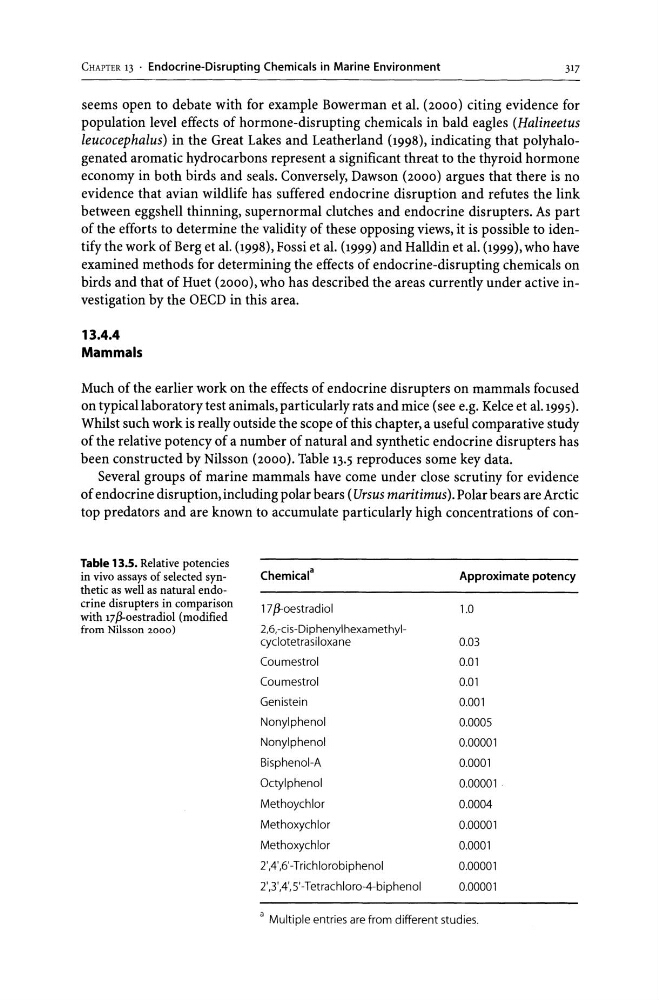
been constructed by Nilsson (2000). Table 13.5 reproduces some key data.
Several groups of marine mammals have come under close scrutiny for evidence
of endocrine disruption, including polar bears (Ursus maritimus). Polar bears are Arctic
top predators and are known to accumulate particularly high concentrations of conTable 13.5. Relative potencies
in vivo assays of selected synthetic as well as natural endocrine disrupters in comparison
with 17/3-oestradiol (modified
from Nilsson 2000)
Chemical"
17 j3-oestradiol
2,6,-cis-Diphenylhexamethylcyciotetrasiloxane
Coumestrol
Coumestrol
Genistein
Nonylphenol
Nonylphenol
Bisphenol-A
Octylphenol
Methoychlor
Methoxychlor
Methoxychlor
2',4',6' -T rich lorobi phenol
2',3 ',4',5' -T etrach loro-4-bi phenol
Approximate potency
l.0
0.03
0.01
0.01
0.001
0.0005
0.00001
0.0001
0.00001
0.0004
0.00001
0.0001
0.00001
0.00001
a Multiple entries are from different studies.
317
seems open to debate with for example Bowerman et al. (2000) citing evidence for
population level effects of hormone-disrupting chemicals in bald eagles (Halineetus
leucocephalus) in the Great Lakes and Leatherland (1998), indicating that polyhalogenated aromatic hydrocarbons represent a significant threat to the thyroid hormone
economy in both birds and seals. Conversely, Dawson (2000) argues that there is no
evidence that avian wildlife has suffered endocrine disruption and refutes the link
between eggshell thinning, supernormal clutches and endocrine disrupters. As part
of the efforts to determine the validity of these opposing views, it is possible to identify the work of Berg et al. (1998), Fossi et al. (1999) and Halldin et al. (1999), who have
examined methods for determining the effects of endocrine-disrupting chemicals on
birds and that of Huet (2000), who has described the areas currently under active investigation by the OECD in this area.
13.4.4
Mammals
Much of the earlier work on the effects of endocrine disrupters on mammals focused
on typicallaboratory test animals, particularly rats and mice (see e.g. Kelce et al.I995).
Whilst such work is really outside the scope of this chapter, a useful comparative study
of the relative potency of a number of natural and synthetic endocrine disrupters has
been constructed by Nilsson (2000). Table 13.5 reproduces some key data.
Several groups of marine mammals have come under close scrutiny for evidence
of endocrine disruption, including polar bears (Ursus maritimus). Polar bears are Arctic
top predators and are known to accumulate particularly high concentrations of conTable 13.5. Relative potencies
in vivo assays of selected synthetic as well as natural endocrine disrupters in comparison
with 17/3-oestradiol (modified
from Nilsson 2000)
Chemical"
17 j3-oestradiol
2,6,-cis-Diphenylhexamethylcyciotetrasiloxane
Coumestrol
Coumestrol
Genistein
Nonylphenol
Nonylphenol
Bisphenol-A
Octylphenol
Methoychlor
Methoxychlor
Methoxychlor
2',4',6' -T rich lorobi phenol
2',3 ',4',5' -T etrach loro-4-bi phenol
Approximate potency
l.0
0.03
0.01
0.01
0.001
0.0005
0.00001
0.0001
0.00001
0.0004
0.00001
0.0001
0.00001
0.00001
a Multiple entries are from different studies.