

CHAPTER 12 . Modelling of Natural Fluids: Are the Available Databases Adequate for this Purpose?
297
12.3
The Thermodynamic Database (TDB) Example
Recent compilations (Grenthe et al. 1992; Silva et al. 1995; Sandino and Osthols 1999;
Lemire 2001) of critically reviewed thermodynamic parameters on the chemistry of
solutions and solids of uranium and some actinides in their various oxidation states
have been promoted by OECD/NEA (Organization for Economic Cooperation and
Development/Nuclear Energy Agency), within a project currently referred to as the
TDB (Thermodynamic Database) project (OstlIols 2000), which started in 1984. It states
that "before that date a number of reviews had already been published, but none could
reliably be used as a complete source data table to study the behaviour of radioelements
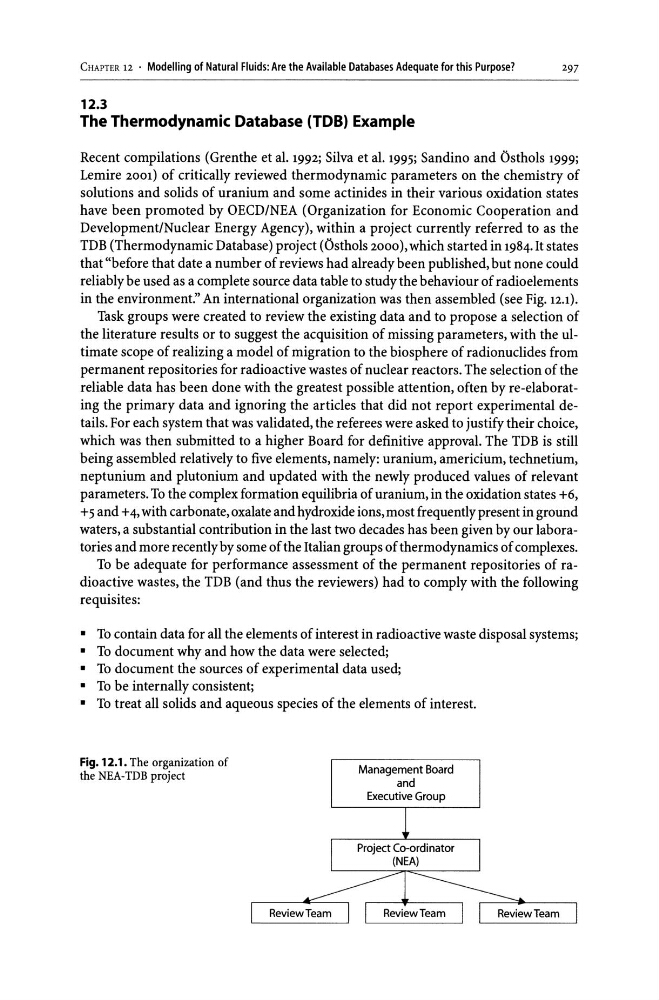
in the environment." An international organization was then assembled (see Fig. 12.1).
Task groups were created to review the existing data and to propose a selection of
the literature results or to suggest the acquisition of missing parameters, with the ultimate scope of realizing a model of migration to the biosphere of radionuclides from
permanent repositories for radioactive wastes of nuclear reactors. The selection of the
reliable data has been done with the greatest possible attention, often by re-elaborating the primary data and ignoring the articles that did not report experimental details. For each system that was validated, the referees were asked to justify their choice,
which was then submitted to a higher Board for definitive approval. The TDB is still
being assembled relatively to five elements, namely: uranium, americium, technetium,
neptunium and plutonium and updated with the newly produced values of relevant
parameters. To the complex formation equilibria of uranium, in the oxidation states +6,
+5 and +4, witlI carbonate, oxalate and hydroxide ions, most frequently present in ground
waters, a substantial contribution in the last two decades has been given by our laboratories and more recently by some of the Italian groups of thermodynamics of complexes.
To be adequate for performance assessment of the permanent repositories of radioactive wastes, the TDB (and thus the reviewers) had to comply with the following
requisites:
• To contain data for all the elements of interest in radioactive waste disposal systems;
• To document why and how the data were selected;
• To document the sources of experimental data used;
• To be internally consistent;
• To treat all solids and aqueous species of the elements of interest.
Fig. 12.1. The organization of
the NEA-TDB project
Review Team
Management Board
and
Executive Group
297
12.3
The Thermodynamic Database (TDB) Example
Recent compilations (Grenthe et al. 1992; Silva et al. 1995; Sandino and Osthols 1999;
Lemire 2001) of critically reviewed thermodynamic parameters on the chemistry of
solutions and solids of uranium and some actinides in their various oxidation states
have been promoted by OECD/NEA (Organization for Economic Cooperation and
Development/Nuclear Energy Agency), within a project currently referred to as the
TDB (Thermodynamic Database) project (OstlIols 2000), which started in 1984. It states
that "before that date a number of reviews had already been published, but none could
reliably be used as a complete source data table to study the behaviour of radioelements
in the environment." An international organization was then assembled (see Fig. 12.1).
Task groups were created to review the existing data and to propose a selection of
the literature results or to suggest the acquisition of missing parameters, with the ultimate scope of realizing a model of migration to the biosphere of radionuclides from
permanent repositories for radioactive wastes of nuclear reactors. The selection of the
reliable data has been done with the greatest possible attention, often by re-elaborating the primary data and ignoring the articles that did not report experimental details. For each system that was validated, the referees were asked to justify their choice,
which was then submitted to a higher Board for definitive approval. The TDB is still
being assembled relatively to five elements, namely: uranium, americium, technetium,
neptunium and plutonium and updated with the newly produced values of relevant
parameters. To the complex formation equilibria of uranium, in the oxidation states +6,
+5 and +4, witlI carbonate, oxalate and hydroxide ions, most frequently present in ground
waters, a substantial contribution in the last two decades has been given by our laboratories and more recently by some of the Italian groups of thermodynamics of complexes.
To be adequate for performance assessment of the permanent repositories of radioactive wastes, the TDB (and thus the reviewers) had to comply with the following
requisites:
• To contain data for all the elements of interest in radioactive waste disposal systems;
• To document why and how the data were selected;
• To document the sources of experimental data used;
• To be internally consistent;
• To treat all solids and aqueous species of the elements of interest.
Fig. 12.1. The organization of
the NEA-TDB project
Review Team
Management Board
and
Executive Group