

CHAPTER 10 • Equilibrium Analysis, the Ionic Medium Method and Activity Factors
281
Table 10.4. Regression data for the determination of Pitzer and SIT parameters
The SIT model
The Pitzer model parameters for models I-IV
Parameter
-1091/= 1.989±0.084 109 1O KO
/:o.e = 0.003 ±0.084
Xl
Xl
Xl
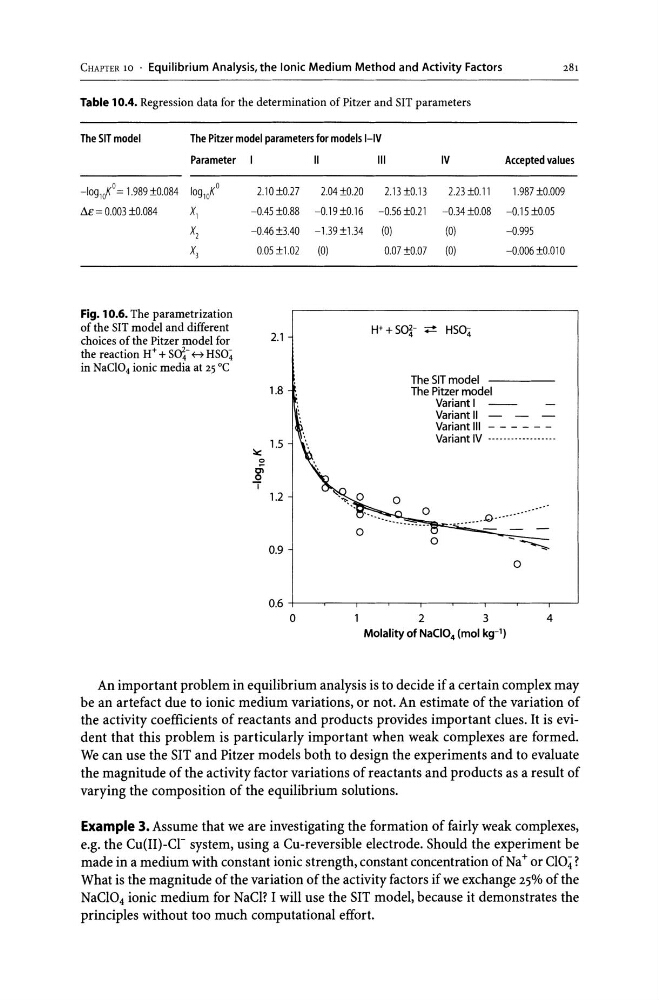
Fig. 10.6. The parametrization
of the SIT model and different
choices of the Pitzer model for
the reaction H+ + S~- H HSO:;
in NaCl04 ionic media at 25°C
II
2.10±0.27
2.04±0.20
-0.45 ±0.88 -0.19±0.16
-0.46 ±3.40 -1.39 ±1.34
0.05 ±1.02
(0)
2.1
1.8
1.5
:0.::
0
Ci' 0
'T
1.2
0.9
0.6
0
III
IV
2.1HO.13
2.23 ±O.ll
-0.S6±0.21 -0.34±0.08
(0)
(0)
0.07 ±0.07
(0)
H+ + SO~- ~ HSG.\
The SIT model
The Pitzer model
Variant I
Variant II
Accepted values
l.987 ±0.009
-0.15 ±0.05
-0.995
-0.006 ±0.01 0
Variant III - - - - - -
Variant IV
o
2
3
Molality of NaCI0 4 (mol kg-l)
~
o
4
An important problem in equilibrium analysis is to decide if a certain complex may
be an artefact due to ionic medium variations, or not. An estimate of the variation of
the activity coefficients of reactants and products provides important clues. It is evident that this problem is particularly important when weak complexes are formed.
We can use the SIT and Pitzer models both to design the experiments and to evaluate
the magnitude of the activity factor variations of reactants and products as a result of
varying the composition of the equilibrium solutions.
Example 3. Assume that we are investigating the formation of fairly weak complexes,
e.g. the cu(II)-cr system, using a Cu-reversible electrode. Should the experiment be
made in a medium with constant ionic strength, constant concentration ofNa + or CI0 4 ?
What is the magnitude of the variation of the activity factors if we exchange 25% of the
NaCI0 4 ionic medium for NaCl? I will use the SIT model, because it demonstrates the
principles without too much computational effort.
281
Table 10.4. Regression data for the determination of Pitzer and SIT parameters
The SIT model
The Pitzer model parameters for models I-IV
Parameter
-1091/= 1.989±0.084 109 1O KO
/:o.e = 0.003 ±0.084
Xl
Xl
Xl
Fig. 10.6. The parametrization
of the SIT model and different
choices of the Pitzer model for
the reaction H+ + S~- H HSO:;
in NaCl04 ionic media at 25°C
II
2.10±0.27
2.04±0.20
-0.45 ±0.88 -0.19±0.16
-0.46 ±3.40 -1.39 ±1.34
0.05 ±1.02
(0)
2.1
1.8
1.5
:0.::
0
Ci' 0
'T
1.2
0.9
0.6
0
III
IV
2.1HO.13
2.23 ±O.ll
-0.S6±0.21 -0.34±0.08
(0)
(0)
0.07 ±0.07
(0)
H+ + SO~- ~ HSG.\
The SIT model
The Pitzer model
Variant I
Variant II
Accepted values
l.987 ±0.009
-0.15 ±0.05
-0.995
-0.006 ±0.01 0
Variant III - - - - - -
Variant IV
o
2
3
Molality of NaCI0 4 (mol kg-l)
~
o
4
An important problem in equilibrium analysis is to decide if a certain complex may
be an artefact due to ionic medium variations, or not. An estimate of the variation of
the activity coefficients of reactants and products provides important clues. It is evident that this problem is particularly important when weak complexes are formed.
We can use the SIT and Pitzer models both to design the experiments and to evaluate
the magnitude of the activity factor variations of reactants and products as a result of
varying the composition of the equilibrium solutions.
Example 3. Assume that we are investigating the formation of fairly weak complexes,
e.g. the cu(II)-cr system, using a Cu-reversible electrode. Should the experiment be
made in a medium with constant ionic strength, constant concentration ofNa + or CI0 4 ?
What is the magnitude of the variation of the activity factors if we exchange 25% of the
NaCI0 4 ionic medium for NaCl? I will use the SIT model, because it demonstrates the
principles without too much computational effort.