

12
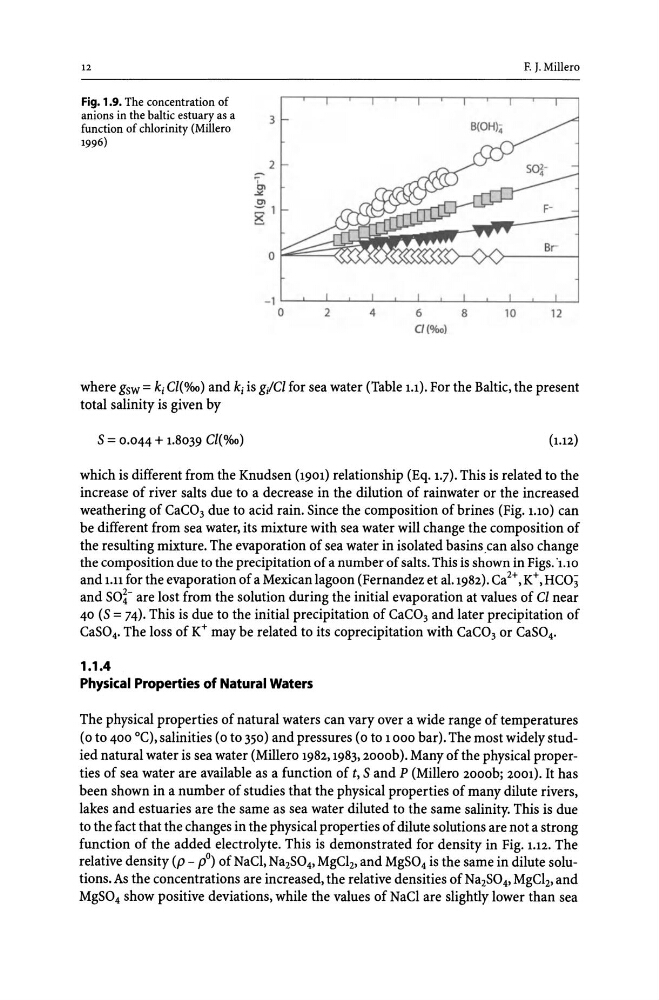
Fig. 1.9. The concentration of
anions in the baltic estuary as a
function of chlorinity (Millero
1996)
3
2
F. J. Millero
-
Br
- 1 ~1 ~ __ ~~ __ L-~~ __ ~-L~~~~ __ L-~
o
2
4
6
8
10
12
(1(%0)
where gsw = k; Cl(%o} and k; is g/Cl for sea water (Table 1.1). For the Baltic, the present
total salinity is given by
S = 0.044 + 1.8039 Cl(%o}
(1.12)
which is different from the Knudsen (1901) relationship (Eq. 1.7). This is related to the
increase of river salts due to a decrease in the dilution of rainwater or the increased
weathering of CaC0 3 due to acid rain. Since the composition of brines (Fig. 1.10) can
be different from sea water, its mixture with sea water will change the composition of
the resulting mixture. The evaporation of sea water in isolated basins .can also change
the composition due to the precipitation of a number of salts. This is shown in Figs. ·1.10
and 1.11 for the evaporation of a Mexican lagoon (Fernandez et al.1982). Ca 2 +, K+, HCO;
and SO~- are lost from the solution during the initial evaporation at values of Cl near
40 (S = 74). This is due to the initial precipitation of CaC03 and later precipitation of
CaS04. The loss of K+ may be related to its coprecipitation with CaC0 3 or CaS04.
1.1.4
Physical Properties of Natural Waters
The physical properties of natural waters can vary over a wide range of temperatures
(0 to 400°C), salinities (0 to 350) and pressures (0 to 1000 bar). The most widely studied natural water is sea water (Millero 1982,1983, 2000b). Many of the physical properties of sea water are available as a function of t, Sand P (Millero 2000b; 2001). It has
been shown in a number of studies that the physical properties of many dilute rivers,
lakes and estuaries are the same as sea water diluted to the same salinity. This is due
to the fact that the changes in the physical properties of dilute solutions are not a strong
function of the added electrolyte. This is demonstrated for density in Fig. 1.12. The
relative density (p - pO) of NaCI, Na2S04, MgCI2, and MgS04 is the same in dilute solutions. As the concentrations are increased, the relative densities of NaZS04' MgCI2, and
MgS04 show positive deviations, while the values of NaCl are slightly lower than sea
Fig. 1.9. The concentration of
anions in the baltic estuary as a
function of chlorinity (Millero
1996)
3
2
F. J. Millero
-
Br
- 1 ~1 ~ __ ~~ __ L-~~ __ ~-L~~~~ __ L-~
o
2
4
6
8
10
12
(1(%0)
where gsw = k; Cl(%o} and k; is g/Cl for sea water (Table 1.1). For the Baltic, the present
total salinity is given by
S = 0.044 + 1.8039 Cl(%o}
(1.12)
which is different from the Knudsen (1901) relationship (Eq. 1.7). This is related to the
increase of river salts due to a decrease in the dilution of rainwater or the increased
weathering of CaC0 3 due to acid rain. Since the composition of brines (Fig. 1.10) can
be different from sea water, its mixture with sea water will change the composition of
the resulting mixture. The evaporation of sea water in isolated basins .can also change
the composition due to the precipitation of a number of salts. This is shown in Figs. ·1.10
and 1.11 for the evaporation of a Mexican lagoon (Fernandez et al.1982). Ca 2 +, K+, HCO;
and SO~- are lost from the solution during the initial evaporation at values of Cl near
40 (S = 74). This is due to the initial precipitation of CaC03 and later precipitation of
CaS04. The loss of K+ may be related to its coprecipitation with CaC0 3 or CaS04.
1.1.4
Physical Properties of Natural Waters
The physical properties of natural waters can vary over a wide range of temperatures
(0 to 400°C), salinities (0 to 350) and pressures (0 to 1000 bar). The most widely studied natural water is sea water (Millero 1982,1983, 2000b). Many of the physical properties of sea water are available as a function of t, Sand P (Millero 2000b; 2001). It has
been shown in a number of studies that the physical properties of many dilute rivers,
lakes and estuaries are the same as sea water diluted to the same salinity. This is due
to the fact that the changes in the physical properties of dilute solutions are not a strong
function of the added electrolyte. This is demonstrated for density in Fig. 1.12. The
relative density (p - pO) of NaCI, Na2S04, MgCI2, and MgS04 is the same in dilute solutions. As the concentrations are increased, the relative densities of NaZS04' MgCI2, and
MgS04 show positive deviations, while the values of NaCl are slightly lower than sea