

CHAPTER 10 • Equilibrium Analysis, the Ionic Medium Method and Activity Factors
275
sible to obtain the individual Pitzer parameters I1/iO) and I1C from this equation alone.
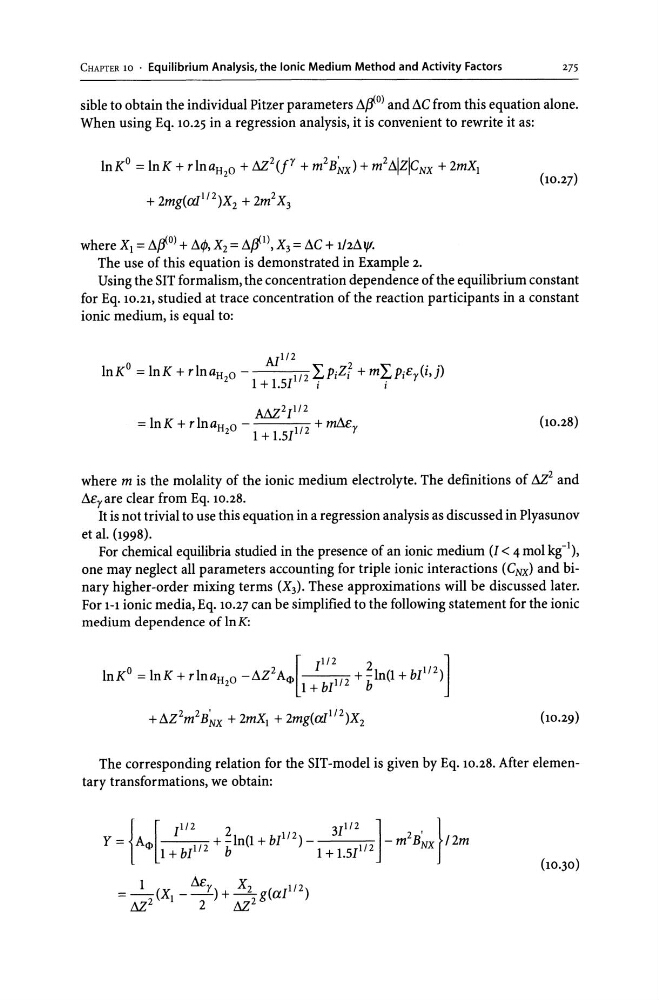
When using Eq. 10.25 in a regression analysis, it is convenient to rewrite it as:
InKO = InK + rlnaH 2 0 + 11Z2(jY + m2B~x) + m2111ZICNX + 2mXI
+ 2mg(aI 1/2 )X2 + 2m2X3
where XI = I1/iO) + 111jJ, X 2 = 11/i1), X3 = I1C + 112111f1.
The use of this equation is demonstrated in Example 2.
(10.27)
Using the SIT formalism, the concentration dependence of the equilibrium constant
for Eq. 10.21, studied at trace concentration of the reaction participants in a constant
ionic medium, is equal to:
112
InKo = InK + rlnaH 0 - AI 112 LPiZ; + mLPil::y(i,j)
2
1 + 1.51
i
i
A/1Z 2 11I2
= InK + rlnaH 0 -
1/2 + mi1£y
2
1 + 1.51
(10.28)
where m is the molality of the ionic medium electrolyte. The definitions of 11Z2 and
l1£yare clear from Eq. 10.28.
It is not trivial to use this equation in a regression analysis as discussed in Plyasunov
et al. (1998).
For chemical equilibria studied in the presence of an ionic medium (I < 4 mol kg -I ),
one may neglect all parameters accounting for triple ionic interactions (CNX ) and binary higher-order mixing terms (X3 ). These approximations will be discussed later.
For 1-1 ionic media, Eq. 10.27 can be simplified to the following statement for the ionic
medium dependence of InK:
[
1112
2
]
InKo = InK + rlnaH 0 _I1Z2 A
112 + -In(1 + bI 1/2 )
2
1 + bI
b
+I1Z2m2B~x + 2mXI + 2mg(aI 1I2 )X2
(10.29)
The corresponding relation for the SIT-model is given by Eq. 10.28. After elementary transformations, we obtain:
1 [
11/2
2
31 112 1 )
y= A
1I2+-ln(l+bII/2)1/2 -m2B~x 12m
1 + bI
b
1 + 1.51
(10.30)
1
11£
X
=-(X _ _ Y)+_2 g(aI1I2)
11Z2 I
2
11Z2
275
sible to obtain the individual Pitzer parameters I1/iO) and I1C from this equation alone.
When using Eq. 10.25 in a regression analysis, it is convenient to rewrite it as:
InKO = InK + rlnaH 2 0 + 11Z2(jY + m2B~x) + m2111ZICNX + 2mXI
+ 2mg(aI 1/2 )X2 + 2m2X3
where XI = I1/iO) + 111jJ, X 2 = 11/i1), X3 = I1C + 112111f1.
The use of this equation is demonstrated in Example 2.
(10.27)
Using the SIT formalism, the concentration dependence of the equilibrium constant
for Eq. 10.21, studied at trace concentration of the reaction participants in a constant
ionic medium, is equal to:
112
InKo = InK + rlnaH 0 - AI 112 LPiZ; + mLPil::y(i,j)
2
1 + 1.51
i
i
A/1Z 2 11I2
= InK + rlnaH 0 -
1/2 + mi1£y
2
1 + 1.51
(10.28)
where m is the molality of the ionic medium electrolyte. The definitions of 11Z2 and
l1£yare clear from Eq. 10.28.
It is not trivial to use this equation in a regression analysis as discussed in Plyasunov
et al. (1998).
For chemical equilibria studied in the presence of an ionic medium (I < 4 mol kg -I ),
one may neglect all parameters accounting for triple ionic interactions (CNX ) and binary higher-order mixing terms (X3 ). These approximations will be discussed later.
For 1-1 ionic media, Eq. 10.27 can be simplified to the following statement for the ionic
medium dependence of InK:
[
1112
2
]
InKo = InK + rlnaH 0 _I1Z2 A
112 + -In(1 + bI 1/2 )
2
1 + bI
b
+I1Z2m2B~x + 2mXI + 2mg(aI 1I2 )X2
(10.29)
The corresponding relation for the SIT-model is given by Eq. 10.28. After elementary transformations, we obtain:
1 [
11/2
2
31 112 1 )
y= A
1I2+-ln(l+bII/2)1/2 -m2B~x 12m
1 + bI
b
1 + 1.51
(10.30)
1
11£
X
=-(X _ _ Y)+_2 g(aI1I2)
11Z2 I
2
11Z2