

CHAPTER 1 • Sea Water as an Electrolyte
9
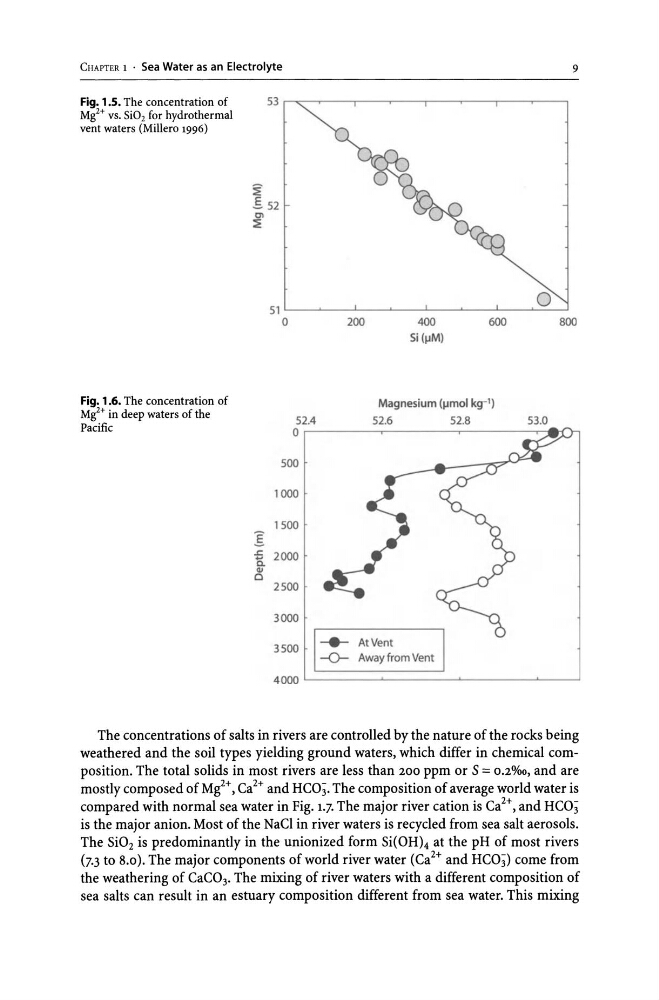
Fig. 1.5. The concentration of
53 '"' ......,.<-~-~---.-----,--~--..----~--,
Mg2+ vs. Si02 for hydrothermal
vent waters (Millero 1996)
Fig. 1.6. The concentration of
Mg2+ in deep waters of the
Pacific
:f
g 52
Cl
~
:[
..r::
a.
~
Q
51'
0
o
52.4
0
500
1000
1500
2000
2500
3000
200
400
Si(IlM)
600
Magnesium (llmol kg- 1 )
52.6
52.8
3S00 f ~ -0- Away from Vent
4000
53.0
800
The concentrations of salts in rivers are controlled by the nature of the rocks being
weathered and the soil types yielding ground waters, which differ in chemical composition. The total solids in most rivers are less than 200 ppm or S = 0.2%0, and are
mostly composed of Mg2+, Ca 2 + and HCO;. The composition of average world water is
compared with normal sea water in Fig. 1.7. The major river cation is Ca 2 +, and HCO;
is the major anion. Most of the NaCI in river waters is recycled from sea salt aerosols.
The Si0 2 is predominantly in the unionized form Si(OH)4 at the pH of most rivers
(7.3 to 8.0). The major components of world river water (Ca 2 + and HCO;) come from
the weathering of CaC0 3 • The mixing of river waters with a different composition of
sea salts can result in an estuary composition different from sea water. This mixing
9
Fig. 1.5. The concentration of
53 '"' ......,.<-~-~---.-----,--~--..----~--,
Mg2+ vs. Si02 for hydrothermal
vent waters (Millero 1996)
Fig. 1.6. The concentration of
Mg2+ in deep waters of the
Pacific
:f
g 52
Cl
~
:[
..r::
a.
~
Q
51'
0
o
52.4
0
500
1000
1500
2000
2500
3000
200
400
Si(IlM)
600
Magnesium (llmol kg- 1 )
52.6
52.8
3S00 f ~ -0- Away from Vent
4000
53.0
800
The concentrations of salts in rivers are controlled by the nature of the rocks being
weathered and the soil types yielding ground waters, which differ in chemical composition. The total solids in most rivers are less than 200 ppm or S = 0.2%0, and are
mostly composed of Mg2+, Ca 2 + and HCO;. The composition of average world water is
compared with normal sea water in Fig. 1.7. The major river cation is Ca 2 +, and HCO;
is the major anion. Most of the NaCI in river waters is recycled from sea salt aerosols.
The Si0 2 is predominantly in the unionized form Si(OH)4 at the pH of most rivers
(7.3 to 8.0). The major components of world river water (Ca 2 + and HCO;) come from
the weathering of CaC0 3 • The mixing of river waters with a different composition of
sea salts can result in an estuary composition different from sea water. This mixing