

CHAPTER 9 . Binding Ability of Inorganic Major Components of Sea Water
235
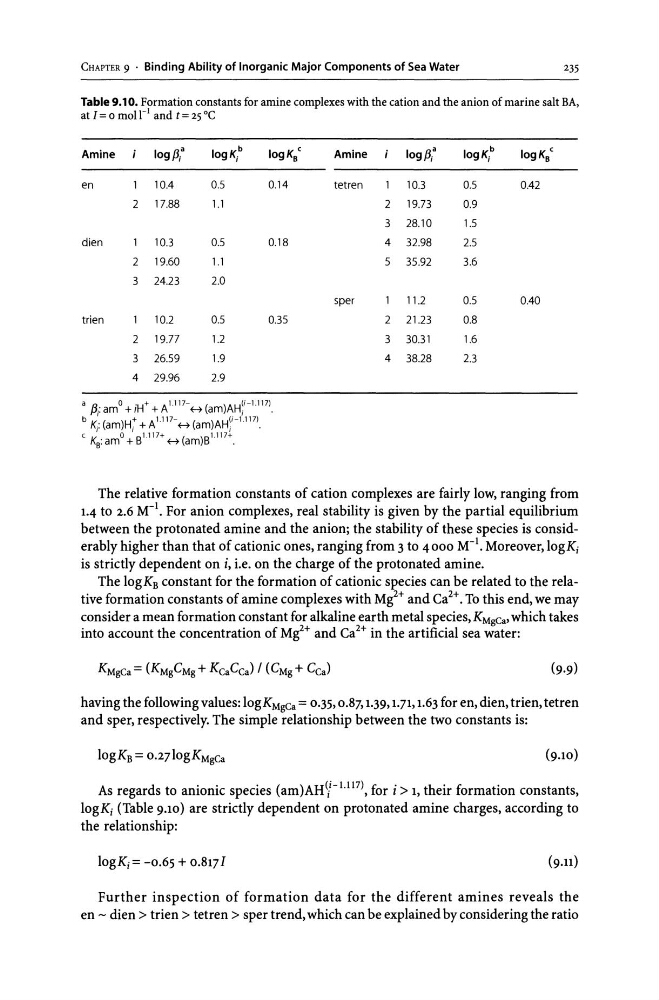
Table 9.10. Formation constants for amine complexes with the cation and the anion of marine salt BA,
at! = 0 molt! and t= 25°C
Amine
log f3;a
10gK;b
10gK B
C
Amine
10gf3;a
10gK;b
10gK B
C
en
lOA
0.5
0.14
tetren
10.3
0.5
OA2
2 17.88
1.1
2 19.73
0.9
3 28.10
1.5
dien
10.3
0.5
0.18
4 32.98
2.5
2 19.60
1.1
5 35.92
3.6
3 24.23
2.0
sper
1 11.2
0.5
OAO
trien
1 10.2
0.5
0.35
2 21.23
0.8
2 19.77
1.2
3 30.31
1.6
3 26.59
1.9
4 38.28
2.3
4 29.96
2.9
a f3;: amO + iH+ + A 1117 -H (am)AH:;-1.117)
b K;:(am)H; + A1. 117 -H (am)AH/-l.l 17 ).
c Ks:amo +Sl.l17+ H(am)S1.117+.
The relative formation constants of cation complexes are fairly low, ranging from
1.4 to 2.6 M- 1 • For anion complexes, real stability is given by the partial equilibrium
between the protonated amine and the anion; the stability of these species is considerably higher than that of cationic ones, ranging from 3 to 4000 M- 1 • Moreover, logKi
is strictly dependent on i, i.e. on the charge of the protonated amine.
The logKB constant for the formation of cationic species can be related to the relative formation constants of amine complexes with Mg2+ and Ca 2 +. To this end, we may
consider a mean formation constant for alkaline earth metal species, KMgCa' which takes
into account the concentration of Mg2+ and Ca 2 + in the artificial sea water:
KMgca = (KMgCMg + KCaCCa) / (CMg + CCa)
(9.9)
having the following values: logKMgCa = 0.35,0.87,1.39,1.71,1.63 for en, dien, trien, tetren
and sper, respectively. The simple relationship between the two constants is:
logKB = 0.27 logKMgca
(9.10)
As regards to anionic species (am)AHY-l.ll7), for i> 1, their formation constants,
logKi (Table 9.10) are strictly dependent on protonated amine charges, according to
the relationship:
logKi = -0.65 + 0.817 I
(9.11)
Further inspection of formation data for the different amines reveals the
en - dien > trien > tetren > sper trend, which can be explained by considering the ratio
235
Table 9.10. Formation constants for amine complexes with the cation and the anion of marine salt BA,
at! = 0 molt! and t= 25°C
Amine
log f3;a
10gK;b
10gK B
C
Amine
10gf3;a
10gK;b
10gK B
C
en
lOA
0.5
0.14
tetren
10.3
0.5
OA2
2 17.88
1.1
2 19.73
0.9
3 28.10
1.5
dien
10.3
0.5
0.18
4 32.98
2.5
2 19.60
1.1
5 35.92
3.6
3 24.23
2.0
sper
1 11.2
0.5
OAO
trien
1 10.2
0.5
0.35
2 21.23
0.8
2 19.77
1.2
3 30.31
1.6
3 26.59
1.9
4 38.28
2.3
4 29.96
2.9
a f3;: amO + iH+ + A 1117 -H (am)AH:;-1.117)
b K;:(am)H; + A1. 117 -H (am)AH/-l.l 17 ).
c Ks:amo +Sl.l17+ H(am)S1.117+.
The relative formation constants of cation complexes are fairly low, ranging from
1.4 to 2.6 M- 1 • For anion complexes, real stability is given by the partial equilibrium
between the protonated amine and the anion; the stability of these species is considerably higher than that of cationic ones, ranging from 3 to 4000 M- 1 • Moreover, logKi
is strictly dependent on i, i.e. on the charge of the protonated amine.
The logKB constant for the formation of cationic species can be related to the relative formation constants of amine complexes with Mg2+ and Ca 2 +. To this end, we may
consider a mean formation constant for alkaline earth metal species, KMgCa' which takes
into account the concentration of Mg2+ and Ca 2 + in the artificial sea water:
KMgca = (KMgCMg + KCaCCa) / (CMg + CCa)
(9.9)
having the following values: logKMgCa = 0.35,0.87,1.39,1.71,1.63 for en, dien, trien, tetren
and sper, respectively. The simple relationship between the two constants is:
logKB = 0.27 logKMgca
(9.10)
As regards to anionic species (am)AHY-l.ll7), for i> 1, their formation constants,
logKi (Table 9.10) are strictly dependent on protonated amine charges, according to
the relationship:
logKi = -0.65 + 0.817 I
(9.11)
Further inspection of formation data for the different amines reveals the
en - dien > trien > tetren > sper trend, which can be explained by considering the ratio