

CHAPTER 9 . Binding Ability of Inorganic Major Components of Sea Water
233
spectra analysis shows intense dialkylamine bands (Mikita et al. 1981). Chloride and
sulphate anions form weak complexes with partially or fully protonated polyamines,
whose stability is strictly dependent on the charge of the polyammonium cation
(Daniele et al. 1997). Mg2+ and Ca 2 + also form complexes with polyamines (De Stefano
et al. 1999a). The stability of these complexes is not very high and shows a regular increasing trend as a function of the number of amino groups. Moreover, for the reaction
M2+ + H;A;+ = M(H;A)(i+2)+
it is possible to express stability using the general equation:
10gK~ = bo + b, n + b2nH
(9·7)
(with nH = i = number of protons in the complex species). The values of empirical parameters are for Mg2+ complexes: bo = 0.39, b, = 0.44 and b2 = -0.16; and for Ca 2 + complexes: bo = -0·95, b, = 0.55 and b2 = -0.05.
In order to check the binding capacity of low molecular weight aminic ligands towards the major components of sea water, we examined the available literature data
(Bates and Calais 1981; Bates and Erickson 1986; Czerminski et al. 1982) and the results of an extensive potentiometric investigation carried out at t = 25°C on the following amines in artificial sea water at different salinities (De Stefano et al. 2000d):
ethylenediamine, diethylenetriamine, triethylenetetramine, tetraethylenepentamine
and spermine (formulas and abbreviations are reported in Sect. A9.1 of appendix).
Apparent proton at ion constant, or 10gf3r* values obtained from potentiometric data
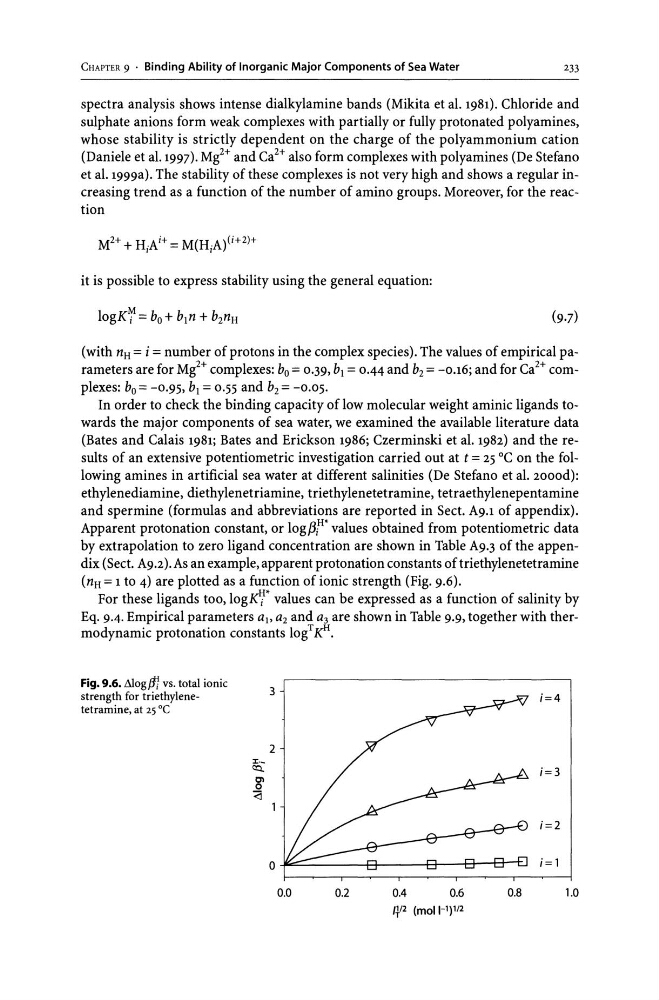
by extrapolation to zero ligand concentration are shown in Table A9.3 of the appendix (Sect. A9.2). As an example, apparent protonation constants of triethylenetetramine
(nH = 1 to 4) are plotted as a function of ionic strength (Fig. 9.6).
For these ligands too, 10gK~* values can be expressed as a function of salinity by
Eq. 9.4. Empirical parameters a" a2 and a3 are shown in Table 9.9, together with thermodynamic protonation constants 10gTKH.
Fig. 9.6. &ogt1i vs. total ionic
strength for triethylenetetramine, at 25°C
".- co..
8'
2
o I'k'="=
D
D
D
D tJ
0.0
0.2
0.4
0.6
0.8
r}'2 (mol 1-1)1/2
;=4
;=3
;=2
;=1
1.0
233
spectra analysis shows intense dialkylamine bands (Mikita et al. 1981). Chloride and
sulphate anions form weak complexes with partially or fully protonated polyamines,
whose stability is strictly dependent on the charge of the polyammonium cation
(Daniele et al. 1997). Mg2+ and Ca 2 + also form complexes with polyamines (De Stefano
et al. 1999a). The stability of these complexes is not very high and shows a regular increasing trend as a function of the number of amino groups. Moreover, for the reaction
M2+ + H;A;+ = M(H;A)(i+2)+
it is possible to express stability using the general equation:
10gK~ = bo + b, n + b2nH
(9·7)
(with nH = i = number of protons in the complex species). The values of empirical parameters are for Mg2+ complexes: bo = 0.39, b, = 0.44 and b2 = -0.16; and for Ca 2 + complexes: bo = -0·95, b, = 0.55 and b2 = -0.05.
In order to check the binding capacity of low molecular weight aminic ligands towards the major components of sea water, we examined the available literature data
(Bates and Calais 1981; Bates and Erickson 1986; Czerminski et al. 1982) and the results of an extensive potentiometric investigation carried out at t = 25°C on the following amines in artificial sea water at different salinities (De Stefano et al. 2000d):
ethylenediamine, diethylenetriamine, triethylenetetramine, tetraethylenepentamine
and spermine (formulas and abbreviations are reported in Sect. A9.1 of appendix).
Apparent proton at ion constant, or 10gf3r* values obtained from potentiometric data
by extrapolation to zero ligand concentration are shown in Table A9.3 of the appendix (Sect. A9.2). As an example, apparent protonation constants of triethylenetetramine
(nH = 1 to 4) are plotted as a function of ionic strength (Fig. 9.6).
For these ligands too, 10gK~* values can be expressed as a function of salinity by
Eq. 9.4. Empirical parameters a" a2 and a3 are shown in Table 9.9, together with thermodynamic protonation constants 10gTKH.
Fig. 9.6. &ogt1i vs. total ionic
strength for triethylenetetramine, at 25°C
".- co..
8'
2
o I'k'="=
D
D
D
D tJ
0.0
0.2
0.4
0.6
0.8
r}'2 (mol 1-1)1/2
;=4
;=3
;=2
;=1
1.0