

230
C. De Stefano· C. Foti . A. Gianguzza . D. Piazzese . S. Sammartano
lationship, valid for all the ligands:
aj= Cjz*
with
at = -0.00648 (±0.0029)Z*
(9.4a)
a2 = -0.00872 (±0.00054) z*
(9.4b )
a3 = -0.00047 (±0.00003) z*
(9.4C)
The empirical parameters of Eq. 9.5 can very probably also be related to some specific parameters for carboxylic ligands; in particular, b2 can be related to the mean
stability of the alkali and alkaline metal complexes of fully deprotonated or partially
protonated ligands.
The sharp decrease in apparent protonation constants with increasing salinity can also
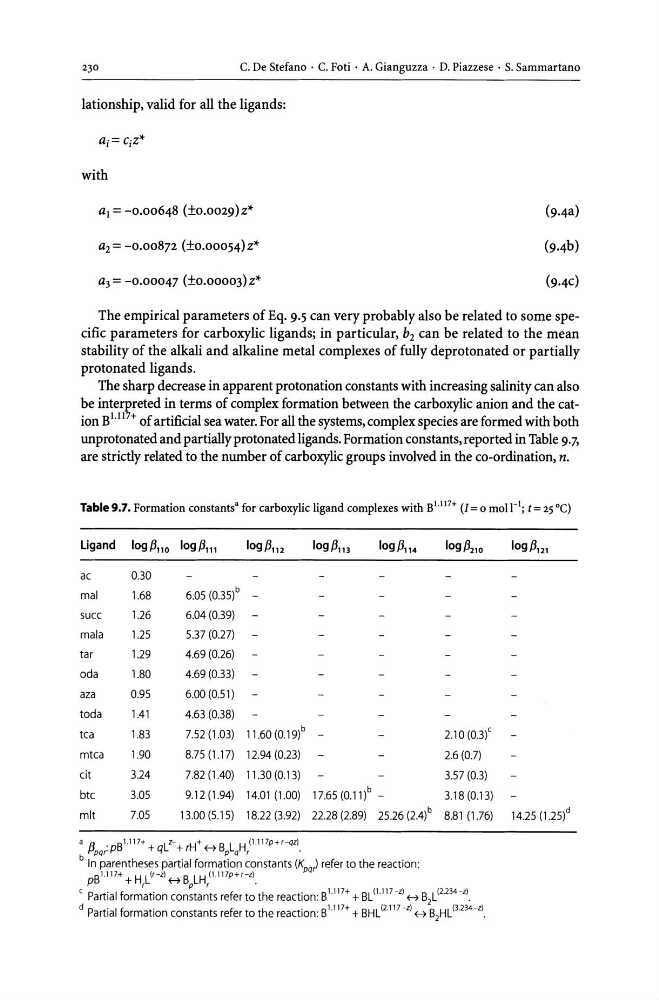
be interpreted in terms of complex formation between the carboxylic anion and the cation B 1.117+ of artificial sea water. For all the systems, complex species are formed with both
unprotonated and partially protonated ligands. Formation constants, reported in Table 9.7,
are strictly related to the number of carboxylic groups involved in the co-ordination, n.
Table 9.7. Formation constants' for carboxylic ligand complexes with BI.l17+ (I = 0 mol t 1 ; t = 25 °C)
Ligand 10g/3110 log/3111
10g/3112
10g/3113
10g/3114
log/3210
10g/3121
ac
0030
mal
1.68
6.05 (OJ5)b -
succ
1.26
6.04 (0039)
mala
1.25
5037 (0.27)
tar
1.29
4.69 (0.26)
oda
1.80
4.69 (0033)
aza
0.95
6.00 (0.51)
toda
1.41
4.63 (0038)
tca
1.83
7.52 (1.03) 11.60 (0.19)b -
2.10 (OJ(
mtca
1.90
8.75 (1.17) 12.94 (0.23)
2.6 (0.7)
cit
3.24
7.82 (1.40) 11.30 (0.13)
3.57 (OJ)
btc
3.05
9.12 (1.94) 14.01 (1.00) 17.65 (0.11)b -
3.18 (0.13)
mit
7.05
13.00 (5.15) 18.22 (3.92) 22.28 (2.89) 25.26 (2.4)b 8.81 (1.76)
14.25 (1.25)d
a f3 . B1.117+ LZ- H+ B L H I1.117P+r-qz)
pq' P
+ q + r H p q r
.
b In parentheses partial formation constants (K pqr ) refer to the reaction:
B1.117+ H Llr -z)
B LH 11.1 17p+r-Z)
P
+ r
H
p
r
.
C Partial formation constants refer to the reaction: B 1.117+ + BL 11.117 -z) H Bl z . 234 - Z )
d Partial formation constants refer to the reaction: B1.117+ + BHLIZ.117-Z) H B z HL I3 .234-Z).
C. De Stefano· C. Foti . A. Gianguzza . D. Piazzese . S. Sammartano
lationship, valid for all the ligands:
aj= Cjz*
with
at = -0.00648 (±0.0029)Z*
(9.4a)
a2 = -0.00872 (±0.00054) z*
(9.4b )
a3 = -0.00047 (±0.00003) z*
(9.4C)
The empirical parameters of Eq. 9.5 can very probably also be related to some specific parameters for carboxylic ligands; in particular, b2 can be related to the mean
stability of the alkali and alkaline metal complexes of fully deprotonated or partially
protonated ligands.
The sharp decrease in apparent protonation constants with increasing salinity can also
be interpreted in terms of complex formation between the carboxylic anion and the cation B 1.117+ of artificial sea water. For all the systems, complex species are formed with both
unprotonated and partially protonated ligands. Formation constants, reported in Table 9.7,
are strictly related to the number of carboxylic groups involved in the co-ordination, n.
Table 9.7. Formation constants' for carboxylic ligand complexes with BI.l17+ (I = 0 mol t 1 ; t = 25 °C)
Ligand 10g/3110 log/3111
10g/3112
10g/3113
10g/3114
log/3210
10g/3121
ac
0030
mal
1.68
6.05 (OJ5)b -
succ
1.26
6.04 (0039)
mala
1.25
5037 (0.27)
tar
1.29
4.69 (0.26)
oda
1.80
4.69 (0033)
aza
0.95
6.00 (0.51)
toda
1.41
4.63 (0038)
tca
1.83
7.52 (1.03) 11.60 (0.19)b -
2.10 (OJ(
mtca
1.90
8.75 (1.17) 12.94 (0.23)
2.6 (0.7)
cit
3.24
7.82 (1.40) 11.30 (0.13)
3.57 (OJ)
btc
3.05
9.12 (1.94) 14.01 (1.00) 17.65 (0.11)b -
3.18 (0.13)
mit
7.05
13.00 (5.15) 18.22 (3.92) 22.28 (2.89) 25.26 (2.4)b 8.81 (1.76)
14.25 (1.25)d
a f3 . B1.117+ LZ- H+ B L H I1.117P+r-qz)
pq' P
+ q + r H p q r
.
b In parentheses partial formation constants (K pqr ) refer to the reaction:
B1.117+ H Llr -z)
B LH 11.1 17p+r-Z)
P
+ r
H
p
r
.
C Partial formation constants refer to the reaction: B 1.117+ + BL 11.117 -z) H Bl z . 234 - Z )
d Partial formation constants refer to the reaction: B1.117+ + BHLIZ.117-Z) H B z HL I3 .234-Z).