

CHAPTER 9 . Binding Ability of Inorganic Major Components of Sea Water
225
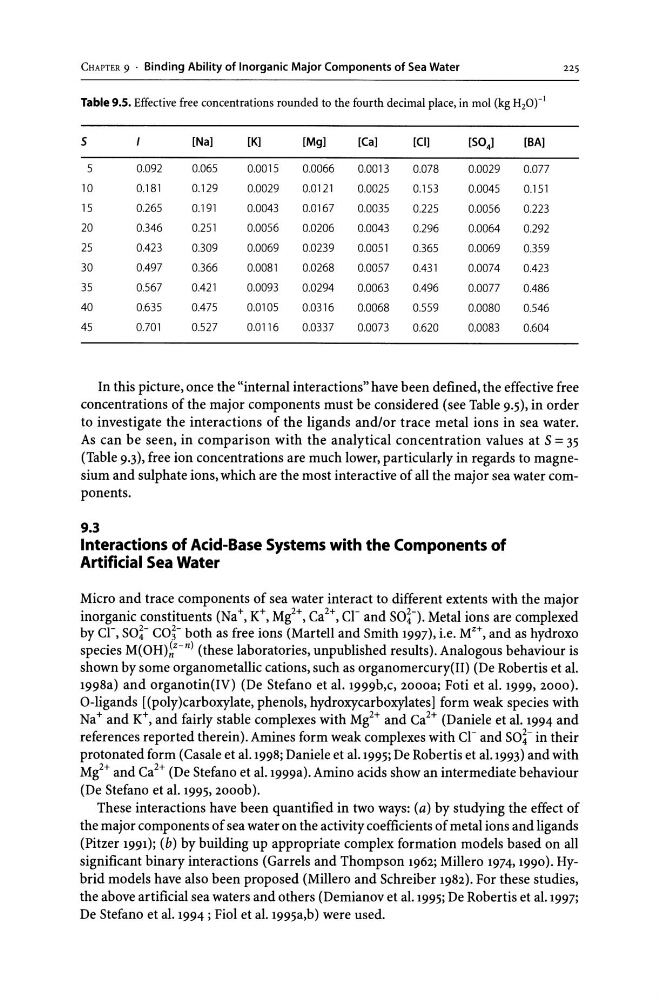
Table 9.5. Effective free concentrations rounded to the fourth decimal place, in mol (kg H20r 1
5
[Na]
[K]
[Mg]
[Cal
[CI]
[5° 4 ]
[BA]
5
0.092
0.065
0.0015
0.0066
0.0013
0.G78
0.0029
0.077
10
0.181
0.129
0.0029
0.0121
0.0025
0.153
0.0045
0.151
15
0.265
0.191
0.0043
0.0167
0.0035
0.225
0.0056
0.223
20
0.346
0.251
0.0056
0.0206
0.0043
0.296
0.0064
0.292
25
0.423
0.309
0.0069
0.0239
0.0051
0.365
0.0069
0.359
30
0.497
0.366
0.0081
0.0268
0.0057
0.431
0.0074
0.423
35
0.567
0.421
0.0093
0.0294
0.0063
0.496
0.0077
0.486
40
0.635
0.475
0.01 05
0.0316
0.0068
0.559
0.0080
0.546
45
0.701
0.527
0.0116
0.0337
0.0073
0.620
0.0083
0.604
In this picture, once the "internal interactions" have been defined, the effective free
concentrations of the major components must be considered (see Table 9.5), in order
to investigate the interactions of the ligands and/or trace metal ions in sea water.
As can be seen, in comparison with the analytical concentration values at S = 35
(Table 9.3), free ion concentrations are much lower, particularly in regards to magnesium and sulphate ions, which are the most interactive of all the major sea water components.
9.3
Interactions of Acid-Base Systems with the Components of
Artificial Sea Water
Micro and trace components of sea water interact to different extents with the major
inorganic constituents (Na +, K+, Mg2+, ci+, cr and SO;-). Metal ions are complexed
by cr, SO~- CO~- both as free ions (Martell and Smith 1997), i.e. MZ+' and as hydroxo
species M(OH)~z-n) (these laboratories, unpublished results). Analogous behaviour is
shown by some organometallic cations, such as organomercury(II) (De Robertis et al.
1998a) and organotin(IV) (De Stefano et al. 1999b,c, 2000a; Foti et al. 1999, 2000).
O-ligands [(poly)carboxylate, phenols, hydroxycarboxylatesl form weak species with
Na + and K+, and fairly stable complexes with Mg2+ and Ca 2 + (Daniele et al. 1994 and
references reported therein). Amines form weak complexes with cr and SO~- in their
protonated form (Casale et a1.1998; Daniele et a1.1995; De Robertis et a1.1993) and with
Mg2+ and ci+ (De Stefano et al. 1999a). Amino acids show an intermediate behaviour
(De Stefano et al. 1995, 2000b).
These interactions have been quantified in two ways: (a) by studying the effect of
the major components of sea water on the activity coefficients of metal ions and ligands
(Pitzer 1991); (b) by building up appropriate complex formation models based on all
significant binary interactions (Garrels and Thompson 1962; Millero 1974,1990). Hybrid models have also been proposed (Millero and Schreiber 1982). For these studies,
the above artificial sea waters and others (Demianov et al. 1995; De Robertis et al. 1997;
De Stefano et al. 1994; Fiol et al. 1995a,b) were used.
225
Table 9.5. Effective free concentrations rounded to the fourth decimal place, in mol (kg H20r 1
5
[Na]
[K]
[Mg]
[Cal
[CI]
[5° 4 ]
[BA]
5
0.092
0.065
0.0015
0.0066
0.0013
0.G78
0.0029
0.077
10
0.181
0.129
0.0029
0.0121
0.0025
0.153
0.0045
0.151
15
0.265
0.191
0.0043
0.0167
0.0035
0.225
0.0056
0.223
20
0.346
0.251
0.0056
0.0206
0.0043
0.296
0.0064
0.292
25
0.423
0.309
0.0069
0.0239
0.0051
0.365
0.0069
0.359
30
0.497
0.366
0.0081
0.0268
0.0057
0.431
0.0074
0.423
35
0.567
0.421
0.0093
0.0294
0.0063
0.496
0.0077
0.486
40
0.635
0.475
0.01 05
0.0316
0.0068
0.559
0.0080
0.546
45
0.701
0.527
0.0116
0.0337
0.0073
0.620
0.0083
0.604
In this picture, once the "internal interactions" have been defined, the effective free
concentrations of the major components must be considered (see Table 9.5), in order
to investigate the interactions of the ligands and/or trace metal ions in sea water.
As can be seen, in comparison with the analytical concentration values at S = 35
(Table 9.3), free ion concentrations are much lower, particularly in regards to magnesium and sulphate ions, which are the most interactive of all the major sea water components.
9.3
Interactions of Acid-Base Systems with the Components of
Artificial Sea Water
Micro and trace components of sea water interact to different extents with the major
inorganic constituents (Na +, K+, Mg2+, ci+, cr and SO;-). Metal ions are complexed
by cr, SO~- CO~- both as free ions (Martell and Smith 1997), i.e. MZ+' and as hydroxo
species M(OH)~z-n) (these laboratories, unpublished results). Analogous behaviour is
shown by some organometallic cations, such as organomercury(II) (De Robertis et al.
1998a) and organotin(IV) (De Stefano et al. 1999b,c, 2000a; Foti et al. 1999, 2000).
O-ligands [(poly)carboxylate, phenols, hydroxycarboxylatesl form weak species with
Na + and K+, and fairly stable complexes with Mg2+ and Ca 2 + (Daniele et al. 1994 and
references reported therein). Amines form weak complexes with cr and SO~- in their
protonated form (Casale et a1.1998; Daniele et a1.1995; De Robertis et a1.1993) and with
Mg2+ and ci+ (De Stefano et al. 1999a). Amino acids show an intermediate behaviour
(De Stefano et al. 1995, 2000b).
These interactions have been quantified in two ways: (a) by studying the effect of
the major components of sea water on the activity coefficients of metal ions and ligands
(Pitzer 1991); (b) by building up appropriate complex formation models based on all
significant binary interactions (Garrels and Thompson 1962; Millero 1974,1990). Hybrid models have also been proposed (Millero and Schreiber 1982). For these studies,
the above artificial sea waters and others (Demianov et al. 1995; De Robertis et al. 1997;
De Stefano et al. 1994; Fiol et al. 1995a,b) were used.