

212
F. Millero . D. Pierrot
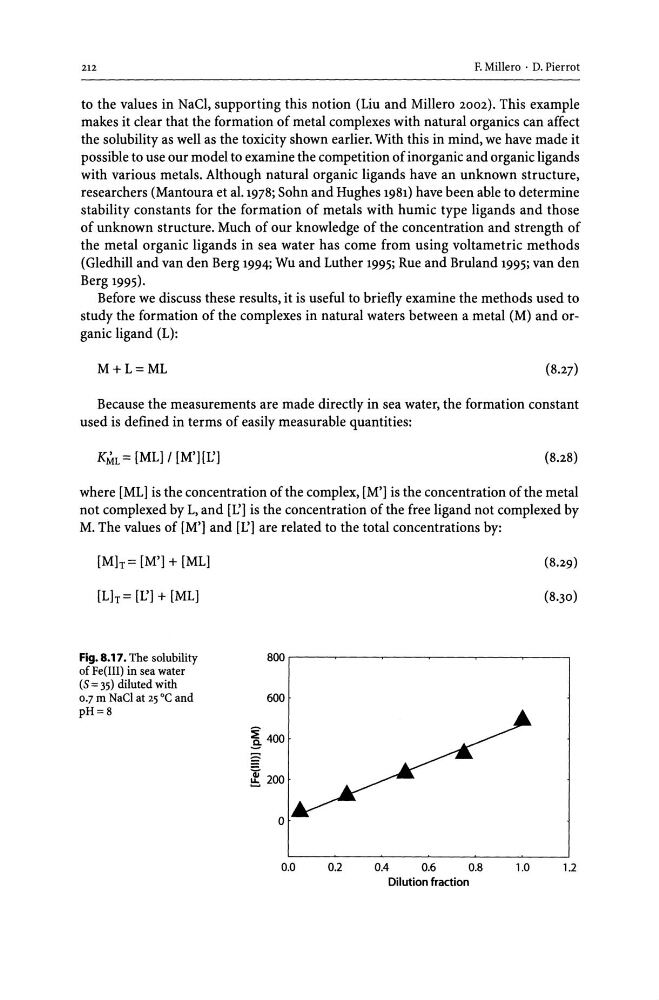
to the values in NaCl, supporting this notion (Liu and Millero 2002). This example
makes it clear that the formation of metal complexes with natural organics can affect
the solubility as well as the toxicity shown earlier. With this in mind, we have made it
possible to use our model to examine the competition of inorganic and organic ligands
with various metals. Although natural organic ligands have an unknown structure,
researchers (Mantoura et al. 1978; Sohn and Hughes 1981) have been able to determine
stability constants for the formation of metals with humic type ligands and those
of unknown structure. Much of our knowledge of the concentration and strength of
the metal organic ligands in sea water has come from using voltametric methods
(Gledhill and van den Berg 1994; Wu and Luther 1995; Rue and Bruland 1995; van den
Berg 1995).
Before we discuss these results, it is useful to briefly examine the methods used to
study the formation of the complexes in natural waters between a metal (M) and organic ligand (L):
M+L=ML
(8.27)
Because the measurements are made directly in sea water, the formation constant
used is defined in terms of easily measurable quantities:
KML = [ML) I [M'J[1')
(8.28)
where [ML) is the concentration of the complex, [M') is the concentration of the metal
not complexed by L, and [1') is the concentration of the free ligand not complexed by
M. The values of [M') and [1') are related to the total concentrations by:
[Mh = [M') + [ML)
[Lh = [1') + [ML)
Fig. 8.17. The solubility
of Fe(lII) in sea water
(S = 35) diluted with
0.7 m NaCI at 25°C and
pH=8
(8.29)
(8.30 )
800rl ----~------~----~----------~----_.
600
~ 400
~ 200
o
0.0
0.2
0.4
0.6
0.8
1.0
1.2
Dilution fraction
F. Millero . D. Pierrot
to the values in NaCl, supporting this notion (Liu and Millero 2002). This example
makes it clear that the formation of metal complexes with natural organics can affect
the solubility as well as the toxicity shown earlier. With this in mind, we have made it
possible to use our model to examine the competition of inorganic and organic ligands
with various metals. Although natural organic ligands have an unknown structure,
researchers (Mantoura et al. 1978; Sohn and Hughes 1981) have been able to determine
stability constants for the formation of metals with humic type ligands and those
of unknown structure. Much of our knowledge of the concentration and strength of
the metal organic ligands in sea water has come from using voltametric methods
(Gledhill and van den Berg 1994; Wu and Luther 1995; Rue and Bruland 1995; van den
Berg 1995).
Before we discuss these results, it is useful to briefly examine the methods used to
study the formation of the complexes in natural waters between a metal (M) and organic ligand (L):
M+L=ML
(8.27)
Because the measurements are made directly in sea water, the formation constant
used is defined in terms of easily measurable quantities:
KML = [ML) I [M'J[1')
(8.28)
where [ML) is the concentration of the complex, [M') is the concentration of the metal
not complexed by L, and [1') is the concentration of the free ligand not complexed by
M. The values of [M') and [1') are related to the total concentrations by:
[Mh = [M') + [ML)
[Lh = [1') + [ML)
Fig. 8.17. The solubility
of Fe(lII) in sea water
(S = 35) diluted with
0.7 m NaCI at 25°C and
pH=8
(8.29)
(8.30 )
800rl ----~------~----~----------~----_.
600
~ 400
~ 200
o
0.0
0.2
0.4
0.6
0.8
1.0
1.2
Dilution fraction