

210
F. Millero . D. Pier rot
while Cu z + forms strong carbonate complexes. The effect of pH on the speciation of
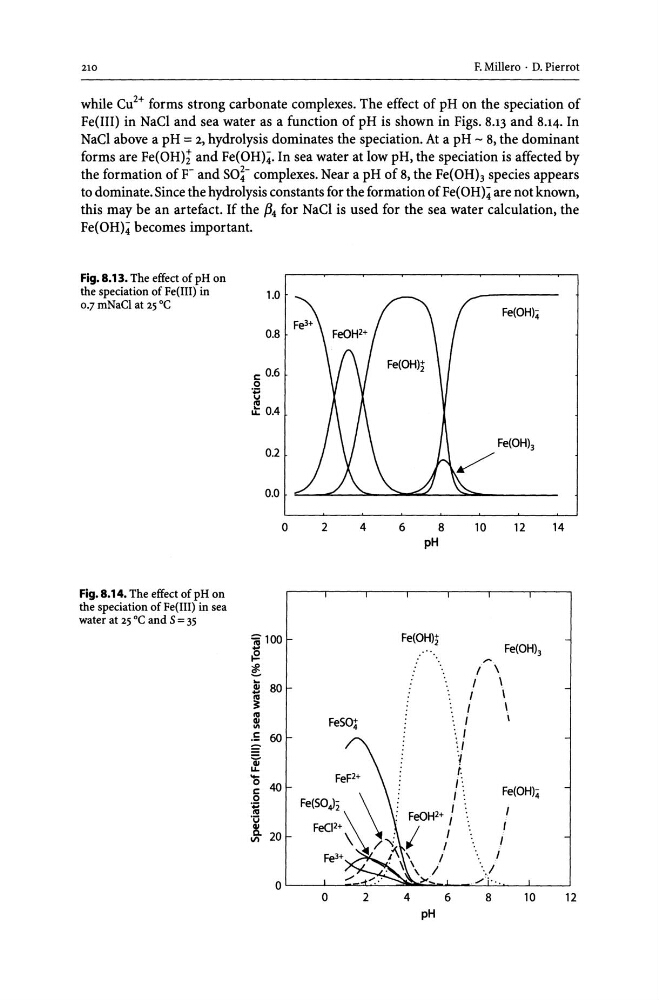
Fe(III) in NaCl and sea water as a function of pH is shown in Figs. 8.13 and 8.14. In
NaCl above a pH = 2, hydrolysis dominates the speciation. At a pH - 8, the dominant
forms are Fe(OH); and Fe(OH)4' In sea water at low pH, the speciation is affected by
the formation of F- and SO~- complexes. Near a pH of 8, the Fe( OHh species appears
to dominate. Since the hydrolysis constants for the formation ofFe(OH)4 are not known,
this may be an artefact. If the /34 for NaCl is used for the sea water calculation, the
Fe(OH)4 becomes important.
Fig. 8.13. The effect of pH on
the speciation of Fe(III) in
1.0
0.7 mNaCl at 25 °C
I ~,,3~
/ \ I
Fe(OH)4
0.8
c 0.6
0
.... v
~ 0.4
0.2
0.0 l
0
2
4
6
8
10
12
14
pH
Fig. 8.14. The effect of pH on
the speciation of Fe(III) in sea
water at 25 °C and S = 35
'iij 100
Fe(OH)!
Fe(OHh
...
~
,.
l
I \
!! 80
I
\
~
I
\
:
I
\
.,
IV
FeS04
'"
.S: 60
'i' u.
-
~ ~[
\A i
Fe(OH)4
8
" , S O " , '
j ,
I
.!!!
\ : FeOH2+
' .
~
FeCI2+
. I I ". I
Q. 20
\ :
I · .
VI
/"'\;
I ' .
Fe3+, ~ /~. '.
I
.... J
' j
0'
- -:::t-,' ~-/j'"
0
2
4
6
8
10
12
pH
F. Millero . D. Pier rot
while Cu z + forms strong carbonate complexes. The effect of pH on the speciation of
Fe(III) in NaCl and sea water as a function of pH is shown in Figs. 8.13 and 8.14. In
NaCl above a pH = 2, hydrolysis dominates the speciation. At a pH - 8, the dominant
forms are Fe(OH); and Fe(OH)4' In sea water at low pH, the speciation is affected by
the formation of F- and SO~- complexes. Near a pH of 8, the Fe( OHh species appears
to dominate. Since the hydrolysis constants for the formation ofFe(OH)4 are not known,
this may be an artefact. If the /34 for NaCl is used for the sea water calculation, the
Fe(OH)4 becomes important.
Fig. 8.13. The effect of pH on
the speciation of Fe(III) in
1.0
0.7 mNaCl at 25 °C
I ~,,3~
/ \ I
Fe(OH)4
0.8
c 0.6
0
.... v
~ 0.4
0.2
0.0 l
0
2
4
6
8
10
12
14
pH
Fig. 8.14. The effect of pH on
the speciation of Fe(III) in sea
water at 25 °C and S = 35
'iij 100
Fe(OH)!
Fe(OHh
...
~
,.
l
I \
!! 80
I
\
~
I
\
:
I
\
.,
IV
FeS04
'"
.S: 60
'i' u.
-
~ ~[
\A i
Fe(OH)4
8
" , S O " , '
j ,
I
.!!!
\ : FeOH2+
' .
~
FeCI2+
. I I ". I
Q. 20
\ :
I · .
VI
/"'\;
I ' .
Fe3+, ~ /~. '.
I
.... J
' j
0'
- -:::t-,' ~-/j'"
0
2
4
6
8
10
12
pH