

194
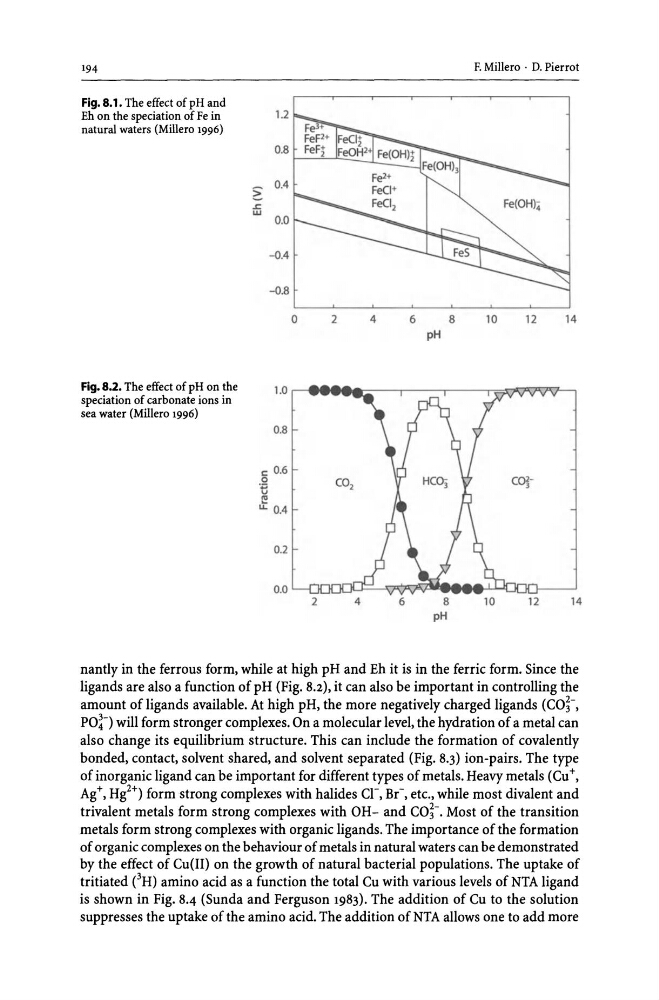
Fig. 8.1. The effect of pH and
Eh on the speciation of Fe in
natural waters (Millero 1996)
1.2
0.8
~ 0.4
2:.s=
w 0.0
-0.4
-0.8
o
F. Millero . D. Pierrot
2
4
6
8
10
12
14
pH
Fig. ~.~. The effect of PI:i on ~he
1.0 i..........
i 'HVVVVV ---,
specIatIOn of carbonate IOns III
sea water (Millero 1996)
0.8
c 0.6
.~
L
CO2
.t 0.4
0.2
0.0
2
4
6
8
pH
10
12
14
nantly in the ferrous form, while at high pH and Eh it is in the ferric form. Since the
ligands are also a function of pH (Fig. 8.2), it can also be important in controlling the
amount of ligands available. At high pH, the more negatively charged ligands (CO~-,
PO~-) will form stronger complexes. On a molecular level, the hydration of a metal can
also change its equilibrium structure. This can include the formation of covalently
bonded, contact, solvent shared, and solvent separated (Fig. 8.3) ion-pairs. The type
of inorganic ligand can be important for different types of metals. Heavy metals (Cu +,
Ag +, Hg 2 +) form strong complexes with halides cr, Br-, etc., while most divalent and
trivalent metals form strong complexes with OH- and CO;-. Most of the transition
metals form strong complexes with organic ligands. The importance of the formation
of organic complexes on the behaviour of metals in natural waters can be demonstrated
by the effect of Cu(II) on the growth of natural bacterial populations. The uptake of
tritiated eH) amino acid as a function the total Cu with various levels of NTA ligand
is shown in Fig. 8.4 (Sunda and Ferguson 1983). The addition of Cu to the solution
suppresses the uptake of the amino acid. The addition of NTA allows one to add more
Fig. 8.1. The effect of pH and
Eh on the speciation of Fe in
natural waters (Millero 1996)
1.2
0.8
~ 0.4
2:.s=
w 0.0
-0.4
-0.8
o
F. Millero . D. Pierrot
2
4
6
8
10
12
14
pH
Fig. ~.~. The effect of PI:i on ~he
1.0 i..........
i 'HVVVVV ---,
specIatIOn of carbonate IOns III
sea water (Millero 1996)
0.8
c 0.6
.~
L
CO2
.t 0.4
0.2
0.0
2
4
6
8
pH
10
12
14
nantly in the ferrous form, while at high pH and Eh it is in the ferric form. Since the
ligands are also a function of pH (Fig. 8.2), it can also be important in controlling the
amount of ligands available. At high pH, the more negatively charged ligands (CO~-,
PO~-) will form stronger complexes. On a molecular level, the hydration of a metal can
also change its equilibrium structure. This can include the formation of covalently
bonded, contact, solvent shared, and solvent separated (Fig. 8.3) ion-pairs. The type
of inorganic ligand can be important for different types of metals. Heavy metals (Cu +,
Ag +, Hg 2 +) form strong complexes with halides cr, Br-, etc., while most divalent and
trivalent metals form strong complexes with OH- and CO;-. Most of the transition
metals form strong complexes with organic ligands. The importance of the formation
of organic complexes on the behaviour of metals in natural waters can be demonstrated
by the effect of Cu(II) on the growth of natural bacterial populations. The uptake of
tritiated eH) amino acid as a function the total Cu with various levels of NTA ligand
is shown in Fig. 8.4 (Sunda and Ferguson 1983). The addition of Cu to the solution
suppresses the uptake of the amino acid. The addition of NTA allows one to add more