

CHAPTER 7 ' Sedimentary Geochemistry of the Carbonate and Sulphide Systems
183
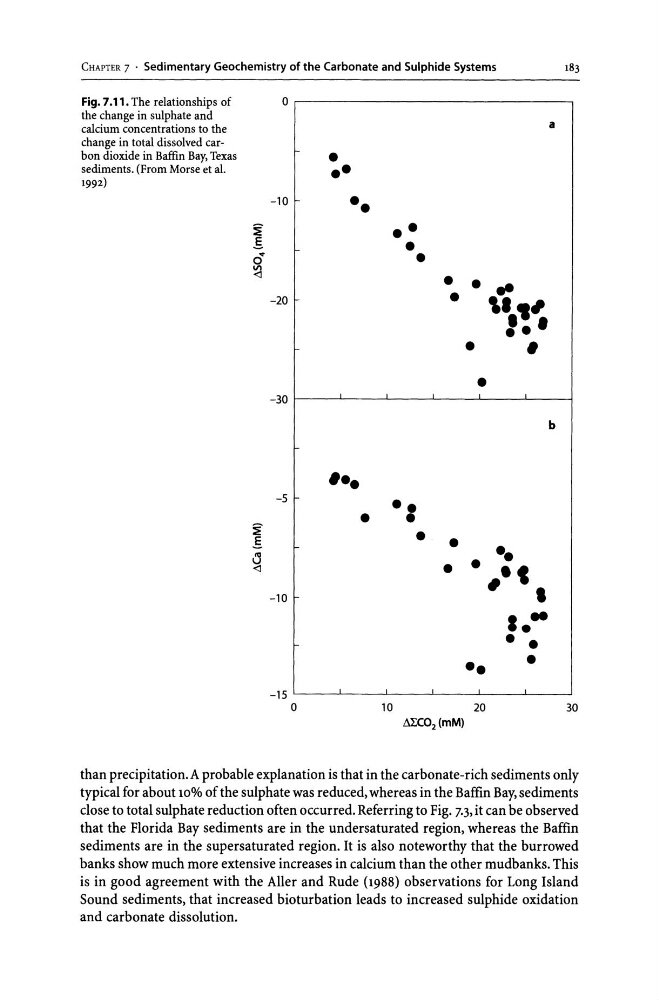
Fig. 7.11. The relationships of
0
the change in sulphate and
a
calcium concentrations to the
change in total dissolved carbon dioxide in Baffin Bay, Texas
J
•
sediments, (From Morse et al,
••
1992)
••
~
f
••
.s
•
...
•
0
VI
-20 l•
'I" I.'
• •
•
-30 I
b
•••
-5 ~
••
f
• •
~
•
E
•
~
••
III
U
•
-10 l• •
I."
• •
•• •
-151
0
10
20
30
&'.C0 2 (mM)
than precipitation. A probable explanation is that in the carbonate-rich sediments only
typical for about 10% of the sulphate was reduced, whereas in the Baffin Bay, sediments
close to total sulphate reduction often occurred. Referring to Fig. 7.3, it can be observed
that the Florida Bay sediments are in the undersaturated region, whereas the Baffin
sediments are in the supersaturated region. It is also noteworthy that the burrowed
banks show much more extensive increases in calcium than the other mudbanks. This
is in good agreement with the Aller and Rude (1988) observations for Long Island
Sound sediments, that increased bioturbation leads to increased sulphide oxidation
and carbonate dissolution.
183
Fig. 7.11. The relationships of
0
the change in sulphate and
a
calcium concentrations to the
change in total dissolved carbon dioxide in Baffin Bay, Texas
J
•
sediments, (From Morse et al,
••
1992)
••
~
f
••
.s
•
...
•
0
VI
-20 l•
'I" I.'
• •
•
-30 I
b
•••
-5 ~
••
f
• •
~
•
E
•
~
••
III
U
•
-10 l• •
I."
• •
•• •
-151
0
10
20
30
&'.C0 2 (mM)
than precipitation. A probable explanation is that in the carbonate-rich sediments only
typical for about 10% of the sulphate was reduced, whereas in the Baffin Bay, sediments
close to total sulphate reduction often occurred. Referring to Fig. 7.3, it can be observed
that the Florida Bay sediments are in the undersaturated region, whereas the Baffin
sediments are in the supersaturated region. It is also noteworthy that the burrowed
banks show much more extensive increases in calcium than the other mudbanks. This
is in good agreement with the Aller and Rude (1988) observations for Long Island
Sound sediments, that increased bioturbation leads to increased sulphide oxidation
and carbonate dissolution.