

CHAPTER 7 . Sedimentary Geochemistry of the Carbonate and Sulphide Systems
181
solved sulphide is present, "reactive" iron is limiting the rate of iron sulphide mineral
formation. A further complication that is little discussed in the literature is that in
sediments where dissolved sulphate is totally reduced in the top few cm of sediment,
its rate of transport into the sediment is the limiting factor for sulphide production in
the sediment (Arvidson and Morse, to be published). In the following section, the influence of biologically driven transport of oxidants on sedimentary sulphides and
carbonates will be discussed.
7.3.1.2
Influences of Biologically-Driven Transport
Oxidation of sedimentary sulphides via reaction with iron and manganese oxides can
be an important or even dominant reaction pathway (Aller and Rude 1988). However,
the active transport of oxygen to several cm below the sediment-water interface by
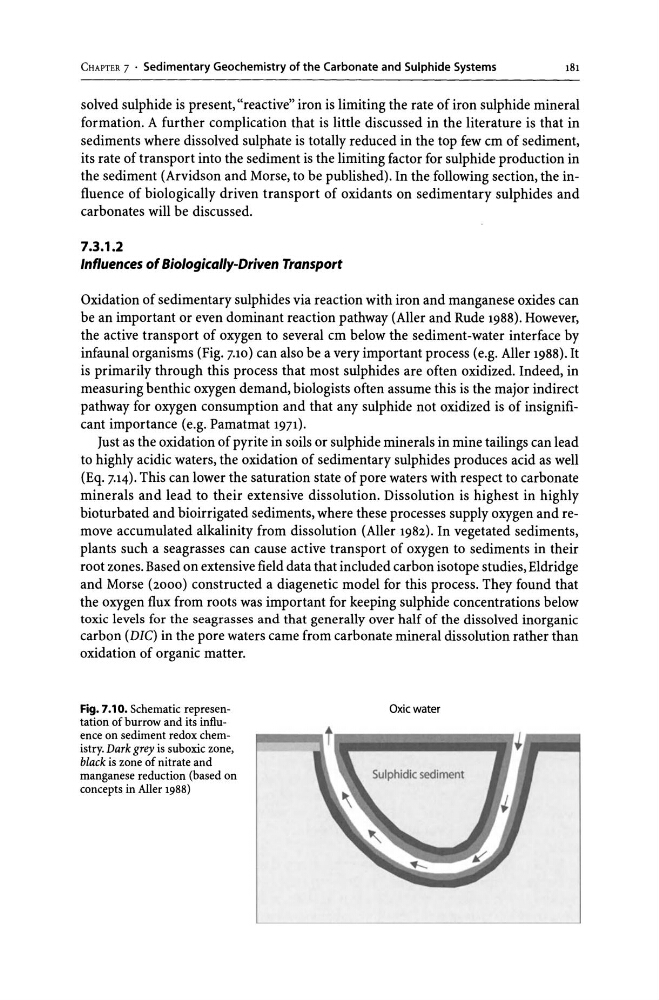
infaunal organisms (Fig. 7.10) can also be a very important process (e.g. Aller 1988). It
is primarily through this process that most sulphides are often oxidized. Indeed, in
measuring benthic oxygen demand, biologists often assume this is the major indirect
pathway for oxygen consumption and that any sulphide not oxidized is of insignificant importance (e.g. Pamatmat 1971).
Just as the oxidation of pyrite in soils or sulphide minerals in mine tailings can lead
to highly acidic waters, the oxidation of sedimentary sulphides produces acid as well
(Eq. 7.14). This can lower the saturation state of pore waters with respect to carbonate
minerals and lead to their extensive dissolution. Dissolution is highest in highly
bioturbated and bioirrigated sediments, where these processes supply oxygen and remove accumulated alkalinity from dissolution (Aller 1982). In vegetated sediments,
plants such a seagrasses can cause active transport of oxygen to sediments in their
root zones. Based on extensive field data that included carbon isotope studies, Eldridge
and Morse (2000) constructed a diagenetic model for this process. They found that
the oxygen flux from roots was important for keeping sulphide concentrations below
toxic levels for the seagrasses and that generally over half of the dissolved inorganic
carbon (DIC) in the pore waters came from carbonate mineral dissolution rather than
oxidation of organic matter.
Fig. 7.10. Schematic representation of burrow and its influence on sediment redox chemistry. Dark grey is sub oxic zone,
black is zone of nitrate and
manganese reduction (based on
concepts in Aller 1988)
Oxic water
181
solved sulphide is present, "reactive" iron is limiting the rate of iron sulphide mineral
formation. A further complication that is little discussed in the literature is that in
sediments where dissolved sulphate is totally reduced in the top few cm of sediment,
its rate of transport into the sediment is the limiting factor for sulphide production in
the sediment (Arvidson and Morse, to be published). In the following section, the influence of biologically driven transport of oxidants on sedimentary sulphides and
carbonates will be discussed.
7.3.1.2
Influences of Biologically-Driven Transport
Oxidation of sedimentary sulphides via reaction with iron and manganese oxides can
be an important or even dominant reaction pathway (Aller and Rude 1988). However,
the active transport of oxygen to several cm below the sediment-water interface by
infaunal organisms (Fig. 7.10) can also be a very important process (e.g. Aller 1988). It
is primarily through this process that most sulphides are often oxidized. Indeed, in
measuring benthic oxygen demand, biologists often assume this is the major indirect
pathway for oxygen consumption and that any sulphide not oxidized is of insignificant importance (e.g. Pamatmat 1971).
Just as the oxidation of pyrite in soils or sulphide minerals in mine tailings can lead
to highly acidic waters, the oxidation of sedimentary sulphides produces acid as well
(Eq. 7.14). This can lower the saturation state of pore waters with respect to carbonate
minerals and lead to their extensive dissolution. Dissolution is highest in highly
bioturbated and bioirrigated sediments, where these processes supply oxygen and remove accumulated alkalinity from dissolution (Aller 1982). In vegetated sediments,
plants such a seagrasses can cause active transport of oxygen to sediments in their
root zones. Based on extensive field data that included carbon isotope studies, Eldridge
and Morse (2000) constructed a diagenetic model for this process. They found that
the oxygen flux from roots was important for keeping sulphide concentrations below
toxic levels for the seagrasses and that generally over half of the dissolved inorganic
carbon (DIC) in the pore waters came from carbonate mineral dissolution rather than
oxidation of organic matter.
Fig. 7.10. Schematic representation of burrow and its influence on sediment redox chemistry. Dark grey is sub oxic zone,
black is zone of nitrate and
manganese reduction (based on
concepts in Aller 1988)
Oxic water