

CHAPTER 7 . Sedimentary Geochemistry of the Carbonate and Sulphide Systems
179
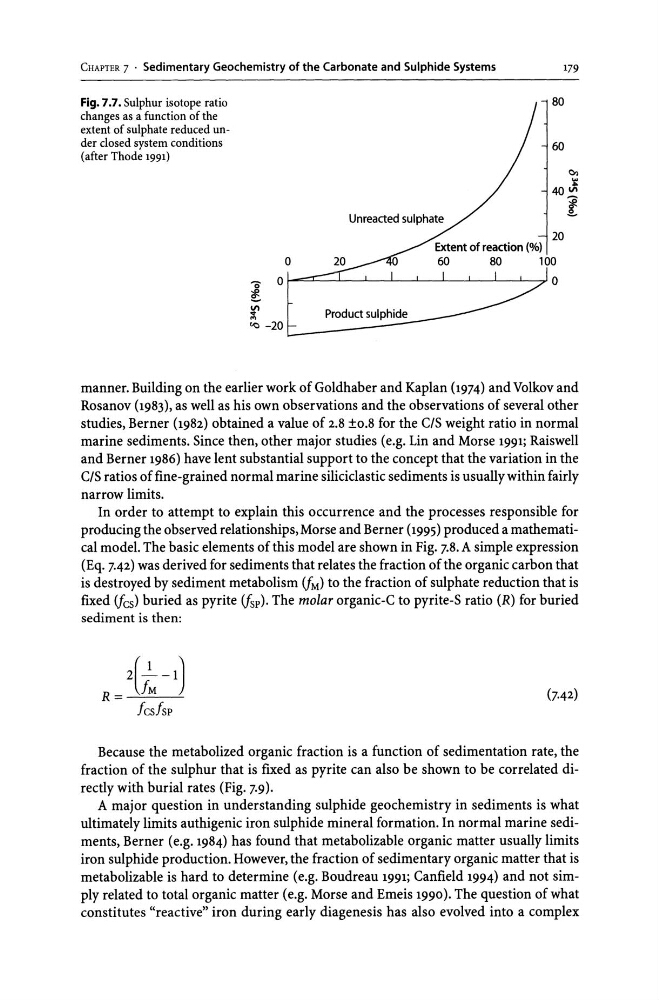
Fig. 7.7. Sulphur isotope ratio
I .., 80
changes as a function of the
extent of sulphate reduced under closed system conditions
/
--j 60
(after Thode 1991)
Co
40 ~
l
20
o
l
~
o I ..--=-r:
7' 0
"<:l -20 L . - - - - -
manner. Building on the earlier work of Goldhaber and Kaplan (1974) and Volkov and
Rosanov (1983), as well as his own observations and the observations of several other
studies, Berner (1982) obtained a value of 2.8 ±0.8 for the CIS weight ratio in normal
marine sediments. Since then, other major studies (e.g. Lin and Morse 1991; Raiswell
and Berner 1986) have lent substantial support to the concept that the variation in the
CIS ratios of fine-grained normal marine siliciclastic sediments is usually within fairly
narrow limits.
In order to attempt to explain this occurrence and the processes responsible for
producing the observed relationships, Morse and Berner (1995) produced a mathematical model. The basic elements of this model are shown in Fig. 7.8. A simple expression
(Eq. 7.42) was derived for sediments that relates the fraction of the organic carbon that
is destroyed by sediment metabolism (fM) to the fraction of sulphate reduction that is
fixed (fcs) buried as pyrite (fsp). The molar organic-C to pyrite-S ratio (R) for buried
sediment is then:
( 1
)
2 ~-l
R=~
fcsfsp
(7.42)
Because the metabolized organic fraction is a function of sedimentation rate, the
fraction of the sulphur that is fixed as pyrite can also be shown to be correlated directly with burial rates (Fig. 7.9).
A major question in understanding sulphide geochemistry in sediments is what
ultimately limits authigenic iron sulphide mineral formation. In normal marine sediments, Berner (e.g. 1984) has found that metabolizable organic matter usually limits
iron sulphide production. However, the fraction of sedimentary organic matter that is
metabolizable is hard to determine (e.g. Boudreau 1991; Canfield 1994) and not simply related to total organic matter (e.g. Morse and Emeis 1990). The question of what
constitutes "reactive" iron during early diagenesis has also evolved into a complex
179
Fig. 7.7. Sulphur isotope ratio
I .., 80
changes as a function of the
extent of sulphate reduced under closed system conditions
/
--j 60
(after Thode 1991)
Co
40 ~
l
20
o
l
~
o I ..--=-r:
7' 0
"<:l -20 L . - - - - -
manner. Building on the earlier work of Goldhaber and Kaplan (1974) and Volkov and
Rosanov (1983), as well as his own observations and the observations of several other
studies, Berner (1982) obtained a value of 2.8 ±0.8 for the CIS weight ratio in normal
marine sediments. Since then, other major studies (e.g. Lin and Morse 1991; Raiswell
and Berner 1986) have lent substantial support to the concept that the variation in the
CIS ratios of fine-grained normal marine siliciclastic sediments is usually within fairly
narrow limits.
In order to attempt to explain this occurrence and the processes responsible for
producing the observed relationships, Morse and Berner (1995) produced a mathematical model. The basic elements of this model are shown in Fig. 7.8. A simple expression
(Eq. 7.42) was derived for sediments that relates the fraction of the organic carbon that
is destroyed by sediment metabolism (fM) to the fraction of sulphate reduction that is
fixed (fcs) buried as pyrite (fsp). The molar organic-C to pyrite-S ratio (R) for buried
sediment is then:
( 1
)
2 ~-l
R=~
fcsfsp
(7.42)
Because the metabolized organic fraction is a function of sedimentation rate, the
fraction of the sulphur that is fixed as pyrite can also be shown to be correlated directly with burial rates (Fig. 7.9).
A major question in understanding sulphide geochemistry in sediments is what
ultimately limits authigenic iron sulphide mineral formation. In normal marine sediments, Berner (e.g. 1984) has found that metabolizable organic matter usually limits
iron sulphide production. However, the fraction of sedimentary organic matter that is
metabolizable is hard to determine (e.g. Boudreau 1991; Canfield 1994) and not simply related to total organic matter (e.g. Morse and Emeis 1990). The question of what
constitutes "reactive" iron during early diagenesis has also evolved into a complex