

CHAPTER 7 . Sedimentary Geochemistry of the Carbonate and Sulphide Systems
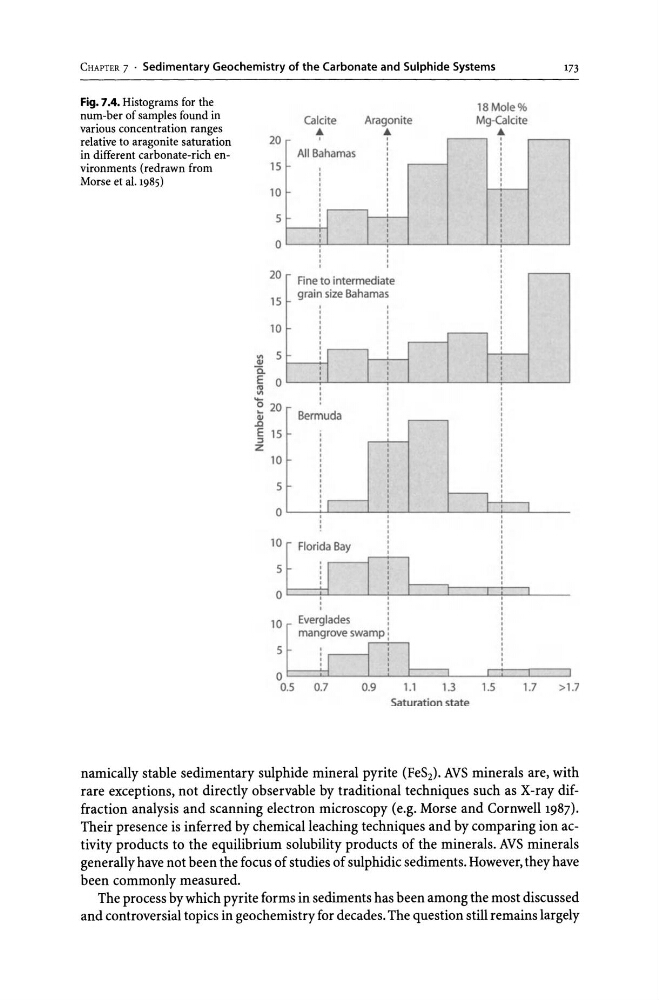
Fig. 7.4. Histograms for the
num-ber of samples found in
various concentration ranges
relative to aragonite saturation
in different carbonate-rich environments (redrawn from
Morse et al. 1985)
Calcite
Aragonite
•
•
20
0
r All Bahamas
15
10
5
0
20.- Fine to intermediate
15 I
grain size Bahamas
10
VI
5
CIJ
c..
I
I
E 0 I
,
~
e 20
CIJ
.0
E 15
:l
z
10
5
0
Bermuda
10 r Florida Bay
5
0
10
Everglades
r mangrove swamp 0
5
0.7
0.9
1.1
1.3
Saturation state
18 Mole%
Mg-Calcite
•
1.S
1.7
173
>1.7
namically stable sedimentary sulphide mineral pyrite (FeS2)' AVS minerals are, with
rare exceptions, not directly observable by traditional techniques such as X-ray diffraction analysis and scanning electron microscopy (e.g. Morse and Cornwell 1987).
Their presence is inferred by chemical leaching techniques and by comparing ion activity products to the equilibrium solubility products of the minerals. AVS minerals
generally have not been the focus of studies of sulphidic sediments. However, they have
been commonly measured.
The process by which pyrite forms in sediments has been among the most discussed
and controversial topics in geochemistry for decades. The question still remains largely
Fig. 7.4. Histograms for the
num-ber of samples found in
various concentration ranges
relative to aragonite saturation
in different carbonate-rich environments (redrawn from
Morse et al. 1985)
Calcite
Aragonite
•
•
20
0
r All Bahamas
15
10
5
0
20.- Fine to intermediate
15 I
grain size Bahamas
10
VI
5
CIJ
c..
I
I
E 0 I
,
~
e 20
CIJ
.0
E 15
:l
z
10
5
0
Bermuda
10 r Florida Bay
5
0
10
Everglades
r mangrove swamp 0
5
0.7
0.9
1.1
1.3
Saturation state
18 Mole%
Mg-Calcite
•
1.S
1.7
173
>1.7
namically stable sedimentary sulphide mineral pyrite (FeS2)' AVS minerals are, with
rare exceptions, not directly observable by traditional techniques such as X-ray diffraction analysis and scanning electron microscopy (e.g. Morse and Cornwell 1987).
Their presence is inferred by chemical leaching techniques and by comparing ion activity products to the equilibrium solubility products of the minerals. AVS minerals
generally have not been the focus of studies of sulphidic sediments. However, they have
been commonly measured.
The process by which pyrite forms in sediments has been among the most discussed
and controversial topics in geochemistry for decades. The question still remains largely