

148
S. Wakeham
composition occurring in the upper ten's of centimetres of the sediment column over
time scales of months to centuries. The study of rates and mechanisms of organic
matter alteration have broad implications related to energy transfer in the benthic
community and organic carbon preservation and control of global atmospheric oxygen (Berner 1989).
This chapter describes some of the processes involved in diagenesis, using examples
of alterations of organic matter that occur at the water-sediment interface and the types
of information that these changes impart to organic biogeochemists.
6.2
Controls on Organic Matter Diagenesis
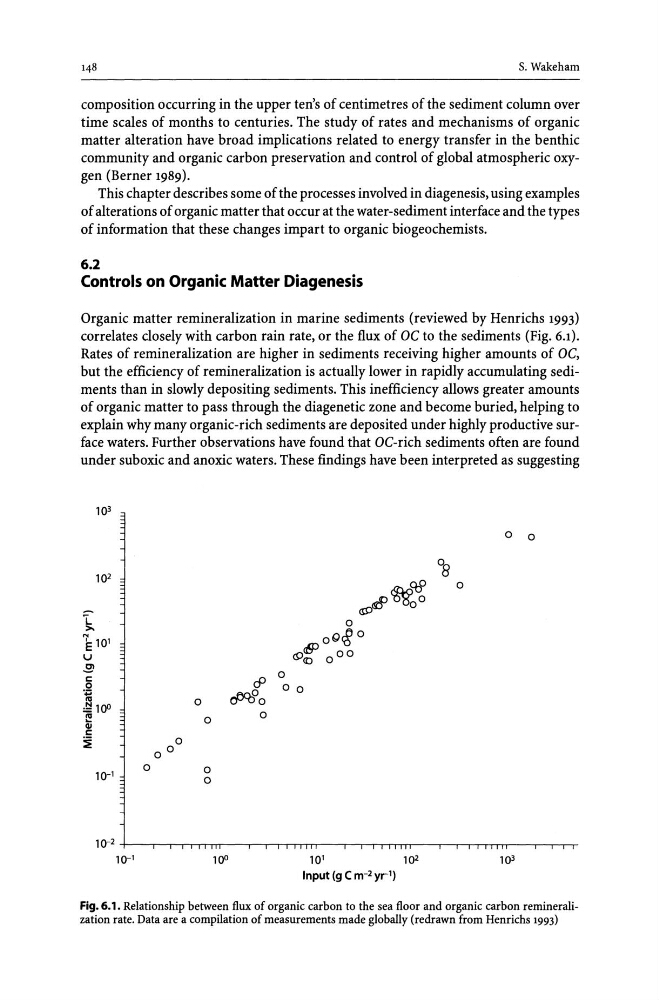
Organic matter remineralization in marine sediments (reviewed by Henrichs 1993)
correlates closely with carbon rain rate, or the flux of OC to the sediments (Fig. 6.1).
Rates of remineralization are higher in sediments receiving higher amounts of ~C,
but the efficiency of remineralization is actually lower in rapidly accumulating sediments than in slowly depositing sediments. This inefficiency allows greater amounts
of organic matter to pass through the diagenetic zone and become buried, helping to
explain why many organic-rich sediments are deposited under highly productive surface waters. Further observations have found that ~C-rich sediments often are found
under suboxic and anoxic waters. These findings have been interpreted as suggesting
10 3
10 2
l
1: 10'
u
.9
c:
o
~
~l()O
~
IV
c:
~
10-'
o
0 0
o
o
o
o
o
~~~~
o
rEP oQcg 0
~\o 000
cP 0
~o 00
o
o 0
0
8
o
10- 2 ~I;:-;--.---r-'-''T''T'-''~'~' -;-,---" -'-, '--TI TI TI ~' f~---'----'---'rT-'I-'I-'I'TITI ~-"---r--r-'-'T'T'T'T"---'-~~
u
"'"
II
10-'
100
10'
10 2
103
Input (g C m- 2 yr')
Fig. 6.1. Relationship between flux of organic carbon to the sea floor and organic carbon remineralization rate. Data are a compilation of measurements made globally (redrawn from Henrichs 1993)
S. Wakeham
composition occurring in the upper ten's of centimetres of the sediment column over
time scales of months to centuries. The study of rates and mechanisms of organic
matter alteration have broad implications related to energy transfer in the benthic
community and organic carbon preservation and control of global atmospheric oxygen (Berner 1989).
This chapter describes some of the processes involved in diagenesis, using examples
of alterations of organic matter that occur at the water-sediment interface and the types
of information that these changes impart to organic biogeochemists.
6.2
Controls on Organic Matter Diagenesis
Organic matter remineralization in marine sediments (reviewed by Henrichs 1993)
correlates closely with carbon rain rate, or the flux of OC to the sediments (Fig. 6.1).
Rates of remineralization are higher in sediments receiving higher amounts of ~C,
but the efficiency of remineralization is actually lower in rapidly accumulating sediments than in slowly depositing sediments. This inefficiency allows greater amounts
of organic matter to pass through the diagenetic zone and become buried, helping to
explain why many organic-rich sediments are deposited under highly productive surface waters. Further observations have found that ~C-rich sediments often are found
under suboxic and anoxic waters. These findings have been interpreted as suggesting
10 3
10 2
l
1: 10'
u
.9
c:
o
~
~l()O
~
IV
c:
~
10-'
o
0 0
o
o
o
o
o
~~~~
o
rEP oQcg 0
~\o 000
cP 0
~o 00
o
o 0
0
8
o
10- 2 ~I;:-;--.---r-'-''T''T'-''~'~' -;-,---" -'-, '--TI TI TI ~' f~---'----'---'rT-'I-'I-'I'TITI ~-"---r--r-'-'T'T'T'T"---'-~~
u
"'"
II
10-'
100
10'
10 2
103
Input (g C m- 2 yr')
Fig. 6.1. Relationship between flux of organic carbon to the sea floor and organic carbon remineralization rate. Data are a compilation of measurements made globally (redrawn from Henrichs 1993)